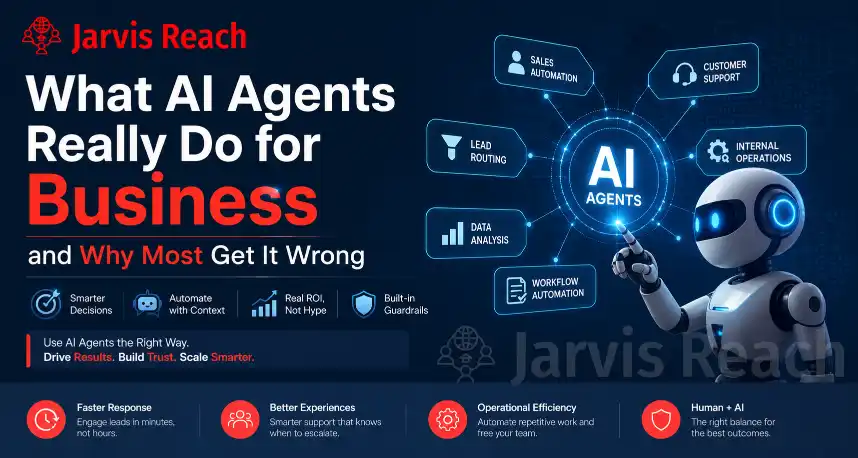
Utilizing artificial intelligence agents in various tasks within a business has made things much easier than previously thought. Through AI agents, companies have been able to close deals faster than humans can on their own, improve customer service experiences through AI, and streamline workflow processes by utilizing AI-driven tools.
The majority of businesses claiming to be “using AI agents” are not, as most have only created chatbots with decision trees attached to them. That’s fine, and using decision trees to build rules is successful. It is simply not the same thing, which is important in how people’s expectations are set, how they spend money, and how they eventually become disappointed.
The Real Definition, Without Any Marketing Lingo
An agent of artificial intelligence receives information, makes decisions based on that information, and ultimately takes action based on those decisions. Not Simply to “Make Recommendations,” But Actually to Perform an Action Based on Those Recommendations.
It seems straightforward at first glance. The key factor that distinguishes this type of automation from conventional automation is the second step, making a decision. Conventional workflows are executed through “if this is true then do that”. However, an AI agent has several functions following that and can perform several functions as a result of processing the data. It will then execute the decision.
At present, AI agents have the ability to manage situations that were never planned for. This is indeed where the true value lies. That is also the reason they are more difficult to set up, because you can’t map out every possible scenario beforehand.
Where They’re Being Used and What’s Actually Working
Sales Follow-Up and Lead Routing
The current highest ROI use case for AI agents is because they allow businesses to respond to leads quickly. A lead that fills out a form at 11pm and then receives a response at 9am is significantly different than one that receives a response within four minutes. AI agents help to close that gap.
In addition to quickly delivering leads, they take on qualification as a responsibility as well. To determine which leads are worthy of the time of a sales rep, they help assign a score, sort, and route leads according to any criteria you prefer, such as company size, industry, behavior on your website, and answers to intake questions. As a result, when a salesperson has a conversation, the leads are already pre-qualified to a degree.
When looking at how AI agents for business are being adopted, many companies initially have success in their sales processes and will eventually adopt AI solutions in other areas.
Customer Support
AI agents are capable of managing support tickets, which are typically processed quickly and on a large scale. However, during vendor presentations, they tend to omit how well AI agents manage different types of requests, as there is a significant variance in quality across agents. For example, an agent may handle a return request from a customer who ordered the wrong size very well but struggle to address the request from a customer who has been billed three times and has already expressed their frustration.
The companies achieving success with this are serious about investing time defining escalation paths. They understand exactly what signals will trigger handing off to humans. They have also planned for these situations from day one rather than as an afterthought.
Internal Operations
Less visible and likely underappreciated, AI agents are being used to do things like summarize meeting notes and distribute action items, flag deals in the CRM that have cooled, and create first drafts of internal reports and triage requests before they hit the actual team.
None of these are glamorous. All of them save real hours.
The Setup Problem Nobody Talks About Upfront
AI agents can be trained, but they’ll require you to connect them to the data they will use in your operation, get trained for your specific environment, and establish limitations regarding what is autonomously executed and where human intervention is necessary.
For businesses looking to build and deploy custom AI agents tailored to their exact workflows and safety requirements, partnering with experienced Hire AI/ML Engineers from Acquaint Softtech ensures your agents are architected with proper guardrails, error handling, and escalation logic built in from day one.
An agent capable of updating CRM records, sending emails, and creating tasks can provide great utility when it does so with guardrails. An agent like this without guardrails means you could have a thousand automated emails sent out to the wrong segment on a Saturday.
Selecting an appropriate AI agent software does not solely rely on the available capabilities. It is also dependent upon the level of control that you will have over behavior, permissions, escalation logic and what happens if something goes wrong. Platforms that offer this type of control are often worth the added initial time investment to set them up.
What They Still Can’t Do Well
Three things keep coming up:
- Judgment calls with a lot at stake. Giving a customer a refund because they’re threatening to cancel is a very different issue than giving a refund for a $12 order. Agents can be taught to understand the difference and escalate appropriately. However, determining the nature of a business relationship is still an individual’s job.
- New situations. If agents do not have a reference point, they either provide the customer with a basic response or fail gracefully. A graceful failure can be addressed, while using a basic approach to respond to an out-of-the-ordinary situation demonstrates to your customer that you are not listening.
- Creating a strong relationship. AI agents work well but not warmly. If an organization is selling a product that relies on building a relationship, such as high-touch enterprise sales or advisory services or anything requiring trust building, then the AI agent should be used as back-office support for logistics while a human manages the relationship.
A Realistic Way to Evaluate ROI
Think about what you would need someone to do if you were going to hire for this type of work. Then determine which parts of that work are repeatable. This is where AI agents excel.
This reframe also makes the internal pitch easier. Cutting costs creates resistance. Adding capability doesn’t.
Certain concrete numbers keep coming up: quicker response time, more leads converted due to improved follow-up, and less time spent managing administrative functions. A less tangible but still very real benefit is the reduction of mental effort placed on the people performing these tasks manually.
Before You Commit to Anything
A few questions worth asking before signing anything:
Is there compatibility between this tool and those previously utilized by your team, or will it form its own separate silo? What does the escalation path look like when the AI agent can’t handle something? What is the real cost of implementation, including setup, maintenance, and management by your staff? Who owns the information accessed by the AI agent, and how will that access be managed?
While they are not your most entertaining type of question, these are exactly the types of things you need to ask to determine whether this is a long-term success versus being unused after only three months.
The Honest Take on Where This Is Going
AI is progressing more rapidly than most individuals can appreciate. Use cases regarded as experimental two years ago are now commonplace implementations. The result is that the disparity between early adopters and non-adopters is decreasing. Thus, there is less importance placed on being the first to deploy an AI solution.
It is essential to fully understand the technology in order to implement it effectively based on its suitability for the task rather than just because its demo impressed you. The most successful companies currently utilizing AI are not necessarily the largest or most advanced, they have just matched the tool to a real problem and built out their implementation well.
That’s a narrower path than most of the hype suggests. It’s also a more reliable one.