
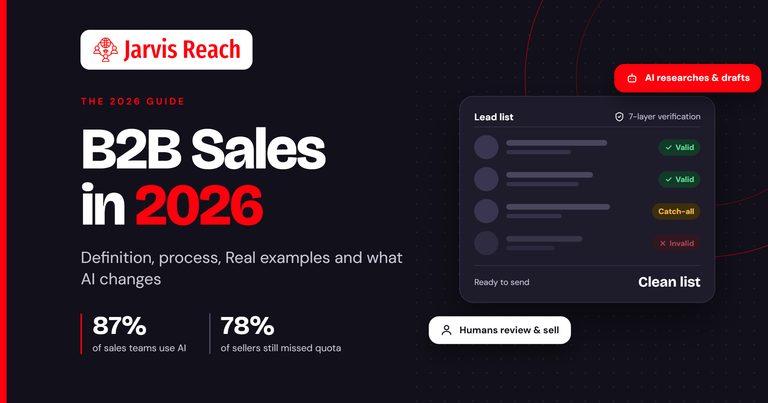
B2B Sales in 2026: Definition, Process, Examples and What AI Changes
By Imran Syed, Founder and CEO of Jarvis Reach · Updated October 2026 The short answer: B2B sales is when one business sells to another. Deals are bigger and slower than consumer sales, and many people sign off on each one. In 2026 most teams use AI to help. Salesforce found that 87% of sales teams now use AI. Yet Ebsta and Pavilion found that 78% of sellers missed quota in their 2025 benchmarks. The teams that win pair AI with verified data and a human who checks the work. Key takeaways What is B2B Sales? B2B sales (business-to-business sales) means selling products or services from one business to another. The buyer is a company, not an individual consumer. A typical deal involves people from finance, operations and leadership. Forrester found that an average of 13 people take part in each B2B buying decision. So B2B sales reps follow a structured process. Each step deals with risk, value and timing. The best B2B sales work is consultative. Sellers listen first and help the buyer frame a clear problem. Then they move each step forward with purpose. B2B vs B2C sales: What’s the Difference? The main difference is who buys and how. In B2C one person usually decides in minutes. In B2B a group of people decides over weeks or months. B2B sales B2C sales Who buys A company One person People in the decision 13 on average (Forrester, 2024) Usually one Sales cycle 91 days on average for new business (Ebsta and Pavilion, 2025) Minutes to days How they buy Research, demos, proposals and contracts Browse and check out Relationship Ongoing, with renewals and upsells Often a single purchase B2B Sales Strategies That Work in 2026 The six strategies that matter most come down to one idea: aim at the right accounts, reach the right people and let AI handle the groundwork while your reps do the selling. What is The B2B Sales Process? (and Where AI Fits) AI fits best at the start and end of the B2B sales process, where the work is research, data and admin. People matter most in the middle, where deals depend on judgment, trust and negotiation. Most B2B deals move through eight stages. Here is who should own what at each one. Stage What AI does What the human does 1. Prospecting Finds accounts that match your ICP, pulls intent signals, finds contacts and verifies every email Picks which accounts get personal attention and approves the final list 2. Qualification Scores leads on fit and activity and flags missing CRM fields Confirms need, budget, timeline and who will decide 3. Discovery Preps account research, recent news and likely pain points before the call Runs the call, asks follow-up questions and listens for what the buyer won’t put in an email 4. Demo Drafts a demo outline based on discovery notes Tailors the demo to each stakeholder and handles live questions 5. Proposal Drafts the proposal from a template and pulls in relevant case studies Owns pricing, scope and the business case 6. Review Tracks who has engaged and flags deals that have gone quiet Handles objections, legal points and negotiation 7. Close Prepares contract paperwork and logs the outcome in the CRM Confirms scope and builds trust with the decision-maker 8. Onboarding Sends welcome sequences, sets tasks and tracks early usage Sets success goals with the customer and watches for expansion chances The pattern is simple. AI handles tasks with clear inputs and a clear right answer. People handle anything where a mistake costs trust. This matters because selling time is short. Salesforce found that reps spend only 40% of their week actually selling. Handing stages 1, 2 and 8 to AI gives that time back. Reps can then spend it in stages 3 to 7, where buying groups of 13 people need a human to build agreement. How Many B2B Sales Teams Use AI in 2026? Most of them. Salesforce surveyed 4,050 sales professionals in late 2025 for its 2026 State of Sales report. It found that 87% of B2B sales teams use some form of AI and 54% have already used AI agents. Nearly 9 in 10 plan to use agents by 2027. Using AI is now normal. Using it well is not. What Salesforce found (survey of Aug–Sep 2025) Figure Sales teams using some form of AI 87% Teams that have already used AI agents 54% Share of a seller’s week spent actually selling 40% Expected time saved on prospect research with agents 34% Expected time saved on drafting emails with agents 36% How much more likely top teams are to use prospecting agents 1.7x So where does AI help today? Mostly in the boring work. It researches accounts. It drafts first emails. It updates the CRM so reps don’t have to. These are tasks with clear inputs and a clear right answer. AI struggles when the job needs judgment or trust. A buyer can tell when a message was written for 5,000 people at once. And a tool that guesses at a contact’s email can damage your sending domain for months. Gartner expects the number of tools to keep rising fast. In a July 2026 forecast it predicted that AI agents will outnumber sellers 10 to 1 by 2028. Yet fewer than 40% of sellers will say those agents made them more productive. Where is AI Failing in B2B Sales? AI fails most often when teams use it to send more messages instead of better ones. A 2025 Gartner survey of 632 B2B buyers found that 73% actively avoid suppliers who send irrelevant outreach. AI makes irrelevant outreach cheap. That is the trap. Here are the four failures we see most often. “Many B2B buyers feel overwhelmed by seller outreach. Bad prospecting damages potential customer relationships.” Robert Blaisdell, VP Analyst, Gartner Sales Practice (June 2025)” The fix is not less AI. It is AI pointed at research and data quality first, with a human checking what goes out. … Continue reading B2B Sales in 2026: Definition, Process, Examples and What AI Changes
Copyright 2026 Jarvisreach. All Rights Reserved.
