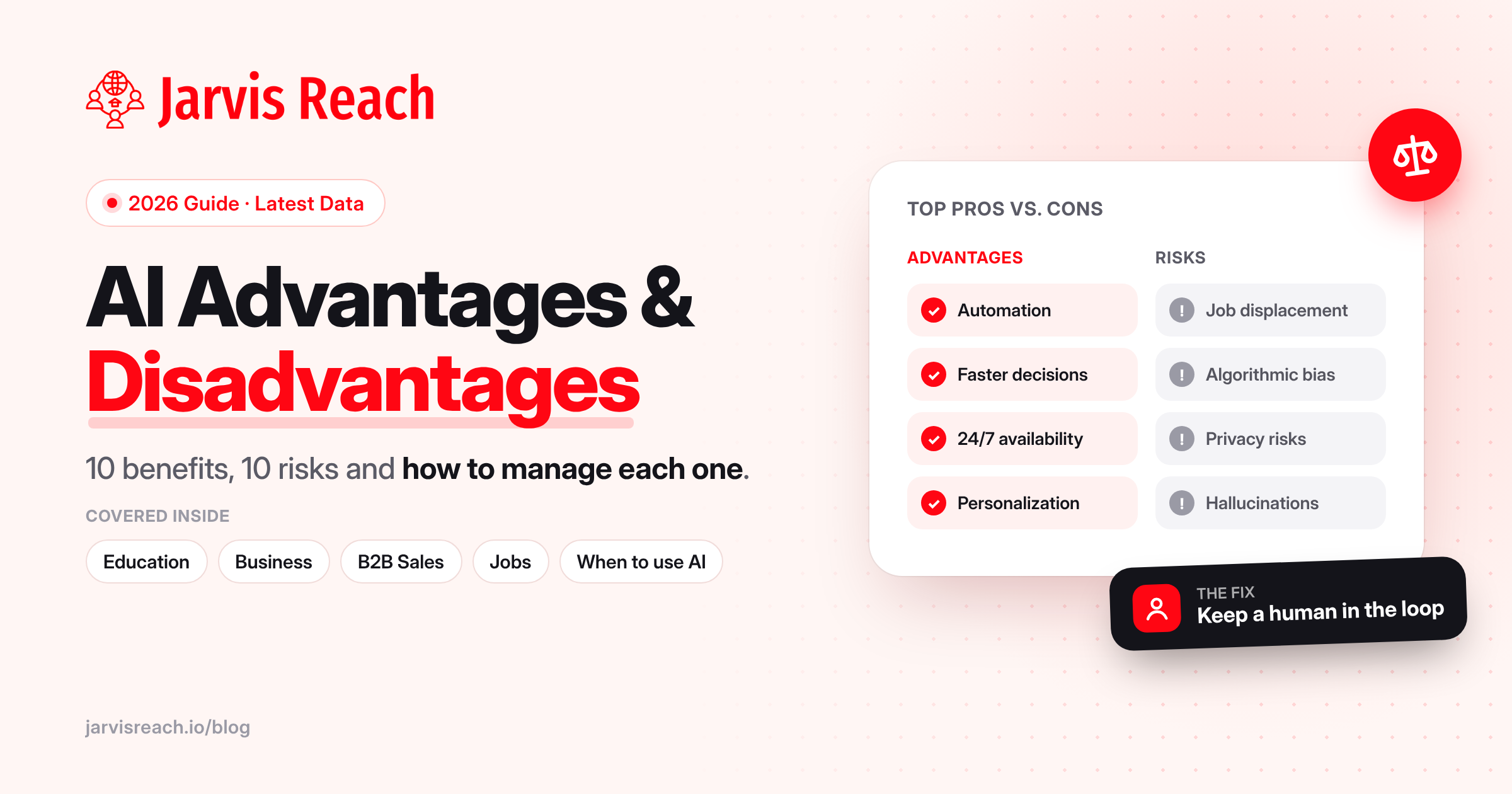
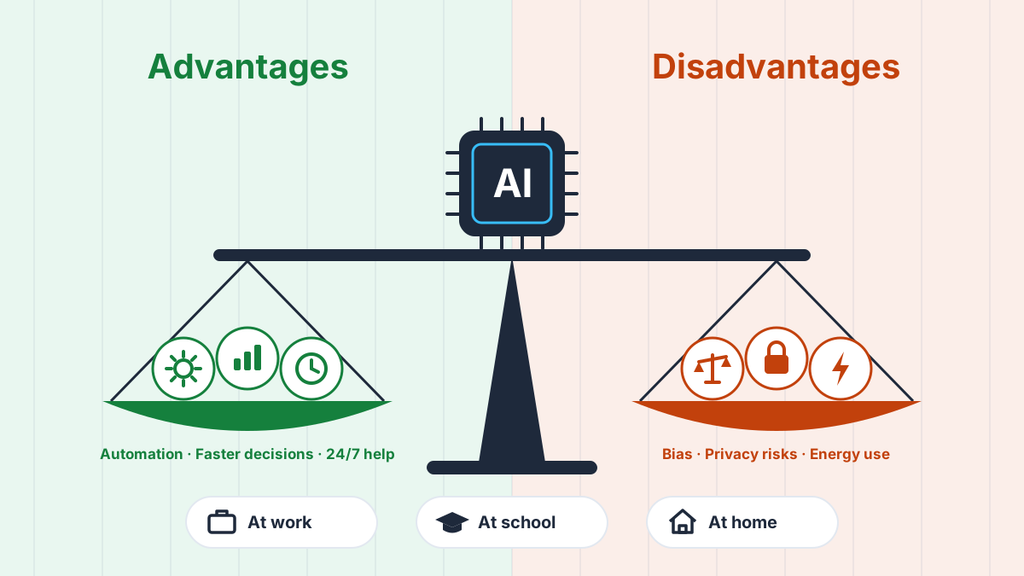
TL;DR: The advantages and disadvantages of artificial intelligence (AI) really come down to one thing: speed versus risk. AI takes over the boring, repetitive work. It also analyzes data much faster than people ever could. It cuts down on routine mistakes, works 24/7 without a break and shapes the experience around each user. But there’s another side. The biggest drawbacks are job displacement and algorithmic bias. Add to that privacy and security risks, “black box” decisions nobody can fully explain, and high energy and setup costs. Still, most of these risks can be managed when a human checks the work.
Weighing the advantages and disadvantages of artificial intelligence isn’t just for experts anymore. It’s an everyday choice now. Generative AI reached 53% of people within just three years. According to the Stanford AI Index 2026, that’s faster than the PC or the internet. This guide puts the advantages and disadvantages of AI side by side. Then it looks at how AI plays out in education, business, sales and jobs, and at when a human should stay in charge.
Advantages and disadvantages of artificial intelligence in 2026: the numbers
The latest data reveals how AI is boosting productivity and transforming industries while raising concerns about job displacement, privacy, bias, and environmental costs.
| Figure | Source |
| 88% of organizations use AI in at least one business function | McKinsey State of AI, Nov 2025 |
| 80% say AI improved their productivity; 37% see a profit (EBIT) impact | McKinsey State of AI 2026, Aug 2026 |
| Documented AI incidents rose from 233 (2024) to 362 (2025) | Stanford AI Index, Apr 2026 |
| 170 million jobs created and 92 million displaced by 2030 (all trends) | World Economic Forum, Jan 2025 |
| Data centers used 415 TWh of electricity in 2024; about 945 TWh projected for 2030 | International Energy Agency, Apr 2025 |
| EU AI Act rules for high-risk AI apply from 2 December 2027 | Regulation (EU) 2026/1744, in force 27 July 2026 |
What is artificial intelligence?
Artificial intelligence is the branch of computer science that builds systems able to do tasks that usually need human intelligence. Think learning, reasoning and even understanding language. Most modern AI technology doesn’t follow fixed rules. Instead, it learns patterns from data. You probably use it every day without noticing, common artificial intelligence examples include voice assistants, recommendation engines and chatbots.
Definition: Artificial intelligence (AI) is a set of computer systems that learn patterns from data to do tasks that normally need human intelligence.
How does AI technology work?
AI technology brings three things together: data, algorithms and computing power. Here’s how it works. A model studies huge datasets and spots patterns in them. Then it uses those patterns to make a prediction or create something new. According to IBM, this is the key difference from traditional software. With traditional software, a programmer has to write a rule for every single situation.
Types of AI: narrow AI, machine learning and generative AI
- Narrow AI does one task, such as translating text or recognizing faces. Every AI product today is narrow AI, chatbots included. Human-level “general AI” is still only a theory.
- Machine learning is a method where software gets better by studying examples instead of following written rules. Deep learning is a type of machine learning. It uses layered neural networks to handle complex inputs.
- Natural language processing (NLP) lets machines understand and produce human language. Computer vision lets them make sense of images and video.
- Generative AI creates new text, images or code. Most text tools run on a large language model (LLM). This is a model trained on huge amounts of text to predict and produce human-like language. OpenAI’s ChatGPT made it mainstream after its launch in November 2022.
- Agentic AI plans and carries out tasks with many steps. AI agents like OpenClaw work this way.
Everyday artificial intelligence examples
- Voice assistants such as Siri, Alexa and Meta AI
- Streaming and shopping suggestions based on your history
- Customer service chatbots that answer simple questions at any hour
Knowing how AI works makes the advantages and disadvantages of artificial intelligence easier to judge. Nearly every benefit and every risk traces back to the data a system learns from.
What are the advantages of artificial intelligence?
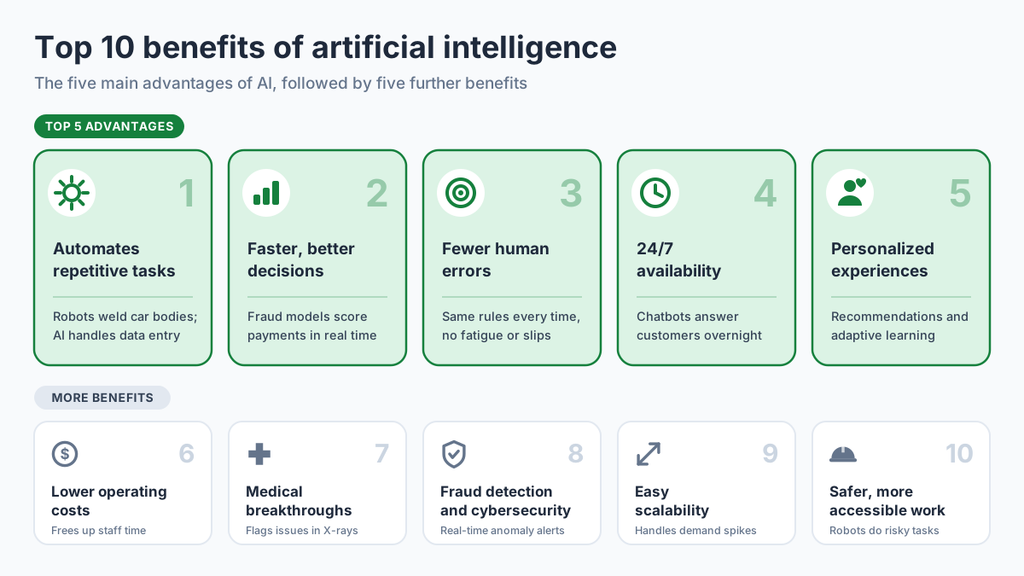
The main advantages of artificial intelligence are speed, scale and consistency. The top five advantages of AI are automating repetitive tasks and making faster data-driven decisions. They also include fewer human errors, 24/7 availability and personalized experiences. Further benefits of artificial intelligence are lower costs and medical breakthroughs. Stronger fraud detection, easy scaling and safer work round out the list.
Each benefit below comes with real artificial intelligence examples. The first five matter most.
1. Automates repetitive tasks
Automation means AI handles repeatable, rule-based work so a person does not have to do each step. Manufacturers use AI-guided robots to weld car bodies. In McKinsey’s 2026 survey, 80% of respondents said AI improved their productivity.
2. Faster data analysis and better decisions
AI finds patterns in more data than any person could review. Thomson Reuters reported in 2026 that 71% of risk and fraud professionals use generative AI to assess risk.
3. Fewer human errors
AI applies the same rules every time. So it avoids the slips that come with fatigue. Law firms use it to review contracts and catch clauses a tired reader might miss.
4. 24/7 availability
AI systems need no breaks, shifts or holidays. Customer service chatbots answer order questions overnight. They pass complex cases to a person in the morning.
5. Personalized experiences
Personalization means shaping content around one person’s behavior and preferences. Streaming services suggest shows based on your history. Adaptive learning platforms change the pace for each student.
6. Lower operating costs
Once it is running, AI lowers the cost of high-volume work. Automated reports and scheduling free staff for more valuable tasks. Setup costs are still real.
7. Medical and scientific breakthroughs
AI speeds up discovery by testing options at a scale no lab can match. In healthcare, AI flags abnormalities in X-rays and MRIs. Google DeepMind’s AlphaFold predicts the structure of proteins.
8. Stronger fraud detection and cybersecurity
AI spots unusual behavior in transactions and networks as it happens. The US Cybersecurity and Infrastructure Security Agency (CISA) uses it to detect network anomalies.
9. Scalability
Scalability means handling more work without hiring at the same rate. AI agents absorb seasonal spikes in service requests and then scale back down.
10. Safer and more accessible work
AI and robotics take on dangerous or physically hard tasks. Robots work in high-radiation zones. Assistive robot arms help older adults regain their independence.
What are the disadvantages of AI?
The main disadvantages of AI are job displacement, biased results and privacy and security risks. Opaque “black box” decisions and high implementation costs are also on the list. Other AI disadvantages include heavy energy and water use and over-dependence. Deepfakes add to the problem. So do hallucinations, which are confident factual errors, and a lack of human empathy.
Below are the ten most cited artificial intelligence downsides. Each one comes with a practical fix.
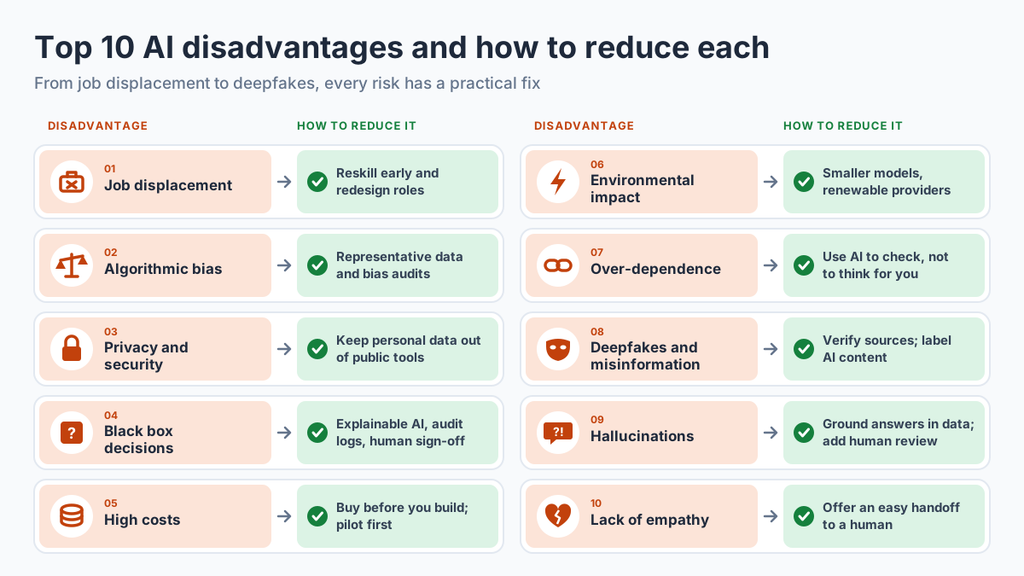
1. Job displacement
Job displacement is the loss or reshaping of jobs when AI takes over tasks people used to do. According to IBM, clerical, data-entry and routine service roles are shrinking fastest. For many workers this is the most personal of the cons of artificial intelligence.
How to reduce it: Reskill early. Redesign roles so AI handles the tasks and people handle the judgment.
2. Algorithmic bias
Algorithmic bias happens when an AI system gives unfair results because it learned prejudice from its training data. Amazon scrapped a hiring tool in 2018 after it penalized résumés that contained the word “women,” as Liberties.eu documents. A 2018 MIT study looked at facial recognition systems. Some misclassified under 1% of light-skinned men but over a third of dark-skinned women. AI is only as fair as its data and testing.
How to reduce it: Train on representative data and audit outputs for bias. Build diverse teams.
3. Privacy and security risks
AI needs vast amounts of data. Much of the text used to train large language models is collected without consent. IBM’s 2026 Cost of a Data Breach report puts the average breach at $4.99 million. It also found that AI-driven attacks rose 56%.
How to reduce it: Keep personal data out of public AI tools and offer opt-outs. Follow laws such as the GDPR.
4. Black box decisions
A black box is an AI system whose inputs and outputs are visible but whose reasoning is not. A US judge sentenced Eric Loomis partly on a “high risk” score from the Compas tool. No one in court could inspect how that score was made. IBM notes that accountability is just as unclear when self-driving cars crash or facial recognition leads to a wrongful arrest. IBM Research scientist Kush Varshney argues that enterprises cannot capture AI’s benefits without trust in a model.
How to reduce it: Use explainable AI. These are techniques that show which inputs drove a decision. Add audit logs and human sign-off.
5. High implementation costs
Building and running AI takes money, clean data and skills. A licence alone is not enough. In McKinsey’s 2026 survey, 20% of respondents said AI operating costs limited their use. This is one of the cons of AI that hits smaller firms hardest.
How to reduce it: Buy proven tools before you build your own. Pilot one process first.
6. Environmental impact
AI runs in data centers that use large amounts of electricity and cooling water. The International Energy Agency estimates that data centers used 415 TWh in 2024. It expects that to reach about 945 TWh by 2030. When the power comes from fossil fuels it adds to AI’s carbon footprint. Cooling adds a water footprint too. A 2023 study estimated that training GPT-3 used about 5.4 million liters of water.
How to reduce it: Choose smaller task-specific models and providers that run on renewable power.
7. Over-dependence and skill loss
Over-dependence means relying on AI so much that your own skills weaken. Virginia Tech computer scientist Eugenia Rho warns that using AI content without scrutiny can reduce critical thinking. Author Thomas Ramge puts it simply: “Artificial intelligence can’t do the thinking for us.”
How to reduce it: Use AI to explain and check your work. Then do the reasoning yourself.
8. Misinformation and deepfakes
A deepfake is AI-made video, audio or imagery that shows someone saying or doing something they never did. In January 2024 robocalls copied President Biden’s voice and urged New Hampshire voters to stay home. It was a clear example of the cons of artificial intelligence in politics.
How to reduce it: Check sources before you share. EU labeling rules for AI-generated content apply from 2 December 2026.
9. Hallucinations
A hallucination is an AI output that sounds confident but is false. An invented citation or statistic is a common case. Generative models predict plausible text. They do not check facts. The Stanford AI Index 2026 counted 362 documented AI incidents in 2025, up from 233.
How to reduce it: Ground answers in trusted documents. Have a person review anything you publish.
10. Lack of empathy and context
AI recognizes patterns but does not understand feelings. Support bots handle routine questions well. Yet they frustrate customers who bring emotional or complex problems.
How to reduce it: Give every AI channel an easy handoff to a human.
Artificial intelligence pros and cons at a glance
This table sets the artificial intelligence pros and cons side by side. Each advantage is paired with an example, the matching disadvantage and a fix. Most AI cons shrink with human oversight and better data. Clear governance helps too. So the risks rarely outweigh the gains.
Reading the artificial intelligence advantages and disadvantages in one table shows a clear pattern. Almost every benefit has a matching risk that comes from the same source.
Artificial intelligence advantages and disadvantages, side by side (2026)
This table compares the key advantages of AI, such as faster decisions and automation, with its disadvantages, including job displacement, bias, and privacy risks, along with practical ways to manage them.
| Advantage | Artificial intelligence example | AI cons | Mitigation |
| Automates repetitive tasks | Robots weld car bodies | Job displacement | Reskill staff; redesign roles |
| Faster decisions | Fraud models score transactions in real time | Algorithmic bias | Representative data; bias audits |
| Fewer human errors | AI contract review | Hallucinations | Trusted data; human review |
| 24/7 availability | Customer service chatbots | Lack of empathy | Handoff to a human |
| Personalization | Adaptive learning platforms | Privacy risks | Collect less data; opt-outs |
| Lower costs | Automated reporting | High implementation costs | Buy first; pilot |
| Medical breakthroughs | AI reads X-rays | Black box decisions | Explainable AI; clinician sign-off |
| Stronger cybersecurity | Network anomaly detection | Deepfakes and AI attacks | Verify sources; security testing |
| Scalability | AI agents absorb peak demand | Energy and water use | Smaller models; renewable data centers |
| Safer work | Robots in hazardous sites | Skill loss | Keep practicing core skills |
What are the advantages and disadvantages of AI in education?
AI in education helps students learn at their own pace. It also saves teachers time on grading. The main disadvantages of AI in education are academic dishonesty and weaker critical thinking. Data privacy risks, biased content and unequal access are problems too. Clear rules and human mentorship keep the AI advantages and disadvantages in balance.
Table: AI in education, five advantages and disadvantages for students and teachers
| Advantages | Disadvantages |
| Learning at each student’s own pace | Academic dishonesty |
| Instant feedback and 24/7 tutoring | Weaker critical thinking |
| Less grading and admin for teachers | Student data privacy risks |
| Accessibility tools such as text-to-speech | Biased or inaccurate content |
| Early warning on struggling students | Unequal access to devices |
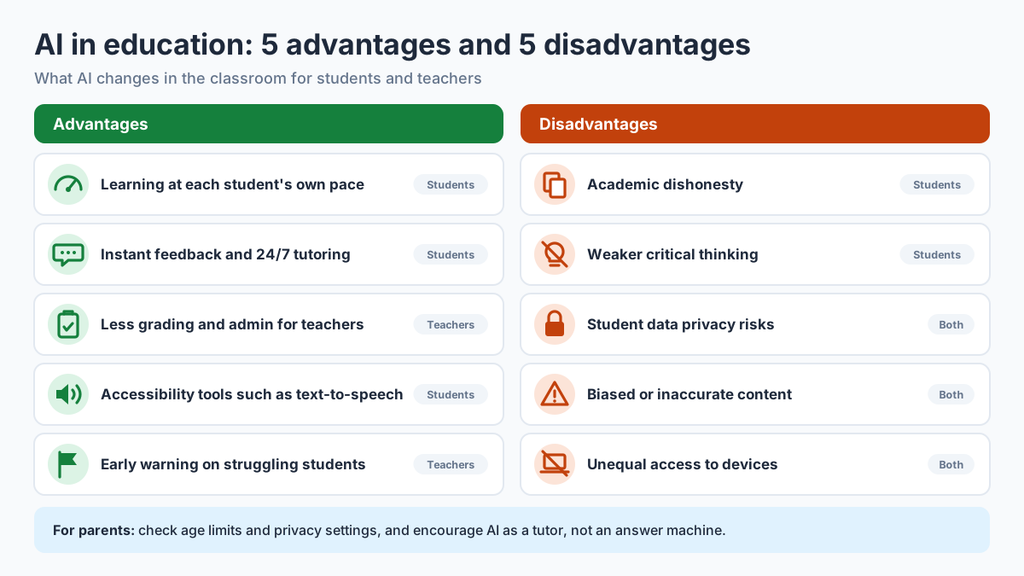
For students: The benefits of AI are tutoring and explanations at any hour. Most schools treat AI-written work as misconduct. So use AI to explain topics or quiz you, then write in your own words.
For teachers: The benefits of artificial intelligence include faster grading and early alerts about struggling students. Label each task as AI-free, AI-assisted or AI-encouraged so everyone knows what is expected.
For parents: Check age limits and privacy settings. Encourage AI as a tutor rather than an answer machine, and talk about deepfakes. Under the EU AI Act, AI used to decide access to education counts as high-risk from 2 December 2027.
In the classroom, the advantages and disadvantages of artificial intelligence depend less on the tool than on how it is used.
What are the advantages and disadvantages of AI in business?
In business, the benefits of AI are productivity, lower costs, faster decisions and scale. The cons of AI are setup and running costs and a need for clean data. Security exposure and biased automated decisions add to them. AI advantages and disadvantages also differ by company size. Small firms buy low-cost tools. Enterprises carry a heavier governance load.
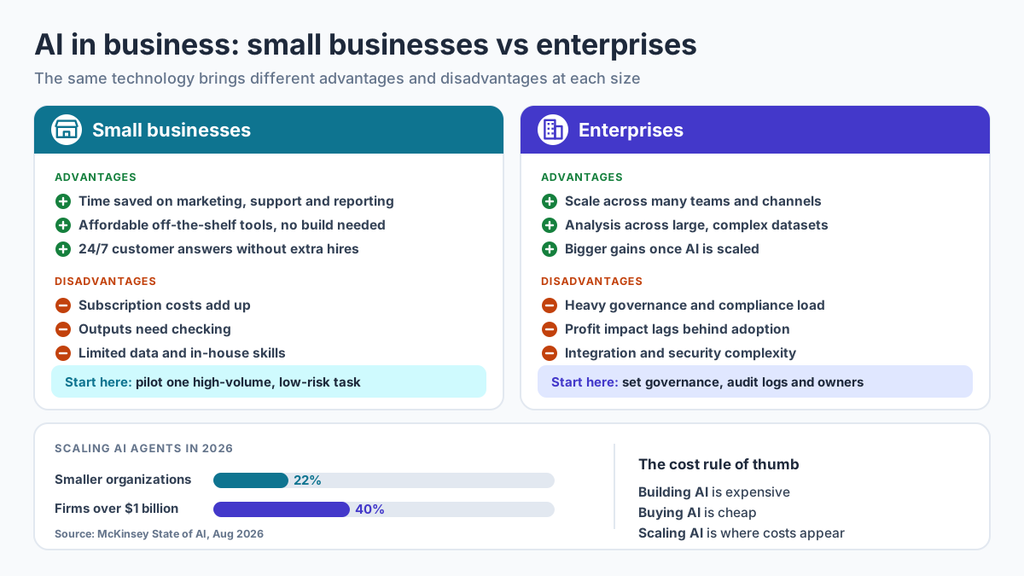
Small business advantages and disadvantages
For small businesses, the advantages of artificial intelligence are mostly time savings. These show up in marketing copy, support and reporting. In McKinsey’s 2026 survey, only 22% of smaller organizations were scaling AI agents. The figure for firms earning over $1 billion was 40%. Start with one task that is high in volume and low in risk.
Enterprise advantages and disadvantages
Enterprises gain scale but carry the heaviest governance load. Only 37% of McKinsey’s 2026 respondents saw AI lift profit. Adoption figures need context. McKinsey’s 88% counts larger organizations using AI anywhere in the business. The US Census Bureau found that 23.2% of all US firms used AI in a two-week window.
The pros and cons of AI by company size answer a common question. Building AI is expensive and buying it is cheap. Scaling is where the costs appear.
What are the pros and cons of AI in B2B sales and lead generation?
The advantages of AI in B2B sales are speed and scale. It finds prospects, enriches contact data, sequences follow-ups and suggests next steps. The cons of AI in sales start with bad data, which AI amplifies. Generic AI emails get fewer replies. Unverified addresses damage sender reputation. Verify data before you automate outreach.
Advantages: The benefits of AI in sales show up first in prospecting.
- Faster prospecting: AI filters large contact databases by role and industry in seconds.
- Data enrichment: AI fills in missing job titles, phone numbers and company details.
- Personalization at scale: AI drafts tailored first versions of emails for hundreds of prospects.
- Automated follow-ups: Sequences send on schedule and stop when someone replies.
Disadvantages:
- Inaccurate or outdated data: Contact details decay as people change jobs. AI repeats those errors.
- Generic AI-written outreach: Prospects ignore emails that sound like a template.
- Over-automation: Sending high volumes to unverified addresses raises bounces and hurts sender reputation.
- GDPR obligations: Contacting EU prospects needs a lawful basis and respect for opt-outs.
Table: AI in B2B sales, advantages and disadvantages by stage
| Stage | AI advantage | AI cons | Safeguard |
| Prospect search | Filters thousands of contacts in seconds | Includes people who left | Refresh data per campaign |
| Enrichment | Fills missing details | Fills gaps with old data | Check data health first |
| Email verification | Flags invalid addresses at scale | Skipping it causes bounces | Verify every list |
| Personalized emails | Drafts in seconds | Generic copy lowers replies | A human writes the opening line |
| Follow-ups | Sends on schedule | Over-sending harms reputation | Cap volume; authenticated SMTP |
| Next-step suggestions | Recommends the next action | Misses account context | The rep decides |
Jarvis Reach is a B2B lead generation and sales engagement platform. It uses AI-assisted suggestions to recommend the next outreach step, but the rep still decides what to send. AI-found contact data can be wrong. That is why Jarvis Reach lets teams run a 7-layer email verification check before a message goes out. Verification lowers data risk. It does not replace judgment about who to contact and what to say.
To decide who to contact first, see our guide to lead prioritization for sales teams or explore AI-assisted sales engagement.
Will AI replace human jobs?
AI is changing more jobs than it removes, but displacement is real. The World Economic Forum projects that all major trends together will create 170 million jobs and displace 92 million by 2030. Yet 39% of McKinsey’s 2026 respondents expect AI to cut headcount. That is one of the clearest cons of artificial intelligence.
The forecasts describe tasks more than whole jobs. Data entry and routine reporting are shrinking. Demand is growing for AI specialists and data analysts.
- Reskilling is the bottleneck: The WEF estimates that 59 in 100 workers will need reskilling by 2030.
- Displacement is starting slowly: Only 14% of McKinsey’s 2026 respondents saw AI shrink their workforce in the past year.
- Experts and the public disagree: 73% of US AI experts see AI’s job impact as positive. Only 23% of the public agree (Stanford AI Index 2026).
For workers, the advantages and disadvantages of artificial intelligence meet here. Roles change fastest for people who never learn to direct AI. Virginia Tech professor Walid Saad suggests treating AI “as an assistant to doctors, not a replacement” (Virginia Tech, 2023).
When should you use AI, and when should you keep a human in the loop?
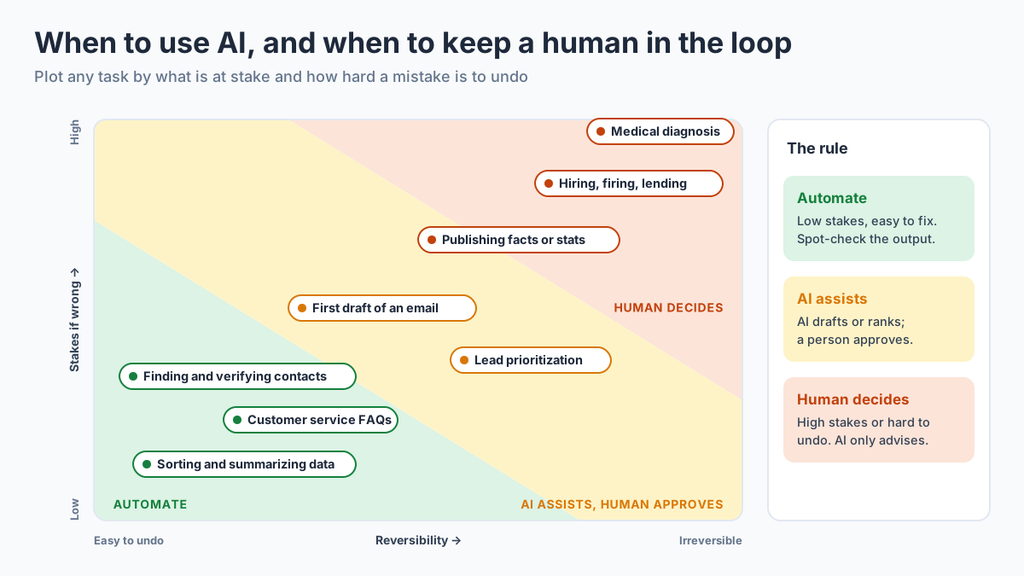
Use AI for tasks that are high in volume, repeatable and low in stakes, where errors are easy to spot. Drafting, sorting data and finding contacts are good examples. Keep a human in the loop for decisions that are high-stakes, hard to undo or need empathy. Hiring, lending and medical diagnosis fall in this group.
When people weigh the pros and cons about artificial intelligence, the real question is who checks the output. The pros and cons of AI shift with the stakes. The advantages of AI are greatest where mistakes are cheap. The AI cons grow as the stakes rise.
| Task | Stakes if wrong | Reversible? | Recommendation |
| Sorting and summarizing data | Low | Yes | Automate |
| Finding and verifying B2B contacts | Low to medium | Yes | Automate, then spot-check |
| First draft of an email or report | Medium | Yes | AI drafts, a human edits |
| Customer service FAQs | Low | Yes | AI answers, with human handoff |
| Lead prioritization | Medium | Yes | AI ranks, a human decides |
| Hiring, firing, lending | High | Hard | A human decides; AI assists |
| Medical diagnosis | High | No | A clinician decides; AI assists |
| Publishing facts or statistics | Medium to high | Hard once shared | A human verifies every claim |
How can society and businesses reduce the cons of artificial intelligence?
Reducing artificial intelligence downsides takes action at three levels. Individuals should check outputs and protect personal data. Businesses should test for bias and keep humans accountable. Policymakers should apply risk-based rules such as the EU AI Act and fund reskilling.
Use this checklist to manage the advantages and disadvantages of artificial intelligence in your setting:
- Verify AI output before you act on it or publish it. (Everyone)
- Keep personal and confidential data out of public AI tools. (Everyone)
- Use AI to learn, then do the thinking yourself. (Students)
- Label classroom tasks as AI-free, AI-assisted or AI-encouraged. (Teachers)
- Check age limits and privacy settings on children’s AI tools. (Parents)
- Pilot one low-risk process before you scale. (Small businesses)
- Test AI technology for bias and audit it regularly. (Businesses)
- Keep audit logs and a named human owner for every AI use case. (Enterprises)
- Map AI uses to EU AI Act risk tiers and the NIST AI Risk Management Framework. (Enterprises)
- Apply risk-based rules, require deepfake labels and fund reskilling. (Policymakers)
- Report AI forecasts as ranges, with publisher and year. (Journalists)
A note for journalists and policymakers: When you report AI forecasts, give the publisher, the year and the range. Say whether the figure counts all trends or AI alone, as the WEF’s does.
Regulation now shapes the artificial intelligence advantages and disadvantages for everyone. The EU AI Act entered into force on 1 August 2024. Bans on prohibited practices followed in February 2025. The EU’s Digital Omnibus has been in force since 27 July 2026. It moved high-risk obligations to 2 December 2027. For AI built into regulated products the new date is 2 August 2028.
Key takeaways: advantages and disadvantages of artificial intelligence
- The advantages and disadvantages of artificial intelligence balance speed and scale against bias, privacy, cost and job risks.
- The top advantages of artificial intelligence are automation, faster decisions, fewer errors, 24/7 availability and personalization.
- The biggest disadvantages of AI are job displacement, algorithmic bias, privacy risks and black box decisions. All AI disadvantages can be reduced.
- In B2B sales, most cons of AI come from bad data. Verify contacts before you automate outreach.
- Keep a human in the loop for high-stakes or irreversible decisions. That is where the artificial intelligence pros and cons tip.
FAQs
What are the advantages and disadvantages of artificial intelligence?
The advantages and disadvantages of artificial intelligence balance speed against risk. AI automates repetitive work and speeds up analysis. It reduces routine errors, runs 24/7 and personalizes experiences. Its main disadvantages are job displacement, algorithmic bias, privacy risks, black box decisions and high costs. When you weigh the pros and cons about artificial intelligence with human oversight, most risks stay manageable.
What are the 5 advantages of AI?
The 5 advantages of AI are: (1) automating repetitive tasks, (2) faster data-driven decisions, (3) fewer human errors, (4) 24/7 availability and (5) personalized experiences. These benefits of AI matter most in high-volume work such as customer service, finance and data entry. That is where speed and consistency save the most time.
What are 10 benefits of artificial intelligence?
The 10 benefits of artificial intelligence are automation, faster decisions, fewer errors, 24/7 availability, personalization, lower operating costs, medical and scientific breakthroughs, stronger fraud detection, easy scalability, and safer, more accessible work. The first five bring the biggest everyday gains. That is why they lead most artificial intelligence pros and cons lists.
What are 5 disadvantages of AI?
The 5 main disadvantages of AI are: (1) job displacement, (2) algorithmic bias, (3) privacy and security risks, (4) black box decisions that are hard to explain and (5) high implementation costs. Each one can be reduced. Reskilling, bias audits, data controls, explainable AI and small pilot projects all help.
What are 10 disadvantages of AI?
The 10 disadvantages of AI are job displacement, algorithmic bias, privacy and security risks, black box decisions, high implementation costs, environmental impact, over-dependence, misinformation and deepfakes, hallucinations, and a lack of empathy. These AI disadvantages are real. They are also manageable with human oversight, clear governance and verified data.
What are 5 negative effects of AI?
The 5 negative effects of AI are lost or changed jobs, unfair decisions from biased data, exposure of personal data, deepfakes that erode trust, and weaker critical thinking from over-reliance. These artificial intelligence downsides hit hardest for workers in routine roles. They also hurt people who trust AI output without checking it.
What are 5 disadvantages of AI in education?
The 5 disadvantages of AI in education are: (1) academic dishonesty, (2) weaker critical thinking, (3) student data privacy risks, (4) biased or inaccurate content and (5) unequal access to devices and tools. Clear classroom policies and AI-free assessments reduce each risk. Human mentorship helps students and teachers too.
Will AI replace jobs?
AI will replace some jobs but change far more. The World Economic Forum’s 2025 report projects 170 million jobs created and 92 million displaced by 2030 across all major trends. Clerical, data-entry and routine service roles are most exposed. Demand is growing for AI, data and care roles.
Is AI safe for students and children?
AI is reasonably safe for students and children when it is used with guardrails. It can explain topics and quiz learners. But it can also give confident wrong answers and collect personal data. It can expose children to deepfakes as well. Parents should check age limits and privacy settings. They should also ask children to show their own reasoning.
What are the advantages and disadvantages of artificial intelligence in sales?
The pros and cons of AI in sales come down to data quality. AI speeds up prospecting and enriches contact records. It personalizes outreach and automates follow-ups. But it amplifies outdated data, and unverified addresses hurt sender reputation. Jarvis Reach offers a free email verifier. Teams can use it to check any list before sending, including one built by AI.
Conclusion: weighing the advantages and disadvantages of artificial intelligence
The pros and cons about artificial intelligence are not a verdict for or against the technology. They are a checklist. Use the decision table above to choose where people stay in charge. Then most artificial intelligence downsides become manageable.
Want to see AI-assisted prospecting with verified contacts in action? Start free with Jarvis Reach. No credit card required.
Written by the Jarvis Reach editorial team, who write and review content on B2B sales tools, lead generation and outreach.