

Imagine giving your sales team sales analytics tools that identify top leads and utilize predictive sales analytics to understand how buyers are likely to behave. This approach shifts sales from simple data collection to data driven sales strategies, empowering teams to outperform competitors in B2B sales intelligence environments.
It helps teams optimize lead generation strategies and tailor outreach with improved timing. Market intelligence software gives a transparent picture of market trends, whereas sales prospecting tools for sales simplify the search for prospects. Combining sales enablement platforms with sales forecasting techniques improves sales performance metrics, fueling long-term revenue growth strategies.
Sales Intelligence is crucial to bridge customer insights and data driven sales to actualizable business growth. Tools like sales analytics tools and market intelligence software are central to this transformation.
What is Sales Intelligence?
Sales Intelligence is the organized gathering, processing, and utilization of information to make sales processes better. At the heart of it are firmographic information, buying intent, history of interaction, and customer insights, all empowering today’s sales teams. Sales Intelligence combines sales analytics tools, human insight, and sales automation to develop proactive, data driven sales strategies.
In B2B sales intelligence, predictive sales analytics are used by teams to predict needs by tracking behavioral patterns, utilizing market intelligence software for competition analysis, and using sales prospecting tools to find key decision makers. It optimizes lead generation strategies, with a focus on high-intent leads and waste elimination. Sales enablement platforms provide immediate customer insights, which enable more precise outreach. Sales forecasting techniques, including regression models and machine learning, enhance precision. Through this, Sales Intelligence aligns sales performance metrics with strategic objectives, basing contemporary data driven sales and revenue growth strategies.
Sales Intelligence tools filter large datasets for opportunities. For instance, predictive sales analytics can identify funding signals that guide timely outreach. This combination of technology and strategy gives organizations a powerful competitive edge.
Where to Gather Sales Intelligence Data
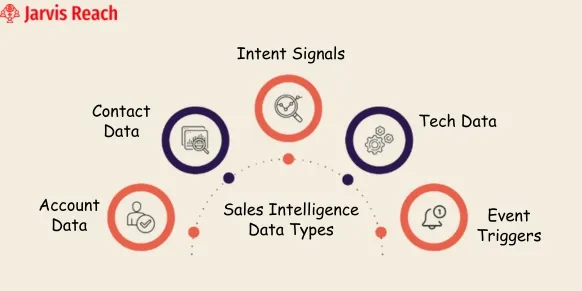
Collecting Sales Intelligence requires diverse, reliable data sources for a complete view of your market.
– Internal sources: CRMs store valuable interaction histories and customer insights.
– Social data: LinkedIn provides B2B sales intelligence on role changes, company growth, and new connections.
– Web analytics: Google Analytics supplies behavioral data that enriches firmographic profiles.
– Market research: Market intelligence software uncovers industry trends and competitive benchmarks.
– Public data: Economic filings and news accounts provide macroeconomic views.
– Automation tools: Sales prospecting tools and AI platforms automate activities, enabling data driven sales.
Optimize such channels by integrating sales analytics tools with CRM data and predictive sales analytics for focused lead generation strategies. Sales enablement platforms assist in harmonizing data across teams, improving sales performance metrics. Always prioritize quality, and clean your data regularly. A mix of diverse, verified sources builds the foundation of effective Sales Intelligence, revenue growth strategies, and accurate sales forecasting techniques.
5 Ways to Use Sales Intelligence Data
Sales Intelligence data transforms operations and drives smarter actions. Here are five practical applications:
1. Improve Prospecting:
Identify key decision makers using Sales Intelligence and sales prospecting tools. Predictive sales analytics interprets buying signals, strengthening lead generation strategies. In B2B sales intelligence, tracking funding rounds reveals high-value targets for data driven sales success.
2. Personalize Outreach:
Use customer insights from Sales Intelligence to tailor outreach. Market intelligence software highlights pain points and opportunities, improving engagement rates. Combined with sales enablement platforms, this personalization directly supports revenue growth strategies.
3. Forecast Smarter:
Apply sales forecasting techniques within Sales Intelligence, such as time series models powered by predictive sales analytics. Forecasts become more accurate, while sales performance metrics help teams monitor and adjust for stronger outcomes.
4. Optimize Operations:
Analyze sales performance metrics using sales analytics tools to identify bottlenecks. Sales Intelligence pinpoints inefficiencies, allowing teams to refine processes and boost data driven sales efficiency.
5. Align Marketing and Sales:
I recommend sharing Sales Intelligence information across teams to refine lead generation strategies. B2B sales intelligence will ensure only high-caliber leads filter through, allowing your teams to more accurately convert customer insights.
Benefits of Sales Intelligence Tools
Sales Intelligence tools revolutionize sales performance by accelerating prospecting and improving forecasting accuracy. They integrate with CRMs to power sales analytics tools that visualize sales performance metrics in real time.
Key advantages include:
– Faster pipelines with automated lead generation strategies
– Higher conversions through customer insights-driven messaging
– Predictable outcomes with predictive sales analytics
– A clear competitive edge in B2B sales intelligence through market visibility
Market intelligence software deepens understanding of market dynamics, while sales prospecting tools reduce manual work, leading to 20% higher win rates, shorter sales cycles, and scalable data driven sales growth.
Sales enablement platforms enhance training and team performance through integrated Sales Intelligence. Sales forecasting techniques become more reliable, directly supporting long-term revenue growth strategies.
Why is Sales Intelligence Important for Sales?
In this era of data driven sales, it reduces time spent on unqualified leads by refining lead generation strategies. Teams using Sales Intelligence are projected to gain 50% more AI-driven leads by 2025. Sales analytics tools monitor sales performance metrics, which indicate pipeline blockages early. In B2B sales intelligence, customer insights from market intelligence software enable the creation of tailored buyer journeys that enhance engagement.
Predictive sales analytics, meanwhile, foresees objections, cutting down sales cycles by as much as 20%. Sales prospecting tools automate lead scoring, pinpointing prospects with good buying signals.
In addition, it accelerates collaboration using sales enablement platforms to align organizations around mutual sales forecasting techniques for predictable and stable revenue growth strategies.
Final Thoughts
Sales Intelligence enhances sales from reacting to a buying decision to taking into account, it’s proactive. Invest in sales analytics tools, optimized processes, and sales enablement platforms to position your outcome for revenue growth strategies.
It informs strategy, empowers teams with actionable customer insights, and scales performance through predictive sales analytics and lead generation strategies optimized for performance. In B2B sales intelligence, it serves as a critical competitive advantage.
Jarvis Reach will support Sales Intelligence as it relates to automated data integration, surfacing insights, and identifying buying signals. Jarvis Reach is designed to integrate with sales enablement platforms across your organization, allowing your sales reps to spend their time doing what they do best, preparing to sell their products.
Build your business using simple and efficient Sales Intelligence tools. With quality data at your core, data driven sales success becomes inevitable.
FAQs
1. What is sales intelligence?
Sales intelligence refers to the act of collecting, analyzing, and using data about customers, prospects, and the marketplace to make better sales decisions and achieve better sales results.
2. What are called the 7 P’s in competitive intelligence?
· Product – Features, quality, product development, differentiation
· Price – Pricing structure, discounts, value propositions
· Place – Distribution channels, where to market, geographic reach
· Promotion – Marketing, messaging, positioning, campaign execution
· People – Leadership, sales team, talent, customer support
· Process – Internal processes/workflows, sales processes, customer onboarding process
· Performance – Market share, revenues, growth, customer satisfaction, overall reputation
3. Can I use A.I. in my sales role?
Indeed, AI can help you bring greater efficiency to your sales role by automating activities, delivering insights, allowing for personalization with customers, and much more.
4. What are the 4 methods involved in collecting data?
The four main ways of collecting data are surveys, observations, interviews, and focus groups. Other common methods are questionnaires, experiments, and secondary data.

