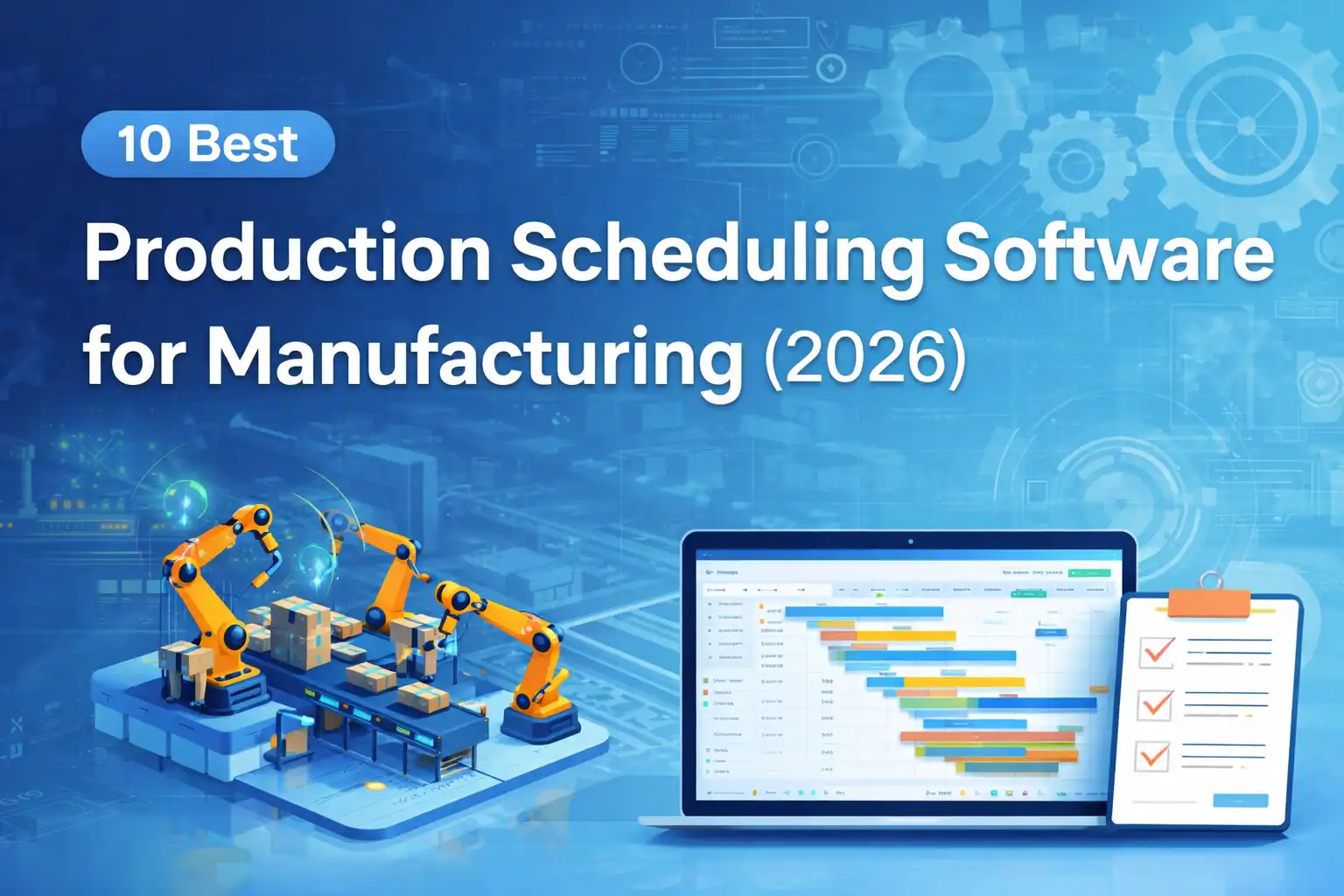
Production scheduling software is an advanced web resource that is designed to handle the complex aspects of production schedules and resource distribution. In its fundamental principle, the production scheduling software ensures inputs of production orders, machine capacities, available labor, and material stocks to produce optimal schedules that would result in minimal waste and maximized output. This is much more than mere calendars or spreadsheets; the production scheduling software uses sophisticated algorithms, sometimes fuelled by an AI, to consider factors such as set-up time, maintenance intervals, and changing customer demand to ensure that each production order is scheduled most efficiently.
Role of Production Scheduling Software in Manufacturing
The production scheduling software is in effect the central nervous system of the manufacturing process, which integrates disparate elements to give them a harmonious operation. It allows project planners to see the workflows on an intuitive interface, such as Gantt charts, where one can drag and drop tasks to capture the real-world changes. The feature of resource optimization is characteristic of it since the software spreads the workloads among labor management teams, machines, and materials so that they do not cause bottlenecks.
The companies that apply the production scheduling software state that the on-time delivery rates have increased significantly (usually more than 95 percent), and that the tools provided by the software also give the companies the ability to see the concealed costs of idle time or overstaffing.
Modern Capabilities of Production Scheduling Software
Besides, supply chains are becoming more global and volatile, so the production scheduling software integrates predictive analytics to predict disruptions, including supplier delays or shortages of raw materials. This aggressiveness in labor management and production budgets enables companies to be agile, hence retaining their state of conforming to customer demand without negatively affecting quality. In the case of small workshops to enterprise factories, production scheduling software democratizes access to enterprise planning to the point that advanced planning and scheduling software is available without requiring the extreme learning curve of old-style software.
Development of Production Scheduling Software
The development of the production scheduling software has been characterised by the incorporation of IoT devices within the shop floor that offer live data feeds that allow to track progress in real-time. This connectedness will give schedules a dynamic nature and will respond to the real conditions as opposed to being based on predictions. As the concept of sustainability intensifies in 2026, a significant portion of production scheduling software has now been able to model energy consumption to assist manufacturers in optimizing time, cost minimization, and environmental impact as well.
In adopting production scheduling software, firms are at a position to survive in the uncertainties of the economic times and convert the possible challenges into growth and a chance to innovate.
Process of Production Scheduling Software
Production scheduling software process is a multi-layered process of transforming business goals into practical plans in a systematic way. Production scheduling software takes the manufacturing process and divides it into manageable phases that build on each other to develop a robust schedule that can tolerate real-world variables. This is a highly organized approach whereby every turn of production is focused on the optimization of its resources, and hence, the production orders are not only fulfilled, but fulfilled in the best way possible in respect of time, cost minimization, and quality.
Dealing with Complexity
At the heart of this process is the fact that the software can deal with complexity through automation. The users key in the parameters such as the production budgets and customer demand profile, and the system produces schedules which take into account labor management constraints and machine availability. With time, the greater the amount of data, the more the outputs of the production scheduling software can improve its outputs through machine learning, resulting in successively accurate predictions and a reduced number of manual interventions. Such an iterative process not only streamlines the day-to-day operations but also helps in strategic decision-making, including capacity expansions or reengineering processes.
Step 1: Demand Forecasting
The production scheduling software process begins with the demand forecasting process, where, based on historical data, market intelligence, and seasonal trends, the future customer demand is set by project planners. State-of-the-art production scheduling software applications use the sales trends, promotional calendar, and even macroeconomic factors to make finer forecasts down to the SKU. The step is important in ensuring realistic production orders to avoid the two traps of overproduction, which will bloat the production budget, and underproduction, which will result in lost sales and customer dissatisfaction.
AI-based Frameworks
Practically, production scheduling software is hooked to CRM and sales platforms where real-time order information is pulled, and predictions are made dynamically. The AI-based frameworks of the advanced planning and scheduling software may be used to simulate scenarios such as the disruption within the supply chain or a sudden increase in demand caused by viral marketing campaigns. The manufacturers are able to gain quantified insights, e.g., the anticipated order volumes depending on the shift, which allows them to plan labor management accurately. Timely demand forecasting directly leads to cost minimization since it helps align inventory with the real demand, and lower holding costs are also included in a total cost ownership analysis.
Moreover, the step integrates the multi-channel inputs, e-commerce platforms, down to B2B portals, which is essential to have a comprehensive picture of customer demand. Forecasts are often represented as interactive dashboards by production scheduling software, which enables project planners to make assumptions together. Having a good baseline of forecasting, the next processes in the forecasting process become reliable, and this is the way smooth optimization of resources through the manufacturing process takes place.
Step 2: Resource Planning
The aspect of resource planning in production scheduling software is that the available assets, machinery, workforce, and materials are carefully mapped to the predicted needs. This stage uses capacity modelling to determine the existing resources against the needed resources, with gaps being noted that may sabotage the production orders. Some software, such as production scheduling software, excels in this area using visual aids such as heatmaps and workload charts, and can identify overloads or underutilizations in real-time and optimize the resources.
Material Management in Production Scheduling Software
The area of labor management is prioritized, and the software takes into consideration skills matrices, shift preferences, and overtime regulations to establish equal schedules. As far as materials are concerned, it compares bills of materials (BOMs) with inventory to indicate possible shortages in advance. Scenario planning is used to protect production budgets by allowing the user to experiment with what-if changes on the total cost ownership analysis. This lean methodology makes sure that all resources are used to the fullest in the production process without spending more than necessary.
Resource planning can also be enhanced with integration with HR and procurement systems, where requisitions are automated, either through temporary labour or a rush order. The sustainability aspect is also factored by most production scheduling software applications in making sure that energy-efficient machines are used at times of peak demand. At the culmination of this step, a blueprint is formed, which can be optimized, and the preparatory phase of effective implementation and monitoring tools is set.
Step 3: Scheduling Optimization
The algorithmic giant of the production scheduling software is known as scheduling optimization, which is the process of sequencing tasks in order to achieve a minimum makespan and a maximum throughput, with finite capacity algorithms. Production scheduling software can be used to analyze thousands of permutations within several seconds, ranking the production orders by due date, profit margin, or strategic value without violating the constraints, such as setup times and sequence dependencies.
Constraint-based Modelling
The major culmination of this is constraint-based modelling in state of the art planning and scheduling programmes that determine the bottlenecks and suggest remedies such as parallel processing or subcontracting. The visual interfaces enable intuitive intervention by the project planners so that they can drag tasks to perfect the auto-generated plan. This is the point of resource optimization, since the software will evenly distribute loads among labor management pools and equipment, directly affecting production budgets by eliminating overtime and cost minimization.
In addition, production scheduling software also includes multi-objective optimization, balancing or weighing such elements as cost minimization against the delivery speed. In the real world, there are 15-25 percent decreases in lead times after implementation. The result of this step will be a dispatch list of the shop floor, including detailed instructions, so that it can be aligned with the demand of the customers, and the transition to execution stages will not have any difficulties.
Step 4: Real-Time Monitoring and Adjustments
Real-time monitoring turns the dead plans into living plans in production scheduling programs. Live data provided by IoT sensors and mobile applications on machine statuses, completions of operators, and quality checks allows dashboards to track progress against baselines. Deviations cause alarms, rapid changes of production orders without notifying of delays. The geofencing and time-tracking integrations are useful to labor management as they check the efforts put in reality and planned.
Drag-and-drop rescheduling
The drag-and-drop rescheduling of production scheduling software ensures that the customer demand is met despite a breakdown or rush job. Root-cause analysis is based on variances captured by analytics and returned into a total cost ownership analysis in order to optimize future budgets. This flexibility is crucial in unstable markets, where the production scheduling software dashboards can give the executives at-a-glance KPIs such as OEE (Overall Equipment Effectiveness). Mobile accessibility enables supervisors to report on the floor and completes the chain of planning and execution to actual agility.
Step 5: Continuous Improvement
Continuous improvement is a cycle that completes the production scheduling software by utilizing post-execution data to implement a cycle of continuous improvement. Measures such as schedule compliance, throughput frequencies, and cost variances are dissected by reports that inform total cost ownership analysis and process adjustments. The trend analysis of production scheduling software helps to see the patterns, including frequent bottlenecks in human resource management or material processes.
Rules engines are optimized by kaizen-type feedback, benefiting operators, whereas AI proposes proactive modifications such as preventive maintenance timelines. The step encourages the culture of excellence, and the production scheduling software will compare the production with the industry standards, encouraging it to cost minimization. In the manufacturing process sector, there is an increase in compounding gains among the manufacturers, 10-20% annual gains in efficiency, which stabilize competitive advantages in the manufacturing processes.
Implementation Features of Production Scheduling Software
The introduction of the production scheduling software requires a combination of intensive features that are adjusted to the manufacturing process reality. Their main features are infinite and finite capacity scheduling modes, which provide multiflexible rough-cut planning to detailed planning. Interfaces are dominated by visual Gantt charts and calendars, statuses are color-coded, and edits are intuitive and drag-and-drop, which is paramount to the optimization of resources.
The integration features are distinctive, and APIs are connected to ERP, MES, CRM, and even the PLM systems to have a complete data flow. Scheduling software should be able to do multi-site production, which includes time zones and cross-plant dependencies. Advanced planning and scheduling software versions contain scenario simulation, where one tests fire scenarios such as worker shortages, with manufacturing process finances.
Reporting Modules and Cloud deployment
The accuracy of track progress is ensured by the features of the shop floor execution, such as work instructions, QR code scanning, and downtime logging. Reporting modules provide tailored KPIs, starting with OTD (On-Time Delivery) through ratios of labor management efficiency. Cloud deployment provides scalability, whereas on-premises fits industries that are controlled. Sensitive production orders data is secured by security protocols such as role-based access. The adoption is fastened by the presence of user trainers, portals, and mobile apps that reduce the learning curve on the part of project planners.
Customization through low-code platforms allows companies to customize workflows to specific production processes, like batch production and discrete production. The AI improvements forecast delays and auto-propose new schedules at the next level of cost minimization. Finally, these characteristics are making sure that the production scheduling software will bring ROI in terms of lower inventories (20-50%), increased use of assets, and responsiveness to customer demand satisfaction.
Advantages of Having Production Scheduling Software
Reduced Cycle Times
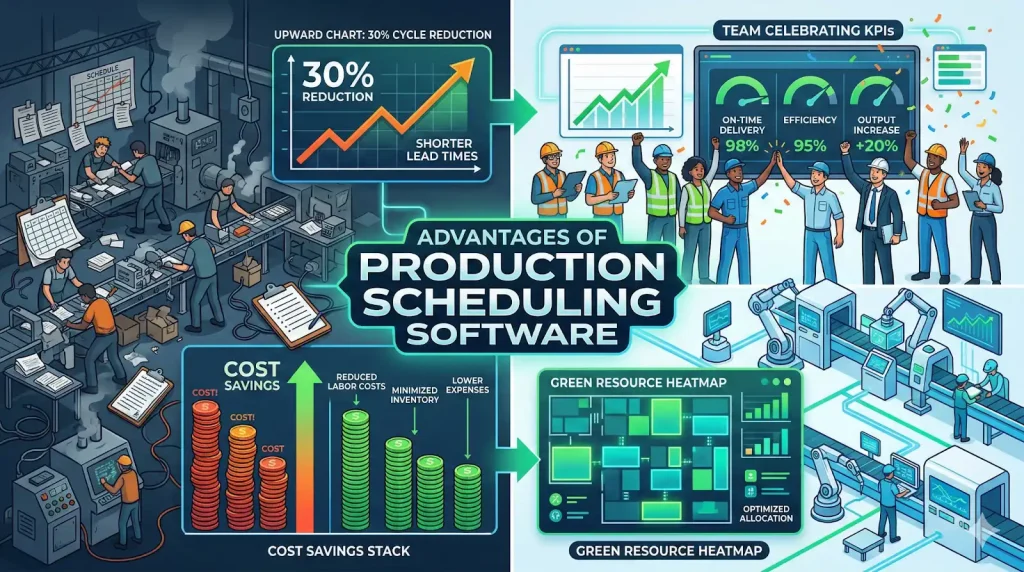
The production scheduling software significantly reduces the length of cycle time by smartly sequencing the production orders and reducing machine and labor downtime. Automated detection of bottlenecks and optimized processes of flowing materials and workers within the manufacturing process are the most common features that enable manufacturers to make 20-30% cuts in the lead times.
Improved On-Time Delivery
The delivery rates increase dramatically due to real-time tracking capabilities and proactive alert systems of production scheduling software. Making the production pattern exactly match the demand trends of the customers and automatically correcting when disruptions occur, manufacturers were able to meet or even exceed the delivery SLAs regularly, which helps to strengthen customer relations and paves way to high-end contracts.
How Jarvis Reach Can Help in Production Scheduling Software
Jarvis Reach revolutionizes vendor and user strategies for production scheduling software by harnessing AI for precision lead generation. This innovative platform identifies manufacturers struggling with outdated scheduling systems, pinpointing specific needs in resource optimization, labor management, and production order track progressing. By analyzing online behaviors and intent signals, Jarvis Reach fuels highly targeted outreach campaigns that connect software providers with decision-makers actively seeking advanced planning and scheduling software solutions. Whether you’re a vendor promoting your production scheduling software or a manufacturer evaluating options, Jarvis Reach bridges the gap between pain points and perfect-fit solutions, driving measurable ROI through qualified leads and faster sales cycles that align perfectly with customer demand patterns and production budget constraints.
Identifying High-Intent Users
Jarvis Reach scans search commands, user information, and interaction with a website in order to identify the high-intent users who actively search for production scheduling software. This is a checkpoint accuracy that is focused on manufacturers seeking answers to resource optimization requests, higher-level planning applications, production orders oversight, or labor control enhancements. Using keywords such as track progress software, manufacturing process optimization, and cost minimization tools, Jarvis Reach will identify companies at various levels of buying, such as awareness and consideration stages, improving your sales funnel.
This empirical model provides warm contacts with documented requirements, including contacts, full company size, and pain points, which can be approached individually, transforming browsers into buyers of your production scheduling software products much more efficiently than conventional solutions do.
Accelerating Market Research
Jarvis Reach will significantly speed up market research results by combining anonymized data on demand trends in the manufacturing process and software production. Get immediate feedback on what capabilities are most important, be it track progress dashboards, total cost ownership analysis tools, production budget controls, or real-time monitoring of the manufacturing process. The platform also shows the new trend of favoring cloud computing services, mobile access, ERP applications, and artificial intelligence-based forecasting that optimizes production orders according to fluctuating customer needs.
The vendors will be able to quickly find untapped niches, such as small-scale manufacturers who require a simple interface or businesses that require detailed constraint modeling. This dynamic intelligence enables its quick product road mapping, competitive positioning, and focused marketing campaigns that speak to the real buyer priorities, putting a product in the market in a decisive position against the many existing production scheduling software players.
Providing Customer Insights
Jarvis Reach provides profound, practical customer data on the issues in the manufacturing process that have to be addressed by production scheduling software. Discover particular areas of pain, such as poor labor management that leads to excessive workloads of the employees, fragmented visibility of the track progresses across numerous plants, production budgets that are overrun by a lack of resource optimization, or delayed deliveries because of customer demand forecasting mismatch. The platform describes the best customer types: a job shop owner versus a high-volume assembler versus a process manufacturer, with their technology stacks, budget ranges, and indicators of decision-making.
With this information, sales teams design hyper-personalized programs that would appeal directly to measured ROI possibilities, e.g., 25 percent cycle time savings or 30 percent inventory cost savings. This knowledge can help turn the generic production scheduling software sales pitches into a problem-solving dialogue that drives the deal velocity and increases the conversion rates by a significant percentage.
10 Best Production Scheduling Software
When selecting production scheduling software, it is necessary to match features with its operational size, industry, and objectives, such as optimizing resources and minimizing costs. The 2026 landscape provides high-end solutions that have niche capabilities through joint workflows to sophisticated constraint modelling. These are category leaders that describe the capabilities, application, and potential ROI to master production orders, labor management, and customer demand through the advanced planning and scheduling software excellence. Find all-in-one solutions that automate all the features of production planning, balance capacity, usability, scaling, and full feature sets to meet all manufacturing process needs up to 2026.
Analysis with Gantt Charts
These exemplary platforms provide end-to-end performance, including demand forecasting, execution, and analysis with intuitive Gantt charts, real-time collaboration, automated resource leveling, and extensive reporting that can be used to conduct the analysis of the total cost of ownership. It is ideal in situations where the manufacturer requires one solution that can address simple job shops to complex multi-site operations with production budget discipline and the ability to maintain complex labor management on all the production orders. These one-stop powerhouses guarantee resource optimization perfection irrespective of the complexity of the manufacturing process or customer demand fluctuation patterns.
1. ProjectManager
ProjectManager is the most advanced production scheduling software in high demand for project planners, with interactive Gantt charts to map dependencies and real-time collaboration. It is great in terms of optimizing resources as it has leveling of workloads and production budget custom fields. The labor management dashboards follow the track progress on the production orders and will be integrated with the MS Project in case of a hybrid environment. It is ideal for mid-sized manufacturers and supports unlimited project planners, and offers 24/7 support. Its user-friendly interface and total cost ownership analysis reporting are highly praised by users and can grow with the enterprise.
Best for Batch Task Scheduling
Discover customized platforms, which are optimized for smart grouping, sequencing, and execution of recurrent high-volume tasks typical of batch manufacturing process setup. These batch masters are ideal for lot traceability, cost minimization of the batch size, administration of holding tanks, and a schedule of formulation that avoids cross-contamination, as well as optimum usage of equipment in production campaigns.
They are ideal in food and beverage, chemicals, and pharmaceutical industries, and are used in managing recipe-driven production orders and automatically compute setup/cleanout time between batches and optimize holding patterns and compliance documentation of all lots. Resource optimization glitters with smart batch windowing that is used to profitably fill production gaps without impacting customer demand fulfillment SLAs or very strict production budget parameters.
2. NetSuite
The manufacturing process system in NetSuite provides batch scheduling, mastered in production scheduling software, demand planning, and work order management. It promotes cost minimization through a lot of traceability and optimization of resources when it comes to production budgets. SuiteSuccess increases faster deployment.
Best for Small to Mid-Size Manufacturers
Custom solutions to the expanding companies, which require cost minimization, easy-to-learn production scheduling software with enterprise capabilities based on limited resources, and with less complex operational models. Such SMB specialists will provide expedited deployment (in weeks, not months), light overhead on IT, flat rate pricing with no user constraints, and full functionality that includes quoting solutions to shipping without the need for individual planners.
They are ideal in job shops, make-to-order, and growing contract manufacturers with 10-500 employees, where the manufacturing process budget is required, and labor management, visual scheduling, and basic MRP are required with easy-to-use interfaces that can be mastered by frontline supervisors. Cloud implementation does away with CapEx and provides 99.9% uptime to production order management that is mission-critical.
3. MRPeasy
MRPeasy is a production scheduling software that is customized to SMBs to run on cloud-based MRP and multi-level booms. QC tools used to optimize manufacturing processes are forward/back scheduling.
Best Material Resource Planning (MRP) Integration
The platforms of the industry leaders provide a unidirectional MRP interconnection, where the material, inventory, and production plans are synchronized to avoid any shortage and overflow. These MRP masters automatically de-explode BOMs in several levels, and net requirements are computed with safety stock and lead times, and purchase orders are automatically generated, and supplier performance releases track progress directly on scheduling views.
They are ideal in the case of assemble-to-order manufacturers that have thousands of parts in operation, where available to promise calculations are made on each order of production, each lot/serial number is assigned to a particular customer order, and where automatic rescheduling occurs in case of delay of the supplier endangers production budgets. Real resource capacity by material constraint view enables the promised early, delivered late phenomenon that afflicts conventional planning to be avoided.
4. Katana MRP
Katana MRP directly links the stock to the production orders by displaying production orders with live inventory and does resource optimisation (platform integrations).
Best for Visual Planning and Shop Floor Control
Graphical-first systems that enable drag and drop user interfaces, interactive Gantt charts, and real-time shop floor management that democratize production management to hands-on operators and supervisors. These graphical planners use visual planning in place of the cryptic dispatch lists, color-coded timing plans, machine conditions, and mobile touch screens, which are the actual interfaces used by the shop floor workers. Ideal for make-to-order and custom fabrication, they offer visibility of the digital twin showing actual versus planned progress, operator expertise equivalent to labor management optimization, and single-click what-if rescheduling to automatically recalculate effects on all production orders. Discipline in production budget was ensured via visual cost to complete projections and resource optimization heat maps.
5. Visual Planning
The maps and calendars of Visual Planning manage the shop floors of any production scheduling software, and the labor skills are equal.
Best for Inventory-Centric Scheduling
Inventory-related, automated replenishment-based, and demand-based material planning specialized solutions that ensure the flow of components without causing production pauses. These inventory-first systems continuously compute economic order quantities, reorder points in response to the variability of lead time, and safety stock optimization across multi-warehouse. Ideal where component stockouts are a problem, but the manufacturer is a high-mix low-volume manufacturer, they offer min/max warning, automatic kanban warning, vendor-operated inventory portals, and ABC analysis built directly into production scheduling displays. Intelligent material constraint scheduling is used to help minimize resource wastage by avoiding the starving of critical production orders, and helps reduce the need to carry obsolete inventory with enormous carrying costs that distort ownership figures in the total cost ownership analysis.
6. Fishbowl Inventory
Fishbowl automates inventory warnings in production scheduling programs and QuickBooks to reduce costs.
Best ERP-Focused Production Scheduler
Native embedded scheduling engines embedded in full ERP environments provide end-to-end operational control, unified data flows, regulatory compliance, and real end-to-end quote to cash operations. These ERP natives will automatically inherit customer, vendor, and financial master data without interfaces, will offer real-time financial and operational visibility, and will impose business rules that are uniform enterprise-wide. They are ideal in controlled industries, or larger manufacturers that require audit trails, lot traceability, and built-in cost accounting, and eliminate nightmares in data reconciliation, besides streamlining labor management between departments. The production scheduling software feature serves as a smooth continuation of the well-known ERP processes, so the accuracy of production budgets and the benefits of resource optimization are delivered instantly to P&Ls.
7. QT9 ERP
QT9 ERP is planned to be automated, and production schedules with QMS integration will follow production scheduling software.
Best for Holistic Business Operations
Actual enterprise solutions that combine production scheduling with CRM, accounting, quality management, and supply chain functionality to create transparency of operations and cross-functional synergy. Such holistic solutions offer executive dashboards with production achievement and sales pipeline, cash flow forecasts, and supplier performance presented in one perspective.
They are ideal in mid-market companies that have 50-500 employees spread across the various value streams, as they allow the facility to have a closed-loop planning in which customer orders are used to automatically generate production schedules, material requisitions, shipping documents, and invoices. The work floor optimization takes into consideration the shop floor capacity and the availability of the field service, and also keeps the production budget in check by real-time cost to complete reporting against the customer demand commitments. To this: The work floor optimization takes into consideration the shop floor capacity and the availability of the field service management system, and also keeps the production budget in check by real-time cost to complete reporting against the customer demand commitments.
8. M1 ERP
M1 ERP integrates the production scheduling software, from quoting to shipping, and optimizes complicated job shops.
Best for Complex Production Processes
Spin-off platforms that are designed with multi-stage manufacturing process environments that have heavy constraints, need finite capacity planning features and advanced scenario modelling capabilities. Automatically represented in these complexity masters are sequence-dependent configurations, alternative routings, parallel machine constraints, labor assignment rules based on skills, and nested batching requirements involving hundreds of work centers. They are perfect when time constraints are a concern, such as engineer-to-order, configure-to-order, and mixed-mode manufacturers, and are fast and can deliver provably optimal or near-optimal schedules under all real-world constraints. The promise of production order turns into sound science and not wishful thinking, and resource optimization helps to see the real bottlenecks in the process, and which infinite capacity assumptions conceal.
9. TACTIC
The engine models of TACTIC APS reduce the production scheduling software constraints, which minimizes the setups.
Best for Real-Time Production Visibility
NexGen platforms make use of IoT sensors, RFID/Barcode scanning, and edge computing to provide real-time shop floor knowledge and an intelligent dynamic rescheduling. These visibility leaders gather machine cycle data, operator touch time, quality inspection data, and material movement on second-level granularity, and feed AI models to forecast delays prior to them causing customer shipments. Ideally, where contract manufacturers have 100 per cent on-time shipment requirements, they offer the so-called digital thread traceability between receipt of raw materials and final shipment, automated labor management time capture, and exception-based alerting, which reduces walking around management. Actual vs. Standard cost variance reporting is production budget control that can be seen at the entire management hierarchy.
10. DELMIAWorks
The MES of DELMIAWorks integrates real-time information into the visibility of production scheduling software and reduces the production cycle by 20% per user monthly.
Conclusion
The 2026 manufacturers would be unable to cope with complexity without production scheduling software. It provides radical outcomes in the optimization of resources and labor management to monitor the production order, track progress, and align with customer demand. ProjectManager, MRPeasy, and DELMIAWorks are examples of the development of the software for planning and scheduling with a high level of advanced intention, cost minimization, and the accurate control of the budget of the production because of the proactive total cost of ownership analysis.
The application of the production scheduling software is producing tangible benefits: the reduction of the cycle time, satisfied customers, and streamlined work processes. You can not afford to wait; choose your solution now and leap-start your manufacturing process. To reach a wider audience, use Jarvis Reach to reach high-intent consumers. Get a demo now and watch your pipeline explode!
Ready to revolutionize? Select the scope of production scheduling software and then begin using it free of charge. Combine with Jarvis Reach to be invincible in the market.
Frequently Asked Questions
What features should production scheduling software have?
There are essential features such as Gantt charts, finite scheduling, ERP integrations, real-time track progress, and AI to optimize resources in production scheduling software.
How does scheduling software improve manufacturing process efficiency?
Production scheduling software streamlines the planning procedure, minimizes downtime, streamlines labor management, and synchronizes production orders with customer demand to increase efficiency by 20-30% percentages.
Can production scheduling tools integrate with inventory systems?
Indeed, software such as Katana MRP and Fishbowl is the best in terms of integrating inventory and synchronizing production scheduling software.
What’s the difference between ERP and standalone scheduling tools?
Production scheduling software, such as QT9 using ERP, contains all the operations of it; standalone programs, such as ProjectManager, are agile scheduling and resource optimization.
Is there free production scheduling software available?
There are simple, free Excel templates, yet scalable production scheduling software, such as MRPeasy trials, can fit emerging requirements with advanced functions.
What is the best production scheduling software for small businesses?
MRPeasy and Katana MRP are best have small businesses at the top of the list, which offer low-cost resource optimization and easy tools to manage manufacturing processes.
Does AI-powered production scheduling software exist?
Yes, DELMIAWorks uses AI to make predictive algorithmic modifications and cost minimization, and dynamically manage labour in production planning software.