TL;DR
Account Based Marketing (ABM) is a B2B marketing strategy where a company does not market to everyone. Instead, it selects specific companies it wants as customers and then markets directly to the people inside those companies.
In simple terms:
Instead of generating random leads and hoping some convert, you decide who you want as a customer first, and then build marketing and sales around winning them.
Account Based Marketing is best for:
- SaaS companies
- B2B agencies
- IT services
- consulting firms
- any high-ticket service business
Expected ROI:
Account Based Marketing usually produces fewer leads, but far higher revenue per deal and more predictable pipeline.
When ABM is not suitable:
- eCommerce stores
- low-price products
- consumer brands
- businesses needing thousands of small buyers
Why this matters:
Modern B2B buyers do not buy alone anymore. Companies now buy as groups, and Account Based Marketing is built specifically for how purchasing decisions actually happen in 2026.
What is Account-Based Marketing? (Core Definition)
Imagine you run a marketing agency.
Traditional marketing would be like standing in a busy street handing flyers to everyone and hoping a few rich business owners walk by.
Account Based Marketing is different.
You first make a list of 50 companies you really want as clients.
Then you research who works there, understand their problems, and personally approach them with relevant messages.
You are no longer fishing in the ocean.
You are targeting specific fish.
Technical definition
Account Based Marketing is a B2B marketing and sales strategy where companies identify high-value target accounts (specific businesses) and run coordinated, personalized marketing and outreach campaigns to influence the entire buying committee inside those accounts.
The important part is this:
Account Based Marketing does not focus on leads.
Account Based Marketing focuses on accounts and buying groups.
How ABM is Different From Traditional Marketing
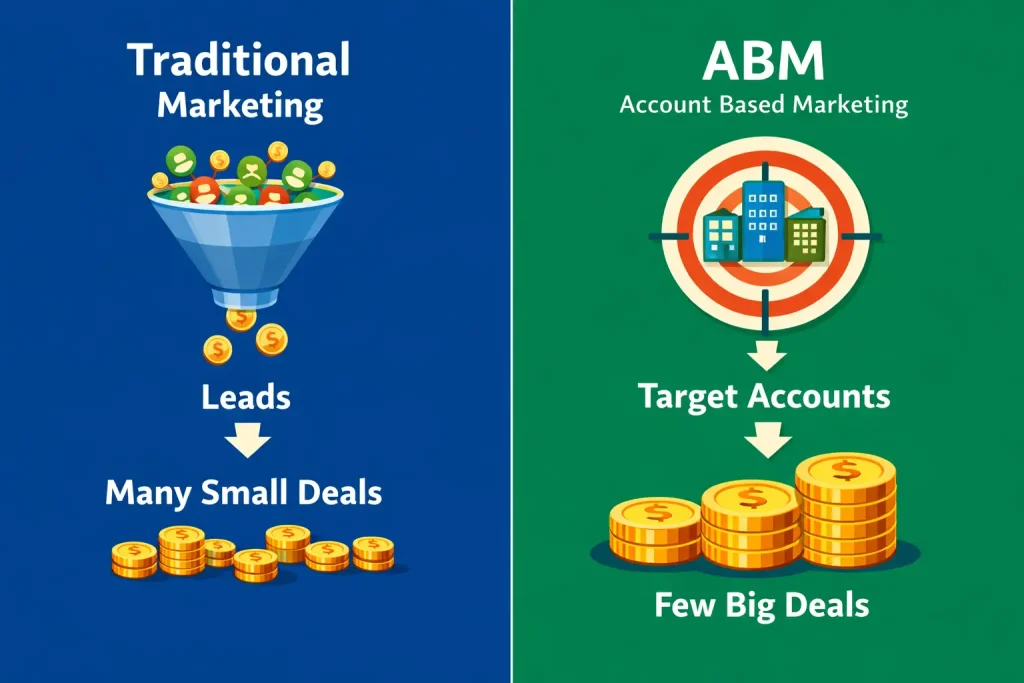
Traditional marketing works like a funnel.
You attract many people → some become leads → a few become customers.
ABM reverses that process.
You identify future customers first → then engage them → then close deals.
Here’s a simple comparison:
| Traditional Marketing | Account Based Marketing |
| Focus on lead volume | Focus on account quality |
| Many prospects | Specific companies |
| Funnel approach | Relationship approach |
| Marketing first, sales later | Sales + marketing together |
| Anonymous website visitors | Known target companies |
In traditional B2B marketing, success means more leads.
In ABM, success means winning the right customers.
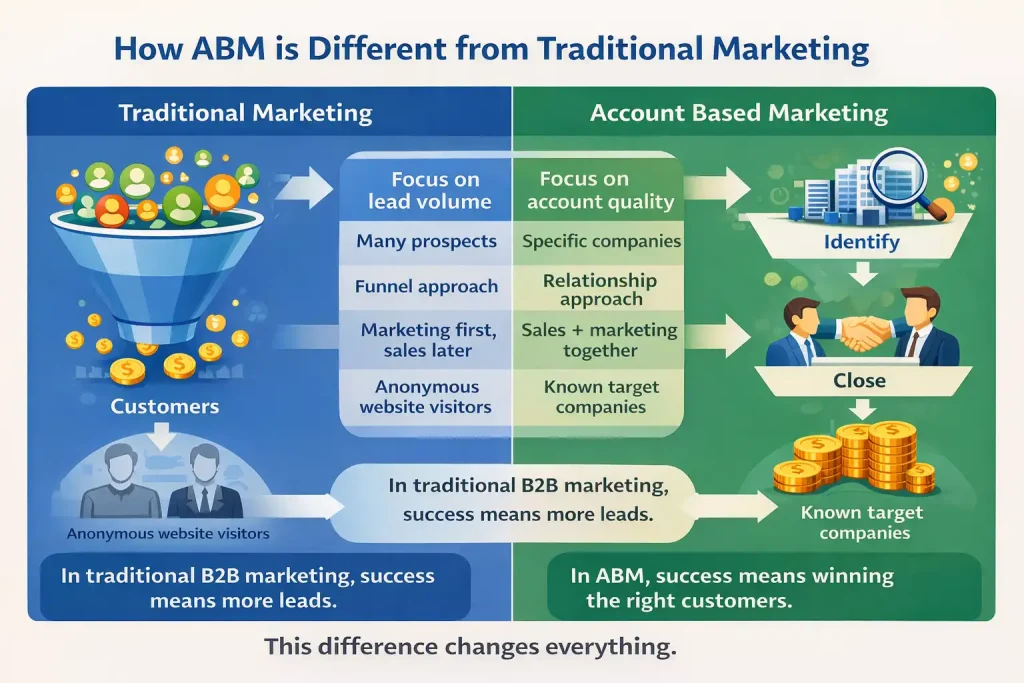
This difference changes everything.
Why Account Based Marketing Became Popular
Account Based Marketing didn’t suddenly appear.
It became popular because B2B buying behavior completely changed.
1. Companies don’t buy — committees do
Years ago, one manager could decide and purchase software.
Today that almost never happens.
A typical B2B purchase now involves:
- department head
- finance
- operations
- technical team
- management
On average, around 6 or more stakeholders influence a single buying decision. To keep these stakeholders aligned during long evaluation processes, many organizations rely on internal collaboration platforms such as a social intranet, where teams can share documents, discuss solutions, and coordinate purchasing decisions across departments.

This group is called a buying group (or demand unit).
Traditional lead generation targets one person.
But one person cannot approve a company purchase anymore.
That is the first reason ABM grew.
2. Inbound marketing alone stopped working
For years, B2B marketing relied on:
- blogs
- SEO
- ebooks
- webinars
The idea was simple:
Bring traffic → collect leads → send to sales.
The problem?
Most of those leads were never serious buyers.
Many were:
- students
- competitors
- early researchers
- people without authority
Marketing teams generated leads.
Sales teams complained about lead quality.
This created a gap between marketing and sales.
Account Based Marketing was created to fix that gap.
3. Customer acquisition cost (CAC) increased
SaaS companies especially noticed this.
Running ads became expensive.
SEO became competitive.
Cold emails became crowded.
Companies were spending more money to get the same customers.
So businesses changed thinking:
Instead of spending money to reach everyone,
why not spend effort only on the companies that matter?
ABM is essentially a focus strategy for rising acquisition costs.
4. The dark funnel
Today buyers do heavy research before talking to a company.
They:
- read reviews
- ask peers
- watch YouTube
- read communities
- compare tools privately
This research happens outside your analytics.
This is called the dark funnel.
By the time a buyer fills a form, they often already made a decision shortlist.
Lead generation sees buyers late.
Account Based Marketing engages them early.
5. Intent data changed marketing
Modern tools can detect when companies are researching a solution online.
For example:
If several employees from one company are reading articles about CRM software, they are likely planning a purchase.
This is called intent data.
ABM uses intent signals to approach companies when they are ready — not randomly.
What does this all means
Traditional B2B marketing assumed:
Buyers discover vendors.
Modern B2B reality:
Buyers research privately and vendors must proactively engage.
Account Based Marketing exists because it matches how companies now buy — not how marketers wish they bought.
How Account Based Marketing Works (Step-by-Step Flow)
Many people think Account Based Marketing is just sending personalized emails to a few companies.
It’s not.
ABM is actually a coordinated system where marketing and sales operate together around a specific set of companies. Instead of a marketing funnel, think of it as a relationship cycle.
A funnel assumes strangers become customers.
ABM assumes customers are already identified, you now build trust until they are ready to buy.
Let’s walk through the real Account Based Marketing engine.

Step 1 — Identify Target Accounts
This is where Account Based Marketing starts.
You do not begin with traffic.
You begin with a list of companies.
You choose organizations that:
- can afford your product
- actually need it
- match your best customers
This group is your Ideal Customer Profile (ICP).
Instead of 10,000 random leads, you may only select 100 companies.
But these 100 companies could represent 80% of your future revenue.
Step 2 — Research Stakeholders (Buying Committee)
Here is where ABM becomes different from normal outreach.
You are not targeting a single contact.
You are targeting the buying group.
Inside one company, different people care about different things:
- A CEO cares about growth
- A finance head cares about cost
- A manager cares about workflow
- A user cares about ease of use
- IT cares about implementation
If you only contact one person, your deal can die internally.
So Account Based Marketing maps stakeholders:
- decision maker
- influencer
- technical approver
- champion
- gatekeeper
This is called multithreading — building relationships with multiple people inside one account.
Step 3 — Personalize Messaging
Now comes the most misunderstood part.
Personalization does not mean adding their name.
Real ABM personalization happens at three levels:
- Industry personalization
(“Companies in logistics often struggle with…”) - Company personalization
(“Your company recently expanded to new regions…”) - Individual personalization
(“I saw your team is hiring SDRs…”)
The goal is simple:
The message should feel relevant to their situation, not like a broadcast.
Step 4 — Multi-Channel Outreach
ABM never relies on one channel.
Instead of one email campaign, companies combine touchpoints:
- LinkedIn messages
- email outreach
- ads
- content
- webinars
- direct mail
- phone conversations
Why?
Because B2B decisions take time.
People need familiarity before trust.
A person might:
see your post → then see an ad → then receive an email → then attend a webinar → then reply.
Account Based Marketing intentionally creates these multiple interactions.
Step 5 — Sales + Marketing Alignment
This is actually the core of ABM.
In traditional marketing:
Marketing generates leads → passes to sales.
In Account Based Marketing:
Marketing and sales work on the same accounts together.
Marketing warms the account.
Sales builds relationships.
They share:
- account lists
- messaging
- feedback
- objections
ABM works mainly because this marketing alignment finally removes the classic conflict between sales and marketing teams.
Step 6 — Deal Nurturing
ABM does not push immediate demos to everyone.
Remember, most buyers are not ready immediately.
Instead, companies nurture accounts through:
- educational content
- case studies
- comparison guides
- discussions
- problem-focused conversations
The goal is to help the company reach internal agreement.
You are not just convincing one person.
You are helping the whole organization become comfortable with change.
Step 7 — Expansion & Retention
This is a major reason ABM produces strong ROI.
ABM doesn’t end after the sale.
Once a company becomes a customer:
- more departments can adopt the product
- upgrades happen
- renewals improve
- referrals occur
So ABM is not a lead generation system.
It is a customer lifetime value strategy.
Account Based Marketing is NOT a funnel
Traditional funnel:
Traffic → Leads → Deals
ABM cycle:
Target → Engage → Build trust → Consensus → Deal → Expand
It behaves more like a relationship than a campaign.
Types of Account Based Marketing
Google expects this section because ABM is usually divided into three models. Each serves a different level of deal size.
1-to-1 Account Based Marketing (Strategic ABM)
This is the highest-touch approach.
You may target:
- 10 companies
- or even 5
Each account gets custom research and tailored messaging.
Activities include:
- custom presentations
- dedicated outreach
- executive conversations
- tailored proposals
Used for:
Enterprise contracts, large SaaS deals, consulting projects.
This is basically enterprise sales supported by marketing.
1-to-Few ABM
Here you group similar companies together.
Example:
Instead of targeting one hospital, you target a cluster of mid-size healthcare companies.
Messaging is customized by industry, not individual company.
Typical actions:
- industry-specific webinars
- vertical case studies
- targeted ads
This balances scale and personalization.
1-to-Many ABM (Programmatic ABM)
This is the scalable version.
You still target specific accounts, but automation helps.
Companies use:
- targeted ads
- automated outreach
- dynamic content
- segmented messaging
Personalization exists, but not fully manual.
This is common for SaaS companies selling mid-ticket products.
Quick comparison
| Type | Accounts | Personalization | Deal size |
| 1-to-1 | Very few | Very high | Enterprise |
| 1-to-Few | Small groups | Moderate | Mid-market |
| 1-to-Many | Large lists | Automated | Scalable SaaS |
Who Should Use Account Based Marketing (and Who Should NOT)
Account Based Marketing is powerful, but only when the business model fits.
Ideal for:
SaaS companies
Long sales cycles and multiple decision makers make ABM very effective.
B2B agencies
Winning a few large clients is more valuable than many small ones.
Consulting firms
Relationships and trust matter more than volume leads.
IT services & software providers
Technical purchases require internal approval and evaluation.
High-ticket services
If one client equals large revenue, ABM works.
Not ideal for:
eCommerce stores
You need thousands of buyers, not a few companies.
Low-price products
The effort of ABM exceeds the value of each sale.
Mass consumer brands
ABM focuses on organizations, not individuals.
Impulse purchase products
ABM works for considered decisions, not quick buying.
The rule is simple:
If your business depends on quality customers, use ABM.
If your business depends on volume customers, don’t.
Benefits of Account Based Marketing
Many articles just say “ABM gives higher ROI” and stop there.
But the real question is why it gives higher ROI.
ABM works better not because it is new.
It works because it matches how B2B companies actually make decisions.
Let’s break the benefits properly.
1. Higher ROI
Traditional lead generation focuses on quantity.
You run ads → collect leads → most leads never buy.
In Account Based Marketing,
you start with companies that already fit your customer profile.
So your marketing effort goes only toward realistic buyers.
Instead of:
1000 leads → 5 customers
You get:
20 accounts → 5 customers
You spend less on wasted attention and more on real opportunities.
That alone increases marketing efficiency.
2. Larger Deal Size
Account Based Marketing targets companies, not individuals.
When a company adopts a solution:
- multiple users join
- multiple departments adopt
- contracts become bigger
This increases average contract value.
Traditional lead gen often closes small deals because individuals sign up.
ABM closes organizational deals.
3. Shorter Sales Cycle
This part surprises many people.
ABM feels slower, but deals often close faster.
Why?
Because you engage the buying group early.
In traditional sales:
You talk to one person → later finance rejects → deal resets.
In Account Based Marketing:
Finance, management, and users are already informed.
Less internal friction = faster agreement.
4. Better Customer Retention
ABM builds relationships before the sale.
That changes the type of customer you get.
Instead of:
a buyer testing your product
You get:
a company that chose you intentionally.
These customers:
- renew more often
- expand usage
- stay longer
Retention increases because expectations were aligned before purchase.
5. Sales and Marketing Alignment
One of the biggest problems in B2B companies is this:
Marketing says: “We generated leads.”
Sales says: “They are not good leads.”
ABM removes that conflict.
Both teams work on the same accounts.
Marketing helps warm conversations.
Sales helps close opportunities.
Instead of handoff, they collaborate.
6. Predictable Pipeline
Lead generation is unpredictable.
Some months bring many leads.
Some months bring none.
ABM creates a controlled pipeline because you always know:
- who you are targeting
- how many accounts exist
- how many are engaged
It becomes closer to account management than marketing campaigns.
Account Based Marketing Strategy (2026 Framework)
Now we move into the actual implementation.
This is the practical system companies use to run ABM today.

Step 1 — Define Your ICP (Ideal Customer Profile)
This is the most important step.
Account Based Marketing fails mostly because companies skip this.
Your ICP is not just industry.
It includes:
Firmographics
- company size
- revenue
- location
- growth stage
Technographics
- tools they use
- software stack
- infrastructure
Pain points
- operational problems
- growth challenges
- inefficiencies
You are basically answering:
“Which companies benefit the most if they buy from us?”
Those are your targets.
Step 2 — Build Target Account List
Now you actually create the company list.
Sources typically include:
- LinkedIn research
- website visitor companies
- industry directories
- intent data signals
Instead of waiting for visitors, you proactively identify companies showing interest in your category.
The output of this step is a named account list.
This is the foundation of ABM.
Step 3 — Map the Buying Committee
Inside each account, you find the people involved.
Usually includes:
- Decision maker (approves purchase)
- Influencer (recommends solution)
- Champion (supports internally)
- Technical evaluator
- Gatekeeper (controls access)
If you only talk to one contact, your deal becomes fragile.
ABM tries to build multiple relationships so internal discussions don’t kill the opportunity.
Step 4 — Personalization Layer
This is where ABM becomes powerful.
You tailor communication based on relevance.
There are levels:
Industry level
Example: messaging specific to healthcare companies
Company level
Reference company initiatives, hiring, expansion, or public updates
Person level
Role-specific concerns (CFO cares about cost, CTO cares about integration)
The goal is simple:
Your message should answer
“Why should this company care about this solution right now?”
Step 5 — Outreach Channels
Account Based Marketing does not rely on one method.
It combines multiple approaches:
- Email conversations
- LinkedIn outreach
- Ads
- Phone discussions
- Educational content
- webinars
- website experiences
Why multi-channel?
Because B2B buyers need repeated exposure before engagement.
Familiarity creates comfort, and comfort leads to conversation.
Relationship Cycle Reminder
Important point:
ABM is not about forcing meetings.
It is about enabling buying decisions.
You educate → build trust → help consensus → close deal.
You are guiding a decision, not pushing a sale.
Account Based Marketing Channels Explained
Many blogs talk about ABM strategy but never explain the channels properly.
Account Based Marketing is not a single tactic. It is a coordinated use of multiple channels aimed at the same accounts.
Let’s break them down clearly.

1. LinkedIn Account Based Marketing
LinkedIn is one of the most powerful platforms for ABM because:
- You can target by company name.
- You can target by job title.
- You can reach decision makers directly.
- It is built for professional conversations.
In ABM, LinkedIn is used for:
- Connecting with stakeholders
- Sending direct messages
- Running targeted ads to specific companies
- Sharing industry-specific thought leadership
For example, if you are targeting 50 SaaS companies, you can run LinkedIn ads visible only to employees of those 50 companies.
That is not broad advertising. That is precision marketing.
2. Email ABM
Email is still extremely important in B2B.
But ABM email is different from bulk cold email.
Instead of sending 10,000 identical emails, you send carefully crafted emails to specific stakeholders.
The goal is not to push a meeting immediately.
The goal is to start a conversation.
For example:
Instead of saying:
“Can we schedule 15 minutes?”
You might ask:
“Are you currently facing challenges with X?”
Email becomes a dialogue channel, not a broadcast tool.
3. Cold Outreach Account Based Marketing
Cold outreach still works, but only when relevant.
ABM outreach focuses on:
- specific accounts
- researched stakeholders
- personalized value
It may include:
- cold email
- cold calling
- LinkedIn messages
The difference is the preparation behind it.
You are not contacting strangers randomly.
You are contacting pre-selected companies that fit your ICP.
4. Content Marketing ABM
Content in ABM is not generic blogging.
It is targeted content designed for specific buying groups.
Examples:
- Industry-specific case studies
- ROI calculators
- comparison guides
- technical briefs
- thought leadership reports
Content is often shared directly with target accounts rather than waiting for organic traffic.
5. Retargeting Ads
Retargeting plays a strong role in ABM.
Once someone from a target account visits your site or engages with content, you can show them ads.
These ads:
- reinforce your brand
- address objections
- highlight case studies
This increases familiarity and trust over time.
6. Website Personalization
Some companies personalize website content based on company IP.
For example:
If a visitor from a logistics company arrives, the homepage may show logistics case studies.
This makes the experience feel tailored instead of generic.
Account Based Marketing Tools & Software
ABM requires coordination. Tools help manage that.
We’ll break tools into categories instead of listing random names.
1. Prospecting & Data Tools
These tools help you build your target account list and find stakeholders.
Used for:
- identifying companies
- finding emails
- detecting intent signals
Examples include:
data platforms, sales intelligence tools, and LinkedIn research tools.
The goal is accuracy.
Without a clean list, ABM cannot start.
2. Outreach Tools
These tools manage multi-step communication.
They allow:
- email sequences
- LinkedIn steps
- follow-ups
- personalization at scale
For example, an outreach workflow may look like:
Day 1 — Email
Day 3 — LinkedIn profile visit
Day 5 — Follow-up email
Day 8 — LinkedIn message
The system tracks replies and engagement.
The important part is not automation itself.
It is managing structured communication with selected accounts.
3. Personalization Tools
These tools help tailor messaging and content.
Used for:
- personalized landing pages
- dynamic website text
- account-specific ads
Personalization increases relevance, which increases response.
4. Analytics & Attribution Tools
ABM success is not measured by open rates alone.
You need tools that track:
- account engagement
- stakeholder interaction
- opportunity creation
- deal progression
ABM measurement focuses on accounts, not individual leads.
Account Based Marketing Best Practices (2026 Edition)
ABM in 2026 is more advanced than it was five years ago.
Here are modern best practices companies follow.
1. Use Intent Signals
Instead of random outreach, look for buying signals.
Examples:
- increased website visits
- content downloads
- category research activity
- trigger events like funding or expansion
Outreach should be signal-based, not volume-based.
2. Warm Outbound > Cold Outbound
Before direct outreach, many companies warm accounts with:
- ads
- content
- LinkedIn engagement
When outreach happens, the company is already familiar with your name.
This improves reply rates.
3. Multithreading
Never rely on one contact.
Build relationships across multiple stakeholders inside the same company.
Deals rarely close because of one person alone.
4. Sales & Marketing SLA
ABM works only if marketing and sales agree on:
- target account list
- messaging
- engagement process
- follow-up timelines
Without alignment, ABM turns into disconnected efforts.
5. Personalization with Research
Automation helps scale, but research drives relevance.
Even light research on:
- recent company news
- hiring activity
- funding announcements
can dramatically improve engagement.
Real Account Based Marketing Examples
Theory helps.
Examples make it clear.
Below are three simple real-world style ABM scenarios so you understand how it actually works.
Example 1 — SaaS Company
Target: Mid-size logistics companies
Problem: Manual sales outreach was not converting
Approach:
The company created a list of 200 logistics businesses.
They identified decision makers: Head of Sales, Revenue Ops, and Marketing Directors.
Channels Used:
- LinkedIn connection requests
- Personalized emails
- Industry case studies
- Retargeting ads
What they did differently:
Instead of pitching software, they sent a short report about “Why logistics companies lose B2B deals due to slow follow-ups.”
No demo link.
Just insight.
Result:
Conversations started.
Meetings increased.
Deal sizes were larger because executives got involved early.
Example 2 — B2B Agency
Target: SaaS startups with 20–100 employees
Approach:
The agency researched funding announcements and new product launches.
Whenever a company raised funding, outreach started.
Channels:
- Personalized cold emails
- LinkedIn engagement
- Website audit video sent to founders
Message Example:
Instead of “we offer marketing services,” they sent:
“We reviewed your website onboarding and noticed 3 conversion leaks.”
Result:
Higher response rates because the outreach was helpful, not promotional.
Example 3 — IT Service Provider
Target: Manufacturing companies
Approach:
They mapped the buying committee:
- CIO
- Operations Manager
- Finance Director
Channels:
- Direct mail package
- Follow-up call
- LinkedIn ads only shown to that company
Key idea:
Multiple stakeholders saw the brand repeatedly.
Result:
Trust built faster → shorter sales cycle.
ABM Metrics You Must Track
This is where many companies fail.
They track email open rate.
ABM is not about email performance.
It is about account progress.
We track metrics in three layers.
1. Engagement Metrics
Measures: Are accounts interacting?
Track:
- account engagement score
- replies from stakeholders
- meeting rate
- content consumption
Important insight:
If only one person engages, the deal is weak.
If multiple stakeholders engage, the deal becomes real.
2. Pipeline Metrics
Measures: Is revenue forming?
Track:
- opportunities created
- pipeline value
- deal velocity (how fast deals move)
ABM success shows up here, not in click rates.
3. Revenue Metrics
Measures: Real business impact
Track:
- average deal size
- win rate
- expansion revenue
- customer retention
ABM usually increases deal size because higher-level decision makers get involved.
Cost of Account Based Marketing & ROI
Many companies hesitate because ABM seems expensive.
Let’s break the cost.
Costs involved:
- data & research tools
- ads
- outreach tools
- time spent on research
- content creation
Yes, ABM costs more per account.
But here is the key:
Traditional marketing → many cheap leads
ABM → fewer but valuable customers
Lead generation may give 500 leads and 3 customers.
ABM may give 30 accounts and 8 customers.
So the cost per deal becomes lower.
ABM is expensive upfront, cheaper long term.
Common Account Based Marketing Mistakes
This section is important because most ABM programs fail here.
1. Targeting Too Many Accounts
ABM is not mass marketing.
If you target 5,000 companies, you are not doing ABM anymore.
Start small.
2. No Sales Alignment
Marketing running ads
Sales doing cold calls
No coordination
This breaks ABM immediately.
3. Fake Personalization
Using only first name:
“Hi John”
That is not personalization.
Real personalization means understanding the company’s situation.
4. Using Only Ads
ABM cannot run on ads alone.
It requires:
ads + email + sales outreach + content.
5. Treating ABM as Lead Generation
Biggest mistake.
ABM is a relationship strategy, not a lead capture form.
Future of Account Based Marketing (2026–2030)
Account Based Marketing is evolving fast.
Here is what is changing.
AI Personalization
Messages will adapt automatically to company context.
Intent-Based Outreach
Outreach will trigger based on buyer behavior signals.
Predictive Pipeline
Companies will predict which accounts will buy months earlier.
Signal-Based Selling
Instead of cold outreach, companies will react to signals like:
- hiring
- funding
- technology changes
Buyer Group Intelligence
Tools will track entire buying committees, not just individuals.
ABM is moving from outreach → intelligence.
Frequently Asked Questions (FAQ)
Is ABM inbound or outbound?
Both. It combines inbound awareness with outbound conversations.
Is ABM only for enterprise companies?
No. Mid-market B2B companies benefit a lot from ABM.
How long does ABM take to work?
Usually 3–6 months. It is slower to start but stronger long term.
Is Account Based Marketing expensive?
Higher upfront effort, but lower cost per customer.
ABM vs demand generation?
Demand gen captures interest.
ABM creates relationships.
Conclusion + 30-Day Action Plan
You do not need a huge team to start.
Follow this simple checklist.
Week 1 — Define
- Create Ideal Customer Profile
- Choose one industry
- Select 50 target accounts
Week 2 — Research
- Identify decision makers
- Study company problems
- Prepare tailored messaging
Week 3 — Outreach Setup
- LinkedIn connects
- personalized emails
- targeted content
Week 4 — Engagement
- follow-ups
- share insights
- schedule conversations
Important:
Do not pitch immediately.
Start conversations.
Final Thought
Account Based Marketing works because B2B buying changed.
People do not buy software or services instantly.
Companies decide together.
Account Based Marketing aligns with how businesses actually make decisions.
You stop chasing leads.
You start building customers.
And that is why ABM is becoming the core B2B growth strategy in 2026. Visit Jarvis Reach for more helpful insights and to get the most of every topic!