Beyond Batch Campaigns: Real-Time Lifecycle Braze Marketing
For years, we treated customers like a queue: collect, segment, wait, and send. That model worked when data moved in hours, and expectations moved slowly.
Today, intent is a flicker, an app tap, a cart add, a product page scroll, and the moment to act is often seconds long.
Braze marketing automation is the architecture that treats those seconds as opportunities. It replaces laggy batch syncs with streaming signals, and static drips with living journeys that react in real time.
This article shows how to move from schedule-first campaigns to behavior-first lifecycle systems that actually match human attention.
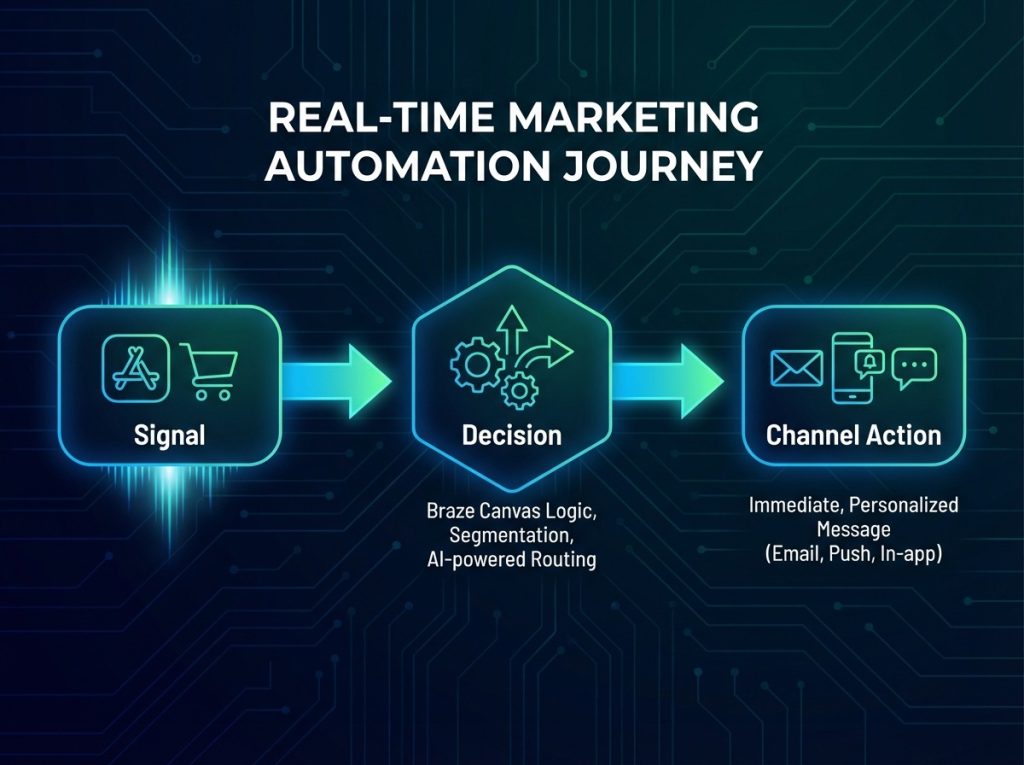
Source: Google Gemini Pro
Let’s cut to the chase and learn how you can build a real-time lifecycle with Braze marketing automation.
The architecture of “now”: Streaming data vs. batch processing
Legacy platforms built for batch thinking: extract, transform, load, then send. That’s fine for weekly newsletters, disastrous for intent-driven moments. When your segment updates every few hours, you miss the micro-moments where conversion probability spikes.
Streaming architecture flips that. Events flow into the system in near-real time, segments update instantly, and journeys trigger milliseconds after the signal. Braze is designed for this: SDK events, Currents-style streaming, decision splits, and immediate segmenting, a pipeline that treats users like people, not rows.
The practical result is simple: relevance delivered when it matters. A user who views pricing twice in 30 minutes can see a timely push or an email without waiting for tomorrow’s export. That responsiveness reduces wasted sends, raises conversion rates, and preserves brand trust.
Four pillars of a real-time Braze lifecycle strategy
Build for intent. Respect frequency. Measure impact.
Here are four pillars that constitute lifecycle Braze marketing in real-time.
1. Journey orchestration with Braze Canvas
Canvas is not a campaign builder. It’s a choreography studio. Design multi-node journeys, route users with Decision Splits, and run Experiment Paths to let the system learn which path wins.
Think in flows, not emails: one journey contains emails, push, SMS, in-app, and webhooks that execute as the customer moves.
Here is the practical play. Model a “cart intent” canvas that escalates messaging by channel and applies frequency caps. Run an experiment path that tests urgency messaging vs. value messaging and let Canvas pick the winner.
2. API-driven dynamic personalization
Personalization must be live, not pre-baked. Use Liquid plus Connected Content to pull inventory, pricing, or session context just before send.
This turns every message into a micro-call: “You looked at X; here’s the live price and the stock level.”
Real-time API calls avoid stale content and reduce the need for heavy template engineering. They also let teams create modular templates that combine safety (fallbacks) with freshness (live data).
3. Connected cross-channel coordination
Customers don’t live in one channel. Journeys shouldn’t either. Braze Marketing unifies email, push, SMS, and in-app to ensure the next touch respects recent contact and channel affinity.
Frequency capping and channel arbitration protect the experience and keep messaging contextual.
Pro tip: Use the most responsive channel for the user, then escalate only if the initial touchpoint doesn’t convert. This reduces fatigue and preserves deliverability while increasing the chance of conversion.
4. AI-powered decisioning
Static IF/ELSE trees drown in edge cases. AI lets you score, rank, and select modules per user.
- Use Intelligent Channel and Intelligent Timing to route messages where they perform best.
- Use Intelligent Selection to bias volume toward top-performing variants without manual shuffle.
Importantly, keep human guardrails: tone constraints, suppression rules, and audit logs. AI optimizes; humans define brand, privacy, and ethical boundaries.

Source: Google Gemini Pro
Proven ROI: Real-world lifecycle success stories
Proof matters. Braze clients show tangible lifts when they adopt real-time lifecycles.
Fiverr used Canvas and Intelligent Timing to tune cross-channel journeys. They tested timing, channel, and content and saw a 21% increase in campaign revenue and a 10% lift in average order value.
The win came from moving messages into the user’s active window rather than blasting them the next morning.
Blacklane moved from batch campaigns to a personalized lifecycle model. By layering real-time signals and adaptive routing, they achieved a 94% increase in revenue and a nearly 200% uplift in lifecycle conversion.
The key was orchestration, not creativity, with coordinated touches that matched intent.
Now, it’s time to put these ideas into action with a proper workflow and a clear process.
4 T’s of Braze implementation roadmap
Here is a quick and effective implementation roadmap in Braze that will take you beyond band campaigns.
1. Target – define the micro-moments you care about.
Map the signals that indicate intent: product view frequency, pricing page depth, checkout friction. Keep targets narrow and measurable.
2. Trigger – capture and act on events in milliseconds.
Use SDK events, server calls, or API triggers. Prefer real-time segment evaluation over nightly exports. Align trigger windows with product behavior (e.g., 10–30 minutes for cart intent).
3. Template – build modular, resilient templates.
Use Liquid conditional blocks and Connected Content to render product cards, offers, or fallback copy at send-time. Lock layout, allow content fields, and enforce accessibility and size constraints to preserve deliverability.
4. Track – instrument for causality.
Define success metrics: conversion within X hours, revenue per treated user, opt-out lift. Run randomized holdouts to measure incrementality and capture which channel and creative variant worked.
So, as your real-time lifecycle Baze marketing strategy grows, it may become more complex. And that would make it difficult to implement proper checks and balances.
Governance, safety, and scale in lifecycle baze marketing
Real-time power needs governance. Enforce suppression lists, rate limits, and consent-first data usage. Schedule model reviews, monitor drift, and keep human override paths.
Scale means standardization: shared template libraries, naming conventions, and incident runbooks. That makes on-call fixes predictable and keeps customer experience consistent across teams.
So, let’s recap the core message and next steps.
Wrapping up
That brings us to the business end of this article, where it’s fair to say that you need to act in seconds, not days
Batch campaigns are a legacy choice in a world that rewards immediacy. Braze marketing automation gives you the plumbing to act when intent happens and the tools to orchestrate journeys that respect customers and scale revenue.
Start small. Pick the single high-intent journey that most impacts revenue, instrument a holdout, and run a two-week experiment. If revenue rises, you’ve found the leverage point, then scale the system, not the chaos.
The ball is in your yard now. Make every effort count.