Buyer intent data is web behavioral data that indicates an individual’s or company’s interest and prospective desire to buy something. It is collected from both first-party data (your own site) and third-party data (other sites) sources and consists of activities like keyword research, site visits, white paper downloads, and social media. Marketers and sales use this information to grasp buyer intent data, recognize researchers who are prospects, and customize their approach efforts in order to get better engagement and greater ROI. The ability to analyze buyer intent data effectively has become a cornerstone for modern b2b sales teams aiming to boost conversion rates and ROI. Modern lead generation tools increasingly rely on intent data to identify high-quality prospects earlier in the buying journey.
Why does intent data matter for modern b2b sales and marketing?
Buyer intent data is relevant in contemporary B2B sales and marketing because it pins down accounts that are actually exploring solution possibilities so that engagement is more focused, personalized, and effective, with shorter sales cycles and higher conversion. Through customer data behavioral insights, intent data allows sales and marketing professionals to target high-intent leads, personally engage in contact, customize content, and get competitor landscape insights in order to build alignment and grow revenue quickly. By leveraging intent data alongside engagement data, marketing teams can sharpen audience targeting for maximum effect. When combined with advanced lead generation tools, teams can significantly improve how they identify and reach high-buying-intent accounts.
Types of Data That Power Sales Teams
Sales teams thrive when they know not just who their buyers are, but what they want, how they behave, and when they’re ready to act.
First-party vs third-party data
First-party intent data is data collected directly by an organization regarding how a prospect or customer engages with their own digital touchpoints, including sites, applications, and emails. This b2b sales intent data is direct feedback on a user’s interests and requirements, hence very accurate, trustworthy, and privacy-friendly, as it is directly from their interaction with your company. Examples include page visits, downloads of content, form submissions, and click-throughs on emails. Best b2b sales teams know how to combine first-party data with external insights for a competitive edge. These insights become even more powerful when synced into lead generation tools that automate qualification and prioritization.
Third-party intent data are composed of the web activity and interests of large aggregates of people that are collected through any number of channels, including message boards, websites, and social networks, from third-party data suppliers. These data empower teams to discover b2b sales opportunities from prospects who have never visited their website, thus expanding their reach significantly. The third-party data that is collected reveals information on market patterns as well as prospective opportunities that have never been attended to on the company’s own website, so that companies can better recognize the opportunities in targeting campaigns and advertising more effectively.
Buyer Intent Data Sources
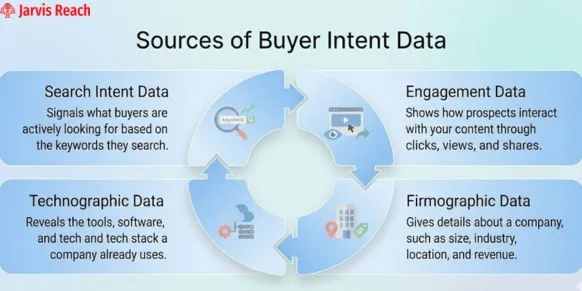
Search Intent Data, Engagement data, firmographic data, and technographic data
There are four types of sources of buyer intent data:
1. Search intent data
This information is gathered when someone who may be interested in buying from you enters a keyword or term on a search engine such as Google. You can apply search intent information to discover what your target audience is actually searching for, allowing sales and marketing to tailor timely responses.
For instance, if you sell b2b sales intelligence software, you can find companies exploring “How can I automate prospecting?” signaling buyer intent early. Search intent signals plug seamlessly into lead generation tools, helping teams identify prospects sooner than traditional methods.
2. Engagement data metrics
This information is related to the prospective buyer’s interaction with certain pieces of content that include activities like reading, sharing, or commenting. Engagement data is gathered through lead source channels like your website, blog, or Facebook or Twitter. In b2b sales, it is crucial to monitor engagement data such as shares in dark social media, which are otherwise challenging to track. When analyzed through lead generation tools, engagement data becomes a powerful predictor of purchase readiness.
3. Firmographic data
This is data regarding a possible company. The company size, geography, industry, and revenue are included in the firmographic data. The data is usually acquired from business directories, web forms, and from the B2B sales data suppliers.
A better idea is to combine ABM with firmographic data so that you can target companies strategically with the highest chance of conversion. Lead generation tools use firmographic filters to help teams zero in on their ideal customer profiles.
4. Technographic data
Technographic data includes the software, hardware, and networks within an organisation. They are often obtained using polls, questionnaires, and surveys. These offer you more insight into the technical capabilities and needs of a target organisation. When synced into lead generation tools, technographic data enables tailored outreach based on real tech-stack insights.
The role of customer data in shaping outreach
Customer data powers outreach through the potential for personalization, segmentation, and timing, permitting more effective engagement, high conversion, and enhanced customer data affinity. Through the analysis of preference, pain, and behavior, businesses may tailor messaging that will resonate with chosen audiences, communicate at the ultimate time via the chosen medium, and craft relevant propositions that meet customer data needs and deliver value. Through this data-driven methodology, businesses transition from leveraging generic campaigns to engender more substantive customer data associations.
Major Means through which Customer Information Defines Outreach:
– Hyper Personalization
Customer data insight will enable tailored contact through the comprehension of personal taste, behavior, and points of pain. Through this, companies will be in a position to create customized communications and offers that will be experienced as being comprehensively understood and respected.
– Audience Segmentation
The customer data is beneficial in dividing the customers into various groupings in terms of demographics, behavior, or preference. What that generates is the ability to offer more influential and relevant campaigns rather than information that is general.
– Best Time and Schedule
By analyzing customer data or contact data, businesses can determine the best timing and frequency of contact so as not to overstay but be top-of-mind.
How Buyer Intent Data Transforms B2B Sales
Buyer intent data revolutionizes B2B sales by bringing into focus the prospects that are actively exploring solution information so that the sales and marketing departments can target, select, and customize their approaches in order to achieve better conversion ratios and shorter selling cycles. By uncovering buyers in the “active buying journey,” enterprises can concentrate on high-fit prospects, minimize efforts in fronts that are uninterested, and get ahead of the competition through engagement with buyers at an earlier point.
Boosting sales prospecting efficiency
Buyer intent data enhances sales prospecting effectiveness by enabling businesses to identify and target high-potential prospects actively looking for solutions like theirs rather than wasting time on uninterested prospects. Through monitoring online buying and research activity signals, businesses can then use relevant messaging in their sales and marketing, enabling more effective engagement, shorter sales cycles, and better conversions. Through this strategy, the B2B sales team can pursue accounts with high potential for buying and thus match their resources more effectively as well as maximize ROI.
Helping B2B sales teams prioritize leads
Buyer intent data enables the sales professionals to prioritize lead routing through the identification of companies and people who are researching solutions online. The data may be applied by the B2B sales team in lead scoring with regard to purchasing readiness, focusing on high-fit opportunities, utilizing customized messaging in outreach, as well as target accounts that are definitely interested in their product or competitor offering. The consequence is streamlined sales, compressed sales cycle, as well as more conversions in terms of enabling the team to focus efforts more effectively on opportunities that close.
Aligning sales and marketing strategies
Buyer intent data synchronizes the marketing and sales through shared, real-time visibility into intent data behavior so that both can attract high-intent, in-market buyers, tailor the approach, maximize campaigns, and share objectives with the end result of enhancing conversion and efficiency. It closes the space between mass marketing campaigns and guesswork sales management, producing a data-driven, aligned method that works better.
Activating Buyer Intent Data in Your Sales Process
Virtual prospecting with buyer intent data can get you ahead of the others, with deeper insight into your marketplace and more context before cold calling. If you remain skeptical, here are some means in which sales and marketing can engage their intent data.
Sales prospecting with intent signals
Intent-based sales prospecting refers to the application of “buyer intent data” – indicators such as website visits, search terms, and social engagement – to find out who among your prospective customers is actually exploring the type of solution you provide. Through the aggregation and activation of the data, sales and marketing professionals can qualify leads, customize approaches, and match messaging with target buyer needs and points in the buying process, driving conversion more effectively by hitting the target at the greatest advantage point.
Building stronger B2B sales pipelines
To build a stronger B2B sales pipeline through buyer intent data, you should first bring intent data into your CRM system, secondly concentrate and segment your leads around the research activity, and thirdly personalize your outreach with message- and content-targeted targeting. By doing this, B2B sales teams can focus on high-intent opportunities, shorten their selling cycles by landing the timing perfectly, increase conversion ratios, and achieve better return on investment in sales.
Improving engagement with target accounts
In order to boost target account engagement with intent data, blend intent signals with firmographic data in order to find high-potential accounts, and build customized, multi-channel campaigns with personalized content that aligns with their appropriate buyer journey phase. Concerted sales and marketing strategy, utilizing the intent data in order to time the outreach and measure account activity, allows timely, personalized engagement that boosts conversion ratios.
Evolving role of AI in B2B sales
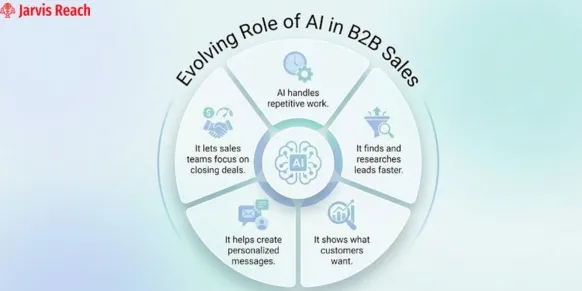
The role of AI in B2B sales is transforming from doing repeatable tasks to powering advanced, customized customer data experiences at scale. It optimizes operations by taking care of data-intensive tasks, automates lead research and development, and gives B2B sales teams a better understanding of customers. Combining AI, most notably generative AI, enables the use of personalized content and customized interactions, increasing customer data engagement, raising conversion rates, and giving sales professionals more time to concentrate on high-level relationship building and high-level deal-making.
FAQs
1. How to collect B2B intent data?
· Collect data on content consumption events and signals.
· Deanonymize, identify accounts or users.
· Analyze the content of the pages viewed by the user.
· Identify patterns and trends.
2. What is the 95-5 rule in B2B?
Understanding the long-lasting impression brand advertising makes is especially important in view of our research into the 95-5 rule, which shows that 95% of your potential buyers aren’t ready to buy today.
3. How to build a B2B sales strategy?
· Steps to a Successful B2B Sales Strategy:
· Choose What Kind of Strategy You Need.
· Determine whether your strategy is inbound or outbound.
· Get Sales and Marketing Working Together.
· Identify Your Leads, Qualify, and Nurture Them.
· Identify Key Activities.
3. What are the 7 P’s of B2B?
Create Valuable Content. The 7 P’s of B2B marketing are an integrated mix that consists of: Product, Price, Place, Promotion, People, Process, and Physical Evidence.
Final Thoughts
Buyer intent data highlights that it’s a competitive imperative for today’s businesses, not a choice, to help sales and marketing reach high-intent leads when they’re most likely to convert and deliver the best ROI. Utilizing this data, combined with the affection for AI-powered analysis, allows for proper lead prioritization, personalized marketing, and optimized sales cycles, providing a powerful advantage in today’s noisy B2B sales landscape. Spending money on buyer intent data is paramount to capitalizing on active demand, reducing wasted time, and driving significant revenue growth.