By Imran Syed, Founder and CEO of Jarvis Reach · Updated October 2026
The short answer: B2B sales is when one business sells to another. Deals are bigger and slower than consumer sales, and many people sign off on each one. In 2026 most teams use AI to help. Salesforce found that 87% of sales teams now use AI. Yet Ebsta and Pavilion found that 78% of sellers missed quota in their 2025 benchmarks. The teams that win pair AI with verified data and a human who checks the work.
Key takeaways
- AI is everywhere now. 87% of sales teams use AI and 54% have used AI agents (Salesforce, 2026).
- More AI does not mean more sales. Gartner predicts agents will outnumber sellers 10 to 1 by 2028. Fewer than 40% of sellers will say agents made them more productive.
- Buyers punish lazy outreach. 73% of B2B buyers avoid suppliers who send irrelevant messages (Gartner, 2025).
- Email deliverability rules are strict. Gmail, Yahoo and Outlook require SPF, DKIM and DMARC from anyone sending 5,000+ emails a day.
- Clean data is the edge. 79% of top B2B sales teams prioritise data hygiene, compared with 54% of underperformers.
- Existing customers are the easiest growth. Expansion deals have an 82% win rate compared with 19% for new logos (Ebsta and Pavilion, 2025).
What is B2B Sales?
B2B sales (business-to-business sales) means selling products or services from one business to another. The buyer is a company, not an individual consumer. A typical deal involves people from finance, operations and leadership. Forrester found that an average of 13 people take part in each B2B buying decision.
So B2B sales reps follow a structured process. Each step deals with risk, value and timing. The best B2B sales work is consultative. Sellers listen first and help the buyer frame a clear problem. Then they move each step forward with purpose.
B2B vs B2C sales: What’s the Difference?
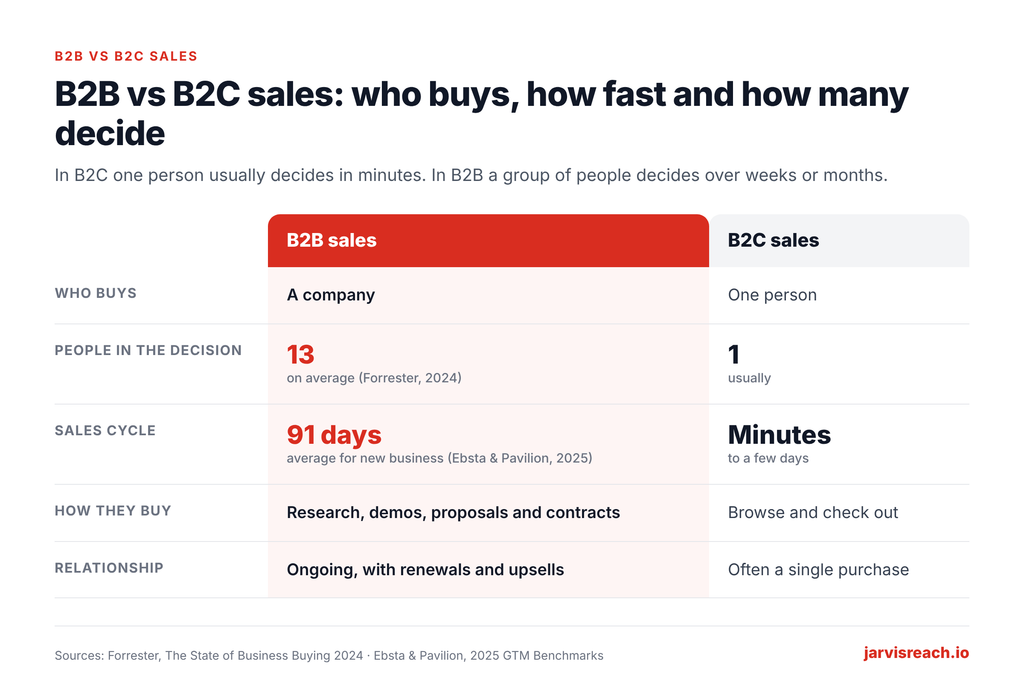
The main difference is who buys and how. In B2C one person usually decides in minutes. In B2B a group of people decides over weeks or months.
| B2B sales | B2C sales | |
| Who buys | A company | One person |
| People in the decision | 13 on average (Forrester, 2024) | Usually one |
| Sales cycle | 91 days on average for new business (Ebsta and Pavilion, 2025) | Minutes to days |
| How they buy | Research, demos, proposals and contracts | Browse and check out |
| Relationship | Ongoing, with renewals and upsells | Often a single purchase |
B2B Sales Strategies That Work in 2026
The six strategies that matter most come down to one idea: aim at the right accounts, reach the right people and let AI handle the groundwork while your reps do the selling.
- Build an ideal customer profile so you only chase accounts that fit.
- Use intent data to find the small share of accounts ready to buy now.
- Reach the whole buying group, not one contact.
- Verify every email before it reaches your sending tool.
- Let AI draft and research. Let people review and sell.
- Grow your existing customers. Expansion deals win far more often than new ones.
What is The B2B Sales Process? (and Where AI Fits)
AI fits best at the start and end of the B2B sales process, where the work is research, data and admin. People matter most in the middle, where deals depend on judgment, trust and negotiation. Most B2B deals move through eight stages. Here is who should own what at each one.
| Stage | What AI does | What the human does |
| 1. Prospecting | Finds accounts that match your ICP, pulls intent signals, finds contacts and verifies every email | Picks which accounts get personal attention and approves the final list |
| 2. Qualification | Scores leads on fit and activity and flags missing CRM fields | Confirms need, budget, timeline and who will decide |
| 3. Discovery | Preps account research, recent news and likely pain points before the call | Runs the call, asks follow-up questions and listens for what the buyer won’t put in an email |
| 4. Demo | Drafts a demo outline based on discovery notes | Tailors the demo to each stakeholder and handles live questions |
| 5. Proposal | Drafts the proposal from a template and pulls in relevant case studies | Owns pricing, scope and the business case |
| 6. Review | Tracks who has engaged and flags deals that have gone quiet | Handles objections, legal points and negotiation |
| 7. Close | Prepares contract paperwork and logs the outcome in the CRM | Confirms scope and builds trust with the decision-maker |
| 8. Onboarding | Sends welcome sequences, sets tasks and tracks early usage | Sets success goals with the customer and watches for expansion chances |
The pattern is simple. AI handles tasks with clear inputs and a clear right answer. People handle anything where a mistake costs trust.
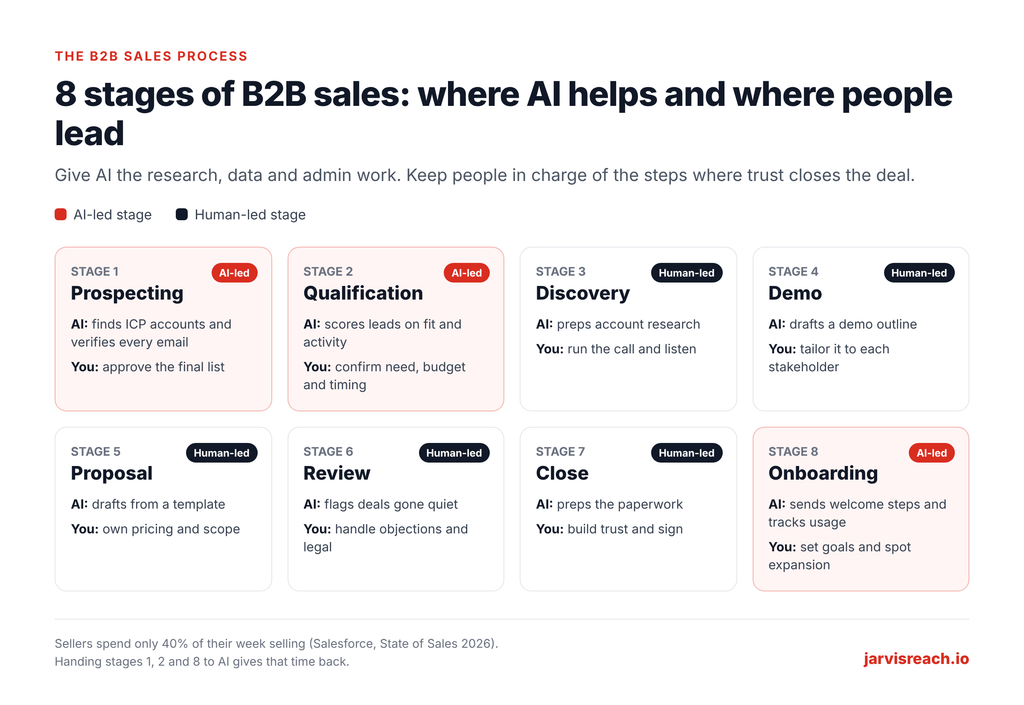
This matters because selling time is short. Salesforce found that reps spend only 40% of their week actually selling. Handing stages 1, 2 and 8 to AI gives that time back. Reps can then spend it in stages 3 to 7, where buying groups of 13 people need a human to build agreement.
How Many B2B Sales Teams Use AI in 2026?
Most of them. Salesforce surveyed 4,050 sales professionals in late 2025 for its 2026 State of Sales report. It found that 87% of B2B sales teams use some form of AI and 54% have already used AI agents. Nearly 9 in 10 plan to use agents by 2027. Using AI is now normal. Using it well is not.
| What Salesforce found (survey of Aug–Sep 2025) | Figure |
| Sales teams using some form of AI | 87% |
| Teams that have already used AI agents | 54% |
| Share of a seller’s week spent actually selling | 40% |
| Expected time saved on prospect research with agents | 34% |
| Expected time saved on drafting emails with agents | 36% |
| How much more likely top teams are to use prospecting agents | 1.7x |
So where does AI help today? Mostly in the boring work. It researches accounts. It drafts first emails. It updates the CRM so reps don’t have to. These are tasks with clear inputs and a clear right answer.
AI struggles when the job needs judgment or trust. A buyer can tell when a message was written for 5,000 people at once. And a tool that guesses at a contact’s email can damage your sending domain for months.
Gartner expects the number of tools to keep rising fast. In a July 2026 forecast it predicted that AI agents will outnumber sellers 10 to 1 by 2028. Yet fewer than 40% of sellers will say those agents made them more productive.
“AI agents should not be viewed as a shortcut to B2B sales productivity. They are only as effective as the systems they operate within.” — Dan Gottlieb, VP Analyst, Gartner Sales Practice (July 2026)”
Where is AI Failing in B2B Sales?
AI fails most often when teams use it to send more messages instead of better ones. A 2025 Gartner survey of 632 B2B buyers found that 73% actively avoid suppliers who send irrelevant outreach. AI makes irrelevant outreach cheap. That is the trap.
Here are the four failures we see most often.
- Generic AI emails at scale. A tool can write 1,000 “personal” emails in a minute. Buyers spot the pattern fast and stop replying. Gartner also found that 61% of buyers would rather buy without talking to a rep at all. A lazy email gives them one more reason.
- AI SDRs that don’t beat humans. In March 2025 TechCrunch reported that ZoomInfo ran a one-month pilot of the AI SDR startup 11x. A ZoomInfo spokesperson said the product “performed significantly worse than our SDR employees.” Former staff told TechCrunch that 70–80% of customers left. 11x disputed this and said its retention was 79%.
- Agent sprawl. Teams add one agent per task and end up with ten tools that don’t share data. Gartner warns this creates “more digital activity, but little improvement in seller impact.”
- Bad data in, bad results out. An AI agent will email a dead address with full confidence. Every bounce hurts your sender reputation. Salesforce found that 79% of top-performing B2B sales teams prioritise data hygiene. Only 54% of underperforming teams do.
“Many B2B buyers feel overwhelmed by seller outreach. Bad prospecting damages potential customer relationships.” Robert Blaisdell, VP Analyst, Gartner Sales Practice (June 2025)”
The fix is not less AI. It is AI pointed at research and data quality first, with a human checking what goes out.
Why Do Most B2B Sales Reps Still Miss Quota?
Most reps miss quota because selling time gets eaten by admin work and too many tools. Ebsta and Pavilion’s 2025 GTM Benchmarks report found that 78% of sellers missed quota, up from 69% a year earlier. Salesforce says reps spend only 40% of their week actually selling. AI helps when it gives that time back.
The numbers point to three causes.
1. Not enough time to sell
Salesforce’s 2026 State of Sales report says the average seller spends 40% of the week selling. The other 60% goes to research, data entry, internal meetings and fixing records. Gen Z reps lose about two hours a week to data entry alone.
2. Too many tools
Salesforce found that sellers use an average of 8 tools to close a deal. 42% of reps feel overwhelmed by them. A 2024 Gartner survey of 1,026 sellers found that overwhelmed sellers are 45% less likely to hit quota.
3. Bad data
Reps waste hours checking emails and phone numbers by hand. Every wrong contact is a wasted touch. Salesforce found that 51% of sales leaders say disconnected systems slow down their AI plans. Good data hygiene fixes this. It costs less than any new tool.
The same Gartner survey has the hopeful part. Sellers who work well with AI sales tools were 3.7 times more likely to meet quota. The key word is partner. AI that removes admin work helps. AI that adds another login does not.
What is Agentic AI in Sales and Should You Trust An AI SDR?
Agentic AI in B2B sales means software that carries out a multi-step task on its own. It might research an account, find the right contacts, draft an email and log it in the CRM. An AI SDR is an agent built to do a junior rep’s prospecting work. It works best when a human checks the output before buyers see it.
Older B2B sales tools followed fixed rules. A sequence sent email 1 on day 1 and email 2 on day 4, whatever the buyer did. Agentic AI reads signals and decides the next step itself. That is powerful. It also means a mistake can repeat a thousand times before anyone notices.
All the big platforms now ship agents. Salesforce has Agentforce. Hub Spot has Breeze agents. Outreach and Sales loft have built agents into their engagement tools. Salesforce found that 92% of sellers who use agents see benefits in prospecting.
| Task | Can an agent do it alone? | Why |
| Research an account before a call | Yes | Clear inputs and low risk |
| Update CRM fields after a call | Yes | Saves hours and is easy to check |
| Find and verify contact emails | Yes, with a verification step | A bad address hurts your domain |
| Write the first draft of an email | Yes, a human edits it | Drafts are fast but often generic |
| Send cold emails with no review | No | One bad batch can damage your sender reputation |
| Handle pricing or a negotiation | No | Buyers want a person they can trust |
Here is the human-in-the-loop setup we recommend.
- The agent researches the account and pulls fresh signals.
- The agent finds contacts and verifies every email before it is used.
- The agent drafts the message.
- A rep reads it, fixes it and decides whether to send.
- The agent logs the activity and sets the next task.
What Should A Rep Check Before Sending An AI-drafted Email?
A good AI-drafted email is short, about one buyer and asks for one thing. Most AI drafts fail on all three. They run long, talk about your product and end with three different asks. Use this checklist before you hit send.
The 5-point review
- Is it short? Aim for a subject line of 6 to 10 words and a body of 2 to 3 sentences. These are common rules of thumb, not proven limits. Test them on your own list.
- Is the first line about the buyer? It should mention something specific: a hire, a funding round, a post they wrote. If the line could go to anyone, rewrite it.
- Is there one clear ask? One question or one call to action. Not a demo, a call and a link at once.
- Is every fact correct? AI can get a company name, a role or a recent event wrong. Check anything specific before it goes out.
- Would you reply to it? If not, don’t send it.
Before and after
Here’s what the 5-point review looks like in practice: the same email before and after a rep fixes it.
| AI first draft | After a rep’s edit |
| Subject: Revolutionize your sales process with AI-powered lead generation | Subject: Your 3 new SDR hires |
| Hi Priya, I hope this email finds you well! I wanted to reach out because Acme is an innovative leader in its industry. Our platform helps companies like yours boost productivity, streamline workflows and drive revenue growth. Would you be open to a quick 15-minute call, or I can send a demo video? | Hi Priya, saw Acme is hiring three SDRs this month. New reps usually lose their first weeks building lists by hand. Want me to send over 50 verified contacts that match your ICP so they can start on day one? |
A simple follow-up sequence
Most replies come after the first email, so plan three short follow-ups that each do one job: give value, show proof, then ask clearly.
| Goal | What to send | |
| 1 | Give value | One useful idea or resource tied to their role |
| 2 | Show proof | A short result from a similar customer |
| 3 | Ask clearly | A direct question: is this a priority this quarter, yes or no? |
Use A/B tests to improve over time. Change one thing at a time, like the subject line or the first sentence, and track reply rate per 100 contacts. This uses the same reply-rate metric as the ROI section.
“We say, make every rep your best rep. So if the AI is able to now augment me and make me a better seller … that’s actually meaningful.” Abhijit Mitra, CEO of Outreach, in a Geek Wire interview (December 2024)”
How Do Intent Data and Buying Groups Change B2B Prospecting?
Intent data tells you which accounts are researching a problem right now. Buying groups tell you how many people you need to reach in each one. Research from the Ehrenberg-Bass Institute and LinkedIn’s B2B Institute suggests only about 5% of B2B buyers are in market at any time. Forrester found that an average of 13 people join each buying decision.
Start with your ideal customer profile
An ideal customer profile (ICP) describes the type of company most likely to buy from you and stay. Build it before you look at intent data. Intent tells you who is shopping right now. Your ICP tells you who is worth selling to at all.
A simple ICP covers five things:
| ICP field | Example |
| Industry | B2B SaaS, IT services, staffing |
| Company size | 50–500 employees |
| Location | United States and UK |
| Tech stack | Uses HubSpot or Salesforce |
| Trigger | Hiring SDRs or recently raised funding |
To find your own, look at your best 10 to 20 customers. Pick the ones who closed fastest, pay the most and renewed. Write down what they have in common. That is your first ICP.
Then put the two together. Your ICP gives you the full list of good-fit accounts. Intent data shows you the roughly 5% of that list that is in market right now. Your reps spend most of their time there. The rest of the ICP list gets light, useful contact until its time comes.
What is intent data?
Intent data is a set of signals that an account may be ready to buy. Common signals include:
- reading articles or reviews about your category
- hiring for a role your product supports
- a new funding round or a new leader
- adding or dropping a tool in their tech stack (this is called technographic data)
Tools such as Bombora, 6sense and G2 Buyer Intent collect these signals. The value is focus. If only 5 in 100 accounts are ready to buy, your best reps should spend their time on those 5. The other 95 still matter. They need light, useful contact so they remember you when their time comes.
Why do buying groups slow deals down?
More people means more opinions and more chances to stall. Forrester’s 2024 State of Business Buying research found:
| Forrester finding (December 2024) | Figure |
| Average people involved in a buying decision | 13 |
| Purchases that involve two or more departments | 89% |
| Purchases that stall at some point | 86% |
| Buyers who expect to use generative AI to help them buy | Almost 95% |
“A deal that runs through one contact is fragile. If that person leaves or loses budget, the deal dies. Ebsta and Pavilion’s 2025 benchmarks found that getting decision-makers involved early lifts win rates by 55%.”
So find several contacts at each target account. Verify each one. Then speak to each person about what they care about. The CFO wants payback. The IT lead wants security. The end user wants an easier day.
What Are The Cold Email Rules From Google, Yahoo and Microsoft?
If you send more than 5,000 emails a day to Gmail or Outlook users, you must prove who you are and make it easy to unsubscribe. That means setting up SPF, DKIM and DMARC and adding one-click unsubscribe. Google also asks you to keep spam complaints below 0.10% and never reach 0.30%. Break these rules and your email deliverability drops fast.
| Mailbox provider | Rules start | Who they apply to | What you must do |
| Gmail (Google rules) | February 2024, with stricter enforcement from November 2025 | Senders of 5,000+ emails a day to Gmail | SPF, DKIM and DMARC. One-click unsubscribe. Spam rate below 0.10% and never at 0.30% or higher |
| Yahoo (Yahoo sender guide) | February 2024 | Bulk senders to Yahoo Mail | SPF, DKIM and DMARC. One-click unsubscribe. Honour unsubscribes within 2 days. Spam rate below 0.3% |
| Outlook (Microsoft announcement) | May 5, 2025 | Senders of 5,000+ emails a day to Outlook consumer inboxes | SPF, DKIM and DMARC (at least p=none). Failing mail is rejected with error 550 5.7.15 |
The three terms in plain English
- SPF (Sender Policy Framework) is a list in your domain settings of the servers allowed to send your email.
- DKIM (DomainKeys Identified Mail) adds a digital signature that proves the email was not changed on the way.
- DMARC tells inboxes what to do when SPF or DKIM fails. It also sends you reports.
Why bounces matter as much as spam complaints
A hard bounce happens when you email an address that does not exist. A few bounces are normal. Many bounces tell Gmail and Outlook that you bought or guessed your list. That hurts your sender reputation and your email deliverability for every campaign that follows. Most deliverability teams aim to keep bounces under 2% per campaign. That is a common rule of thumb, not a published Google limit.
Even if you send fewer than 5,000 emails a day, follow these rules anyway. They are the clearest signal of what inbox providers expect from every sender.
How Do You Verify a B2B Email List Before You Send?
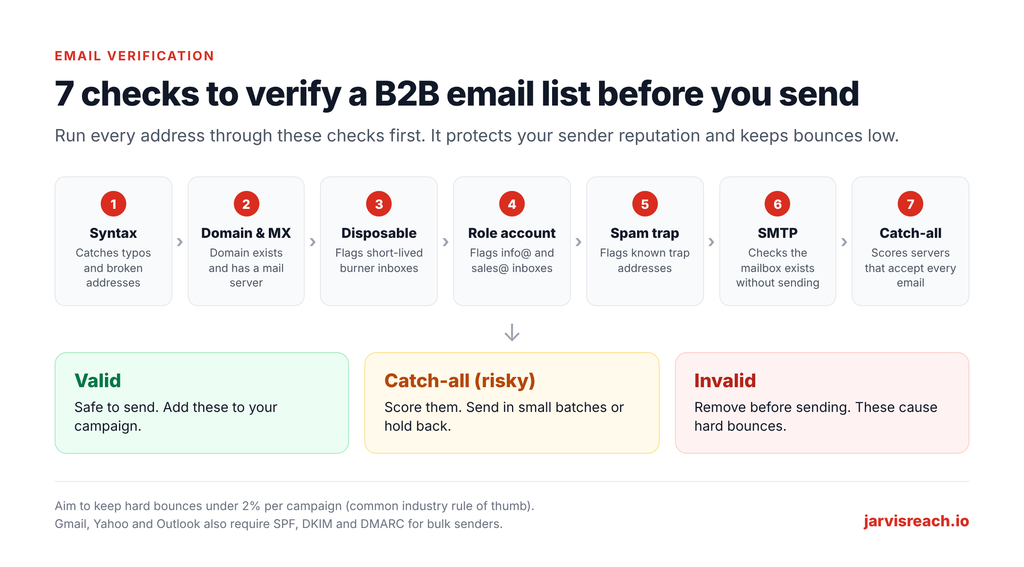
You verify a B2B email list by running each address through a series of email verification checks before it reaches your sending tool. The checks confirm the format is valid, the domain can receive mail, the mailbox exists and the address is not a trap. Anything risky is removed or held back. This protects your sender reputation and email deliverability.
The checks a good email verification tool runs
- Syntax check. Catches typos and broken addresses like john@@acme.com.
- Domain and MX record check. Confirms the domain exists and has a mail server.
- Disposable email check. Flags short-lived burner inboxes.
- Role account check. Flags shared inboxes like info@ or sales@ that rarely reply.
- Spam trap check. Flags known trap addresses that inbox providers use to catch bad senders.
- SMTP check. Asks the mail server if the mailbox exists without sending an email.
- Catch-all check. Scores addresses on servers that accept every email.
What is a catch-all email address?
A catch-all domain accepts mail sent to any address at that domain. So the server says “yes” even if the person left the company years ago. The SMTP check cannot tell you if the mailbox is real. That is why catch-all addresses need a risk score instead of a simple yes or no. Send to them in small batches or leave them out of your first wave.
How we handle email verification at Jarvis Reach
We built Jarvis Reach as an all-in-one B2B lead generation and B2B sales automation platform. Teams use one dashboard to find leads, verify contact details, reach out to prospects, manage follow-ups and track each lead to a closed deal. Our database has 750M+ verified contacts. We run a 7-layer verification on every email before it reaches your sending tool. Across the platform we aim for a 95% delivery rate. To show how that holds up in practice, we ran a small test of our own. We recommend testing any data provider on a small sample before you commit.
Our Test: 100 B2B Contacts On The Jarvis Reach Free Plan
We wanted a test any reader can repeat at no cost. We kept the email list small on purpose. So we used only the 100 free credits on Jarvis Reach’s free plan.
How we ran it
- On October 8 2026, we searched our database for B2B sales leaders, including Head of Sales, VP of Sales and Sales Director, at B2B companies with 50–500 employees in the United States.
- We picked the first 100 contacts that matched.
- We ran our email verification on each work email.
- We recorded each result as valid, catch-all or invalid.
- We sent one short email from our dashboard to the valid contacts only and counted hard bounces after 72 hours.
What we found
| Result | Contacts (out of 100) |
| Emails found | 100 |
| Valid | 85 |
| Catch-all (risky) | 6 |
| Invalid (removed before sending) | 9 |
| Emails sent to valid contacts | 85 |
| Hard bounces | 4 |
| Successfully delivered | 81 |
| Delivery accuracy | 95.3% |
the Jarvis Reach results screen for this test, 11 October 2026 Names and emails blurred for privacy.
Want to check our work? Run the same search on your free plan and compare.
Which Sales Intelligence Tool Should You Choose in 2026?
Pick a B2B sales intelligence tool based on three things: how well it verifies emails, how it charges for credits and how well it fits your team size. Apollo suits small teams that want one cheap all-in-one tool. ZoomInfo and Cognism suit larger teams that will pay for a custom contract. Jarvis Reach suits small and mid-size teams that want lead search, verification, outreach and follow-ups in one dashboard. Lusha suits small teams that mainly need direct dials.
Sales intelligence vs revenue intelligence
Sales intelligence tools help you find people to sell to. They give you contacts, verified emails, phone numbers and buying signals. Revenue intelligence tools such as Gong and Clari study the deals you already have. They record calls, track deal activity and help you forecast. Most teams need both, but B2B sales intelligence comes first. You can’t analyse a deal you never started.
Tool comparison (October, 2026)
Here’s how five popular B2B sales intelligence tools compare on database size, free plan, pricing and the kind of team each one suits best.
| Tool | Database size (vendor claim) | Free plan | Paid pricing | Best for |
| Jarvis Reach | 750M+ contacts | 100 credits | Basic $98/mo (4,400 credits). Advance $148/mo (6,600). Enterprise $198/mo (13,200) | Founders, SMB sales teams and agencies that want lead search, verification, outreach and follow-ups in one dashboard |
| Apollo.io | 240M contacts and 30M companies | Yes, with limited credits | Basic from $49 per user/mo billed yearly (Docket, April 2026) | Small teams that want data and outreach in one tool |
| ZoomInfo | Not stated on pricing page | Free trial | Custom quote only | Large sales and marketing teams |
| Cognism | Not stated on pricing page | No free plan listed | Custom quote. Plans include 5 seats | Teams selling into Europe that want phone-verified mobiles |
| Lusha | Not stated on pricing page | 40 credits a month | Paid plans priced by credits. Email = 1 credit and phone = 5 credits | Small teams that mainly need direct dials |
Prices change often. Always check the vendor’s own page before you buy.
What does a credit mean?
A credit is what you spend to reveal one piece of contact data. Most tools charge 1 credit for an email. Phone numbers usually cost more. Lusha charges 5 credits per phone number. Jarvis Reach charges 1 credit per [email / phone number]. So enriching 1,000 contacts with emails only costs about 1,000 credits. Adding phone numbers can cost five to eight times more.
A lean sales stack for 2026
- CRM: Salesforce or HubSpot
- Contact data and verification: Jarvis Reach, Apollo, Zoom Info, Cognism or Lusha
- Outreach: Outreach or Salesloft
- Revenue intelligence: Gong or Clari
- Data workflows: Clay for teams that want to combine several data sources
Five tools is plenty for most teams. Salesforce found the average seller already juggles eight.
Can AI Make Sales Forecasts More Accurate?
Yes, but only if your CRM data is clean. AI forecasting tools look at real activity such as emails, meetings, deal stage history and who is involved. They don’t rely only on a rep’s gut feel. Gartner found that just 45% of sales leaders and sellers had high confidence in their forecast accuracy. That survey is from 2020, but the gap it shows has not gone away.
AI forecasting tools such as Clari and Gong spot warning signs a rep may miss. A deal with no buyer reply in three weeks is at risk. So is a deal where the only contact is a junior manager. The model flags these early so the manager can step in.
There is a catch. The model learns from your CRM. If reps don’t log calls or if half the contacts are out of date, the forecast will be confidently wrong. The same Gartner study found that only 47% of respondents thought their company had high-quality data. Fix your data hygiene first. Then trust the model.
Be careful with vendor claims of “95% forecast accuracy”. Ask how they measured it, over how many quarters and on which kind of customers.
Why Are Existing Customers The Best Growth Bet in 2026?
Existing customers are easier to win and faster to close. Ebsta and Pavilion’s 2025 GTM Benchmarks found that 52% of new revenue came from existing accounts. Expansion deals had an 82% win rate. New logo deals had a win rate of just 19%.
| Ebsta and Pavilion, 2025 GTM Benchmarks | New logos | Expansion |
| Win rate | 19% | 82% |
| Average sales cycle | 91 days | 52 days |
The classic research agrees. Frederick Reichheld of Bain & Company found that a 5% rise in customer retention can lift profits by 25% to 95%. Harvard Business Review still cites this work. It is older research but it shaped how most SaaS companies think about growth.
A simple expansion habit: watch for job changes at your current customers. When a new leader joins, find and verify their contact details quickly. Reach out before a competitor does. Your champion leaving is one of the biggest renewal risks. A new champion is one of the best expansion openings.
How Do You Measure The ROI of AI Sales Tools?
Measure the ROI of an AI sales tool by comparing the extra revenue or saved time it creates with what it costs. Track it for at least one full quarter. Use the same metrics before and after so the comparison is fair.
ROI = (Revenue gained + Value of time saved − Tool cost) ÷ Tool cost × 100
- Hours saved per rep each week on research, data entry and list cleaning
- Bounce rate on cold campaigns
- Reply rate and meetings booked per 100 contacts
- Pipeline created per rep
“In July 2026 Gartner predicted that sales leaders who overhaul their systems will be 5 times more likely to see ROI from AI. Buying the tool is the easy part. Changing the workflow around it is where the return comes from.”
Is B2B Cold Email Legal Under CAN-SPAM and GDPR?
B2B cold email is legal in the US and in most of Europe if you follow the rules. In the US, CAN-SPAM lets you email business contacts without consent as long as you are honest and give a clear way to opt out. In the EU and UK, GDPR usually lets you rely on “legitimate interest” when the email is relevant to the person’s job.
This section is general information, not legal advice. Check with a lawyer for your own situation.
CAN-SPAM (United States)
The FTC’s CAN-SPAM guide says the law “makes no exception for business-to-business email.” Each email that breaks the rules can cost up to $53,088 in penalties. The main rules are:
- Use honest sender details and a subject line that matches the email.
- Include a valid postal address.
- Explain clearly how to opt out.
- Honour opt-out requests within 10 business days.
- You stay responsible even if an agency sends the emails for you.
GDPR (EU and UK)
Under GDPR you need a lawful reason to process someone’s data. For B2B outreach this is usually legitimate interest under Article 6(1)(f). To use it safely:
- Email people about things that relate to their job.
- Say where you got their details if they ask.
- Make it easy to opt out and keep a suppression list.
- Don’t keep data you no longer need.
UK and EU countries also have their own e-marketing laws, such as PECR in the UK. Rules for contacting sole traders can be stricter than for company employees. Choose data vendors that publish a GDPR policy and can show where their data comes from.
Is Your B2B Sales Team Ready For AI? A 12-Point Checklist
AI works when the basics underneath it are solid. Use this checklist before you add another tool or agent. If you can’t tick most of these boxes, fix them first. A new tool won’t fix them for you.
Targeting
- ☐ You have a written ideal customer profile, and the whole team uses it
- ☐ You track intent signals for the accounts on your ICP list
- ☐ You know who is in the buying group at each target account, not just one contact
Data
- ☐ Every email is verified before it reaches your sending tool
- ☐ Catch-all addresses are scored and sent in small batches
- ☐ CRM records are updated after every call, by a rep or an agent
Sending
- ☐ SPF, DKIM and DMARC are set up on your sending domain
- ☐ Every email has a one-click unsubscribe and a postal address
- ☐ Bounces stay under 2% and spam complaints under 0.10%
People and process
- ☐ A human reviews every AI-drafted email before it goes out
- ☐ Your team uses five tools or fewer, and they share data
- ☐ You track hours saved, bounce rate, reply rate and pipeline every month
The Bottom Line
Nearly every B2B sales team now uses AI. The ones that win use it to do the boring work well: research, verification and CRM updates. They keep people in charge of what buyers actually see and every decision that needs trust. Start with clean data and a human review step. Then add agents one task at a time.
Frequently asked questions about B2B sales and AI
Quick answers to the questions sales teams ask most about using AI, verifying emails, cold email rules and choosing the right tools.
What is the best use of AI in B2B sales?
The best use of AI in B2B sales is removing admin work. Let it research accounts, find and verify contacts, draft first emails and update the CRM. Salesforce found that sellers expect AI agents to cut prospect research time by 34% and email drafting time by 36%. Keep humans in charge of final messages and live deals.
Will AI replace SDRs?
Not in the near term. AI can take over much of an SDR’s research and data work. But buyers still want a person they can trust. In a TechCrunch report ZoomInfo said an AI SDR it trialled “performed significantly worse than our SDR employees.” Expect smaller SDR teams that each do more with AI support.
How do I verify a cold email list?
Run every address through an email verification tool before you send. A good verifier checks syntax, the domain’s mail server, disposable and role inboxes, spam traps, the mailbox itself through an SMTP check, and catch-all servers. Remove invalid emails and treat catch-all emails as risky. Aim to keep bounces under 2% per campaign.
What is a catch-all email domain?
A catch-all domain is a mail server set up to accept email sent to any address at that domain. It accepts mail even when no real person owns the mailbox. That means a normal check cannot confirm the address. Treat catch-all emails as risky. Send to them in small batches or leave them out.
What are the Gmail rules for cold email?
Google requires anyone sending more than 5,000 emails a day to Gmail to set up SPF, DKIM and DMARC. They must offer one-click unsubscribe. They must keep the spam complaint rate below 0.10% and never let it reach 0.30%. Yahoo and Microsoft Outlook have similar rules. Outlook’s rules took effect on May 5, 2025.
What is the difference between sales intelligence and revenue intelligence?
Sales intelligence helps you find buyers. It gives you contacts, verified emails, phone numbers and buying signals. Revenue intelligence helps you manage deals you already have. It records calls, tracks deal activity and supports forecasting. Jarvis Reach, Apollo and ZoomInfo are B2B sales intelligence tools. Gong and Clari are revenue intelligence tools.
How many credits do I need to enrich 1,000 contacts?
You need about 1,000 credits to find emails for 1,000 contacts on most tools, since one email usually costs one credit. Phone numbers cost more. Lusha charges 5 credits per phone number. Jarvis Reach’s Basic plan includes 4,400 credits a month for $98 (pricing checked October 6, 2026).
Is cold email legal for B2B?
Yes, in most places, if you follow the rules. In the US, CAN-SPAM applies to B2B email. It requires honest headers, a postal address and an opt-out that you honour within 10 business days. In the EU and UK, GDPR usually allows B2B outreach under legitimate interest when the email is relevant to the person’s role.
How many people are in a B2B buying group?
Forrester’s 2024 research found an average of 13 people involved in each B2B buying decision. 89% of purchases involve two or more departments. This is why deals stall when you only talk to one contact. Find and verify several people at each target account early in the deal.
What is intent data in B2B sales?
Intent data is a set of signals that show an account may be researching a purchase. Examples include reading reviews in your category, hiring for related roles, new funding and changes to their tech stack. Tools such as Bombora, 6sense and G2 Buyer Intent collect these signals. They help reps focus on the small share of accounts ready to buy.
What is agentic AI in sales?
Agentic AI in sales is software that completes a multi-step task on its own instead of following fixed rules. An agent can research an account, find and verify contacts, draft an email and update the CRM. Salesforce found that 54% of sales teams have already used AI agents. The safest setup keeps a human reviewing what the agent sends.
How do you measure the ROI of AI sales tools?
Measure the ROI of AI sales tools by comparing the revenue gained and time saved with the tool’s cost. Track hours saved per rep, bounce rate, reply rate and pipeline created for at least one quarter. Use the same metrics before and after so the comparison is fair. Gartner says teams that change their workflows see far better ROI.