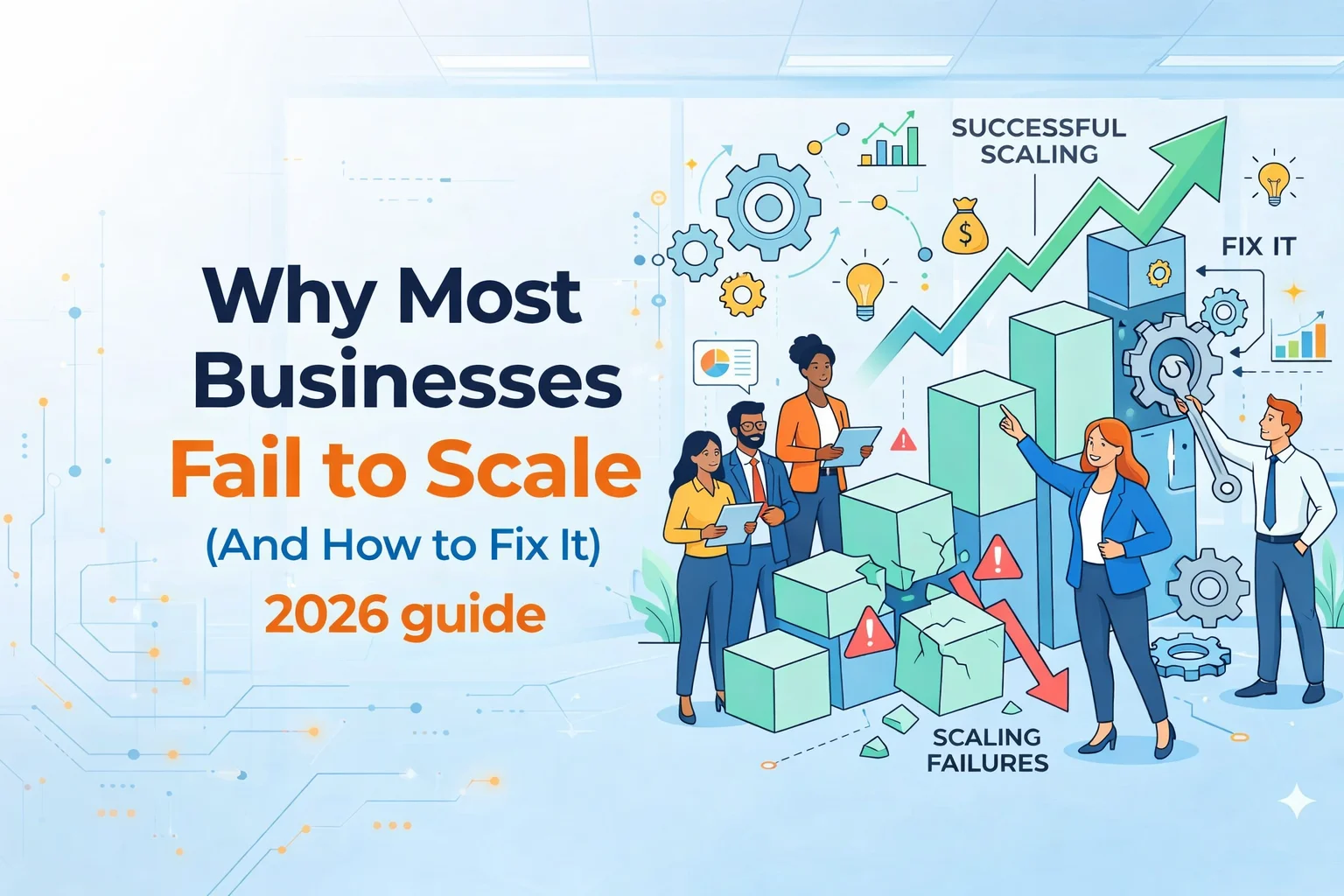
How to Scale a Business through a scaling plan is a formal strategic document that outlines the financial requirements for a company to increase its revenue without an equivalent increase in costs. This plan includes the required infrastructure, such as automated software and standardized workflows, with the intention of managing a larger volume of customers. It comprises a detailed business model analysis to ensure that profit margins remain sustainable as the organization expands. By laying out clear milestones for hiring, technology investment, and lead generation, a scaling plan provides a roadmap for evolving a startup business plan into a high-growth corporate structure.
What Exactly Is a Scaling Plan?
A scaling plan is a document that shows how you are going to grow your operations. It is not just a startup business plan that you write once and forget; it is a living guide. The best plans focus on systems. In order to understand how to scale up a business, you must first map out the entire process and know exactly what is happening when you get a new customer. If your process is manual, you will fail.
Many people start with a plan that focuses only on getting the first ten customers, but that does not show how to scale to a thousand. You need to perform a deep business model analysis to identify bottlenecks. If you are the only one making decisions, that is a bottleneck. You must build a system that works even when you are not there; that is the true secret of scaling a business.
How Modern Businesses Fail to Scale
It is sad to see, but most businesses actually fail when they try to scale up. It is usually not because they don’t have enough customers, but because they can’t handle the ones they already have. If you don’t know how to scale up a business, and on the other hand, you are hiring too many people. This eats up your cash.
A common reason for failure is a weak startup business plan. People get excited about unique business ideas and forget about accounting or customer support. When you look at business plan examples, notice how the failed ones skip over the operational details. If you lose five dollars on every sale, doing more sales just means you go bankrupt faster. That is why learning how to scale a Business is so important before you start spending your life savings.
Applying the Six S Framework for Growth
If you want a structured way to look at this, the Six S Framework is a great tool. It covers the main areas you need to watch. It helps answer the big question of how to scale my business without losing your mind.
1. Building Your Staff
You cannot do everything yourself if you want to grow. You need a team that can take full ownership of their departments. When you are looking at how to scale up a business, your hiring strategy is basically everything. You do not just need basic workers; you need leaders who can manage themselves. This is one of the best business tips for long term survival. If you are buying a business, you should check the quality of the existing staff before signing anything. According to experts in business growth, a company is only as good as its middle management. You need to hire people who have already seen what a bigger company looks like.
When you draft your startup business plan, it is better to set a budget for high-quality talent because cheap labor eventually leads to mistakes that might cost you way more. Learning how to scale my business means learning how to let go and trust the people you hire.
2. Aligning Shared Values
As you get bigger, your company culture can get very messy and confusing. You need everyone from the top to the bottom to believe in the same goal. This alignment should be clearly defined in your start up business plan. A strong business model example always includes a core set of values that guide decision making. When you are studying how to scale a business, you will find that companies with strong cultures have much lower turnover.
This is vital for a business model analysis because hiring new people is much more expensive than keeping the ones you have. Whether you have unique business ideas or are just buying a business, the human element is what keeps the engine running during rapid expansion.
3. Organizing Your Structure
A small team can talk in a simple group chat, but a big team needs a real hierarchy to function. You need a business model example where you know exactly who reports to whom without any confusion. Without a business structure, you end up with people getting frustrated with each other because they don’t know where they fit into the entire process. This is a vital part of How to Scale a Business. When you perform a business model analysis, look at your communication lines.
If information is getting lost, your structure is broken. Even the best startup business plan will fail if the internal reporting is a mess. You need to build a framework that can support five times your current headcount. This is a common theme when people discuss how to scale up a business on professional forums. A solid structure allows you to focus on strategy while the managers handle the daily operations.
4. Optimizing for Speed
Complexity is the ultimate enemy of speed in any industry. You have to keep your internal processes as simple as possible. If you want to know how to scale my business, look closely at your decision-making process. If it takes three weeks to approve a small change, you are going to lose to smaller, faster competitors who can pivot in days. This is one of the most practical business tips for the modern era. When looking at business plan examples, notice how successful companies prioritize agility. They do not get bogged down in endless meetings.
If you are buying a business, see how fast they can ship a new feature or close a deal. To understand how to scale up a business, you must remove every unnecessary step in your workflow. Speed is what allows you to capture a market before anyone else notices the opportunity.
5. Defining Your Scope
Do not try to be everything to every customer. You must stick to what you are actually good at. Many unique business ideas fail because the owners try to add too many features too soon. This is called scope creep. Focus on your core business model analysis and do that one specific thing better than anyone else in the world. When you look at a start up business plan, it should be narrow and deep, not wide and shallow. If you spread your resources too thin, you will not have the power to scale anything.
This is a recurring lesson in business plan examples from failed tech companies. To successfully master How to Scale a Business, you have to say no to good ideas so you can say yes to the great ones. Whether you are buying a business or starting fresh, focus is your greatest asset.
6. Preparing for Series X
Whether it is Series A, B, or C, you need to be ready for the next level of funding or massive growth. Your startup business plan should show investors that you are ready for the big leagues with data to prove it. Knowing how to scale up a business means always looking two steps ahead of your current situation. You need a business model example that proves your unit economics work at a much larger scale. During a business model analysis, investors will look for predictability. You must know how to turn their one dollar into five. This is the heart of how to scale my business.
Five Critical Steps to Scaling Successfully
Now, let us get into the actual steps you can take today. These are the practical bits that help you figure out How to Scale a Business in the real world.
Evaluate and Plan Readiness
Before you go big, ask yourself if you are truly ready. Does your product work perfectly? Is your customer base happy? Look at business plan examples from companies that successfully made the jump. They did not just guess; they planned. A start up business plan is a good start, but you need a scaling audit. You need to ensure your business model example is actually profitable.
Find the Necessary Money
You need capital to grow. This might mean taking a loan or looking for investors. Some people consider buying a business that is already scaled to save time, but that requires even more money. Make sure your business model example shows exactly how that money will be turned into more profit. You cannot figure out how to scale my business if you are broke.
Secure Your Sales Engine
You need a way to get leads consistently. If your sales depend on luck, you cannot scale. This is where professional tools come in. For example, Jarvis Reach is a specialized B2B lead generation and sales outreach platform designed to help businesses automate their prospecting and customer acquisition. Visiting Jarvis Reach is a great move for anyone who needs to automate their lead generation. They help you find the right people so you can focus on closing deals. This is one of those business tips that saves you hundreds of hours. A predictable sales engine is the most important part of how to scale up a business.
Invest in New Technology
You cannot scale using spreadsheets and sticky notes. You need a CRM, automation software, and good communication tools. When you do a business model analysis, look for tasks that a computer can do. This is a huge part of how to scale up a business. It frees up your staff to do creative work while the tech handles the repetitive stuff. Technology is what makes your business model example work at a large scale.
Find Staff or Outsource Strategically
Sometimes hiring is not the answer. You might want to outsource your HR or your marketing. This keeps your fixed costs low. If you’re looking for some new business ideas, consider how you can take advantage of the global workforce. This is an important part of how to scale up a business in the modern world.
Conclusion
However, it is imperative not to hasten growth, as this could destroy the foundation you have worked so hard to lay. By adhering to a strict business model analysis and using tools like Jarvis Reach to automate outreach, you lay the groundwork for professional advancement. Whether you are buying a business or starting from scratch, the principles of efficiency and automation remain the same.
FAQ
Ways to measure your business strategy’s success?
Revenue & Profit
Customer Acquisition Cost
Customer Retention Rate
Employee Turnover Rate
Net Promoter Score
How to successfully scale a business?
Scaling a business involves increasing revenues significantly faster than costs. This is achieved through creating sustainable systems, automating processes, and increasing market reach. To achieve this, there are several strategies, such as creating a competent team, utilizing technology such as AI and CRM, creating multiple revenue streams, and maintaining high customer levels. To achieve this, there is a need to move from daily activities to strategy.
What is the 1% rule in business?
The 1% rule in business is a rule aimed at creating massive growth of 37 times within a year through compounding improvements of 1% every day.
How to scale a service business?
Scaling a service business requires turning expertise into a “product.” Instead of selling hours, you must perform a business model analysis to create a repeatable business model example. Key moves include:
- Standardizing Workflows: Create SOPs so the business functions without your constant presence.
- Automation: Employ solutions like Jarvis Reach to automate the process of getting sales leads.
- Tech Automation: Replace manual labor with technology to serve more clients without any extra costs.
What are the steps to scaling a business?
Here is how to learn about scaling your business from a startup business plan to a successful business growth model:
- Audit: Ensure the profitability of your unit economics before expansion.
- Capital: Secure the funds necessary for infrastructure and people building.
- Sales Machine: Create predictable lead generation rather than hoping.
- Structure: Organize yourself into a hierarchical structure to stay fast and efficient.
- Leaders: Stop being a tactician, start employing people who can be leaders.
- Scope: Concentrate on what you’re best at, no “scope creep” allowed.