
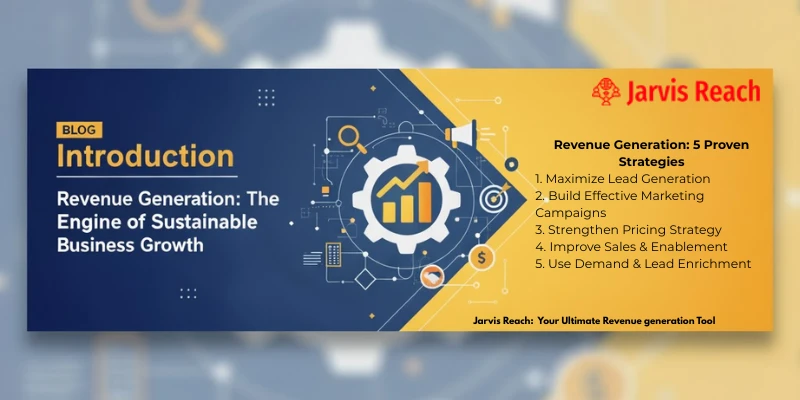
Each business strives to grow, but revenue generation defines sustainable success. Though most businesses emphasize sales alone, revenue growth actually demands a combination of lead generation strategies, marketing strategies, and efficient selling strategies. Both small and large businesses can improve their revenue generation by understanding how to generate steady income.
In this article, we’ll examine why revenue generation is so important, actionable ways you can enhance it, and how your team can use the latest tools to get the best possible outcomes.
Why Revenue Generation Matters for Business Growth?
Revenue generation is more than generating profits. It propels the business growth, enhances brand momentum, and attains sustainable stability. That’s why it must take the priority seat:
· Sustainable Development: Focusing clearly on revenue generation enables your company to reinvest in resources, people, and technology.
· Competitive Advantage: Companies employing effective sales strategies and lead generation strategies overshadow industry competition by constantly converting and onboarding customers.
· Investor Confidence: Consistent growth in revenues is an indicator of stability, making it simple to bring in investors or raise capital.
· Scalability: With well-defined sales enablement of doing things and streamlined sales management, your company can scale quickly without losing quality.
· Attract the Best Employees: Increased earnings speak favorably of an organization and allow it to provide benefits such as higher pay. Top-tier sales employees look to be compensated for their hard work.
In short, revenue generation can’t be avoided it’s the very core of any successful business.
How to Improve Revenue Generation: 5 Proven Strategies
Boost your company’s profitability by focusing on smarter marketing, stronger pricing, and better-qualified leads.
Set your objectives:
As a B2B SaaS sales company, your first step towards generating income should involve developing a plan that is in line with your revenue objectives.
It is important to keep defining your revenue objectives even as you progress through your revenue generation process.
2. Optimize the sales process:
There are plenty of things that you can improve with the sales process itself. This could actually be another major reason why your sales are not bringing in as much revenue as you’d want:
B2C sales: Use UX specialists to improve your app and website user experience, resulting in an easier process of generating sales and subscriptions (the latter of which is essential for your revenue). Also, train your employees who work at your physical locations to be able to close more sales with people who visit those stores.B2B sales: Your CPQ (Configure, Price, Quote) sales process can be improved to streamline the whole process from the moment the deal is reached. Make it possible for buyers to purchase simple goods through your e-commerce store. In case of more complicated purchases, use configurability of orders to turn them into quotes using self-service software, making the sales process quicker
3. Maximize Lead Generation Methods
Lead generation tactics are the foundations of healthy revenue generation. You’re lead generation strategies attract high-quality prospects who are more likely to convert. Some effective methods are:
· Make use of content marketing campaigns to educate and attract potential buyers.
· Leveraging targeted email campaigns that build leads.
· Attracting the right audience through social media channels to increase sales.
· Adding lead enrichment tools in order to qualify and append contact information.
By raising the quality of the lead generation strategies, your sales team spends less time waiting on unqualified leads and more time closing deals.
4. Construct Winning Marketing Campaigns
Marketing strategies in concert with business goals are essential in growing revenue generation. Intelligent campaigns marry brilliance and analytical understanding:
· Personalize the campaign with buyer personas.
· Use multi-channel marketing strategies by including digital, social and traditional tactics.
· Monitor metrics to assess ROI and refine marketing campaigns for effectiveness.
· Include B2B marketing strategies, provided that you are marketing to corporate clients.
Using sustained marketing strategies can provide regularity of demand to support a sales strategy and maintain opportunities for revenue generation long-term.
5. Having a Strong Pricing Strategy
Revenue generation and pricing strategy go together. Your optimal price is what customers are willing to pay for your offerings in sufficient quantities so that you make money out of it. You could be suffering from sub-optimal prices currently; hence, consider some options:
Cost-based pricing: This type of pricing method involves adding your required profit margin on top of the production costs of your products or services. In this way, you are sure that you will be making money from your sales. Considering this option would mean getting more profits to cover expenses, which might have been challenging in the past.
Competitor pricing: This pricing approach evaluates your competitors in order to either reduce the prices below your competitors to gain more market share, equalise prices, and therefore outperform on better service
Price Skimming: Under price skimming, a high price is initially placed on a product to target early adopters while maximizing revenue. As demand begins to fade, the price can be gradually reduced, and a larger market share can be achieved. By discouraging new competitors and increasing production, it allows for revenue growth in a sustainable manner.
Penetration Pricing: Through penetration pricing, a product starts off at a low price, helping the firm secure a quick market share as well as build brand awareness. In this instance, profit can either come from upselling or achieving high-volume sales with thin margins. With sufficient market share and higher prices in the long run, revenue could potentially grow.
Value-Based Pricing: Value-based pricing involves using value as the key driver to charge prices for certain products. High-end brands, luxury goods, and status symbols all fall under this form of pricing strategy. Provided that you can achieve the appropriate value perception, the large margins inherent to value-based pricing would boost revenue.
In short:
· Observe the market to understand the competitors’ pricing strategy.
· Provide tiered pricing or subscription plans so you can serve multiple sets of customers.
· Promote and discount test strategically in order to increase sales.
· Priced appropriately against perceived value in order to prevent an underpricing and overpricing strategy.
A transparent pricing strategy enables the customer to see the value that you provide and increase sales.
6. Enhance Selling Approach and Sales Enablement
The sales teams are the main revenue generation. By integrating effective selling strategies with sales enablement, the efficiency and conversion are increased:
· Supply reps with the latest product information, case studies, and competitive intelligence.
· Educate teams in consultative sales methods from the customer’s perspective.
· Monitor interactions, pipeline, and performance with the assistance of CRM programs.
· Sync sales strategy with marketing efforts for aligned communication.
Through the use of the right sales enablement, the teams can increase sales.
7. Cross-sell and upsell
In most cases, the cost of acquiring a client that already does business with you will be lower compared to the cost of getting a new customer. The former is an attempt to boost sales by selling additional products/services to the buyer(s), while the latter involves selling upgrades to the product being sold to generate more revenue. You may try the following tactics:
Bundling: Provide small discounts or package offers with multiple products because, as a result, there will be bigger sales and even upgrades to costlier items compared to those the client intended to purchase.
Recommendations: Check out the purchase history of comparable customers with CRM solutions or web analytics data; hence, you will find out what other products they have purchased and provide an appropriate suggestion.
Loyalty programs: Give exclusive discounts to your loyal customers because this can be especially useful in situations when the customer is ready to spend their money elsewhere.In the course of service calls: This type of upsell strategy involves the use of field service representatives who can persuade the buyer during an in-person meeting. It often happens that a number of additional.
8. Leverage Demand Generation and Lead Enrichment
Lead enrichment and demand generation are hand in hand in order to accelerate revenue generation. While demand generation generates interest in your offerings, lead enrichment checks for quality and readiness in order to convert:
· Use AI-driven tools to enhance lead data, improving targeting accuracy
· Develop learning content in alignment with prospects at the point of sale.
· Apply retargeting techniques and re-target interested leads.
· Track lead-to-customer conversions as a measure of the mode of revenue generation for future marketing strategies.
By utilizing lead enrichment in conjunction with demand generation, businesses can create predictable, scalable models of revenue generation with regularly increase sales.
Who is Responsible for Revenue Generation in a Business?
The revenue generation does exist outside the sales team. It needs collaboration among the marketing, sales, and leadership teams:
· Sales Team: Create conversions, manage customer relationships and support sales strategy.
· Marketing Department: Execute marketing campaigns, demand generation, and apply lead enrichment strategies.
· Leadership and Management: Set goals, oversee sales management, manage cross-functional activity, and manage sales strategy.
Once each team realizes its own contribution to revenue generation, businesses grow faster and more sales enablement.
Jarvis Reach: Your Ultimate Revenue Generation Tool
Streamline revenue generation with technology in the competitive market. The Jarvis Reach platform allows organizations to optimize all parts of the revenue process:
· Automates lead generation strategies and nurtures prospects efficiently.
· offers actionable advice for enhancing marketing strategies and sales enablement.
· Boosts lead enrichment to prioritize high-end opportunities.
· Follows marketing campaigns and sales management for maximum ROI.
Using Jarvis Reach enables your team to invest more time engaging interested prospects, rather than spending time on manual tasks. Whether improving B2B marketing strategies, refining your sales strategy or optimizing pricing strategy, Jarvis Reach enables marketable, measurable revenue generation opportunities that enable you to increase sales.
Revenue Stream Diversification
In business, depending on a single source of revenue, such as a single line of products, could be highly risky. However, through revenue stream diversification, you can reduce risks, achieve stability, grow, optimize your resource utilization, and more. In cases where one revenue stream reduces, becomes insignificant, or even ceases, the remaining revenue streams will keep you safe from losses.
To do that, start by examining your revenue streams using your CRM and determining the share of the revenue and profitability from each revenue stream. Also, seek customers’ segments where you can derive other revenue streams and assess your competitors and the market trends.
Do you see any gaps in the market? Is there an opportunity for expanding to another geographical location? After acquiring all the necessary data, identify the new revenue streams and develop a business plan to generate the new revenue.
Revenue Streams Types
Sales of a Product: Revenue generation from a digital or tangible product is the most common method of revenue.
Service Charges: Service charges can be significantly varied. Examples include the hourly charges of a landscape artist, photography
Advertisement: This is money in return for leasing out a portion of your real estate or online space to the advertiser.
Affiliate Marketing: These are commissions you receive for sending business to another business organization.
Revenue growth through the use of technology
A large number of opportunities for expanding revenue tend to be easier to find when you use a revenue growth platform. Using a specific platform, its users were able to cut down their average quote turnaround time by 34%, which means more opportunities and faster growth.
Features used
Configure, Price and Quote support: Create an intelligent product catalog in the platform that can access information related to sales, which helps it to generate information about intelligent bundling to expand your shopping cart size, or identify the days of the month that would result in approvals for your quotes.
Contract Management: Automate contract creation and store all of your contracts in one place so that sales teams and finance departments can manage it. Even better if it is connected to your CRM so that salespeople know which offers succeed or fail, helping you make more successful future offers.
Automation for order management: Execute orders via the same platform used for CPQ and contracts so that any modifications made during negotiation and contract amendments have an impact on the rest of the process.
Automation for invoice and payment collections: Generate and manage all sorts of invoices, including those generated based on usage, subscription, or any other kind, thus facilitating collections and generating income.
Quick Table for Revenue Generation Strategies
| Strategy Name | Category | Description | Actionable Tactics | Target Outcome |
| Lead Generation and Enrichment | Lead Generation | Foundational tactics to attract high-quality prospects and verify data to accelerate the conversion process. | Execute content marketing and targeted email campaigns; use AI-driven tools to enhance data; apply retargeting techniques. | High-quality prospect attraction, increased sales, and scalable growth. |
| Sales Process Optimisation | Sales Enablement | Improving the efficiency of B2B and B2C sales cycles through user experience design and digital tools. | Use UX specialists for apps; train physical store staff; enable e-commerce for simple goods; implement self-service software for complex orders. | Improved revenue and faster sales growth. |
| Technological Revenue Growth Platform | Sales Enablement | Utilising integrated platforms to automate the quote-to-cash process and manage contract lifecycles. | Automate contract creation; synchronise sales with finance; automate order and invoice management. | Faster growth and maximum ROI. |
| Pricing Strategy Optimisation | Pricing | Developing pricing models based on costs, competitors, or perceived value to maximise margins. | Implement cost-based, competitor, or value-based pricing; use price skimming or penetration pricing; offer tiered/subscription plans. | Increased market share and boosted profit margins. |
| Winning Marketing Campaigns | Marketing | Strategic campaigns aligned with business goals using analytical insights and buyer personas. | Personalise content with buyer personas; use multi-channel strategies (digital, social, traditional); monitor metrics to assess ROI. | Sustainable demand and improved ROI. |
| Cross-selling and Upselling | Sales Enablement | Selling additional products or upgrades to existing customers to leverage lower acquisition costs. | Bundle products with small discounts; provide recommendations based on buying behaviour; implement loyalty programs. | Increased purchase volumes and higher revenue per customer. |
| Revenue Stream Diversification | Business Growth | Expanding into new product lines, services, or geographical locations to mitigate risk. | Examine current streams via CRM; identify market gaps; develop business plans for new locations or segments. | Business stability and risk reduction. |
Final Thoughts
Revenue generation is the oxygen of any business. When you bring together customers’ strong lead generation strategies, data centric marketing processes, and effective selling strategies, you can activate scalable growth. Some tools such as Jarvis reach enhance performance and make sure the team is focused on essential and high Return on Investment (ROI) activities that create sales.
Keep in mind that sustainable revenue generation occurs with great discipline, cross functional collaboration is critical, and continuous improvement in moving forward. Adopt these styles and watch your business morph into a capable and profitable business.
FAQs about Revenue Generation
What do you understand from the term revenue generation?
Revenue generation is an all-inclusive approach to developing a plan for the production and sale of goods or services to generate profit and make the organization profitable. All actions that result in earnings for the firm, including marketing and sales operations,
What are the 5 pillars of RGM?
Pricing, Promotions, PPA, Trade Terms, and Distribution Mix are the five RGM Pillars.
Name three types of revenue.
Total Revenue, Average Revenue, and Marginal Revenue are three types of revenues.
List four ways through which one can improve his or her revenue.
Increase your number of customers, increase the value of each transaction, increase the number of transactions per customer, and increase your prices.

