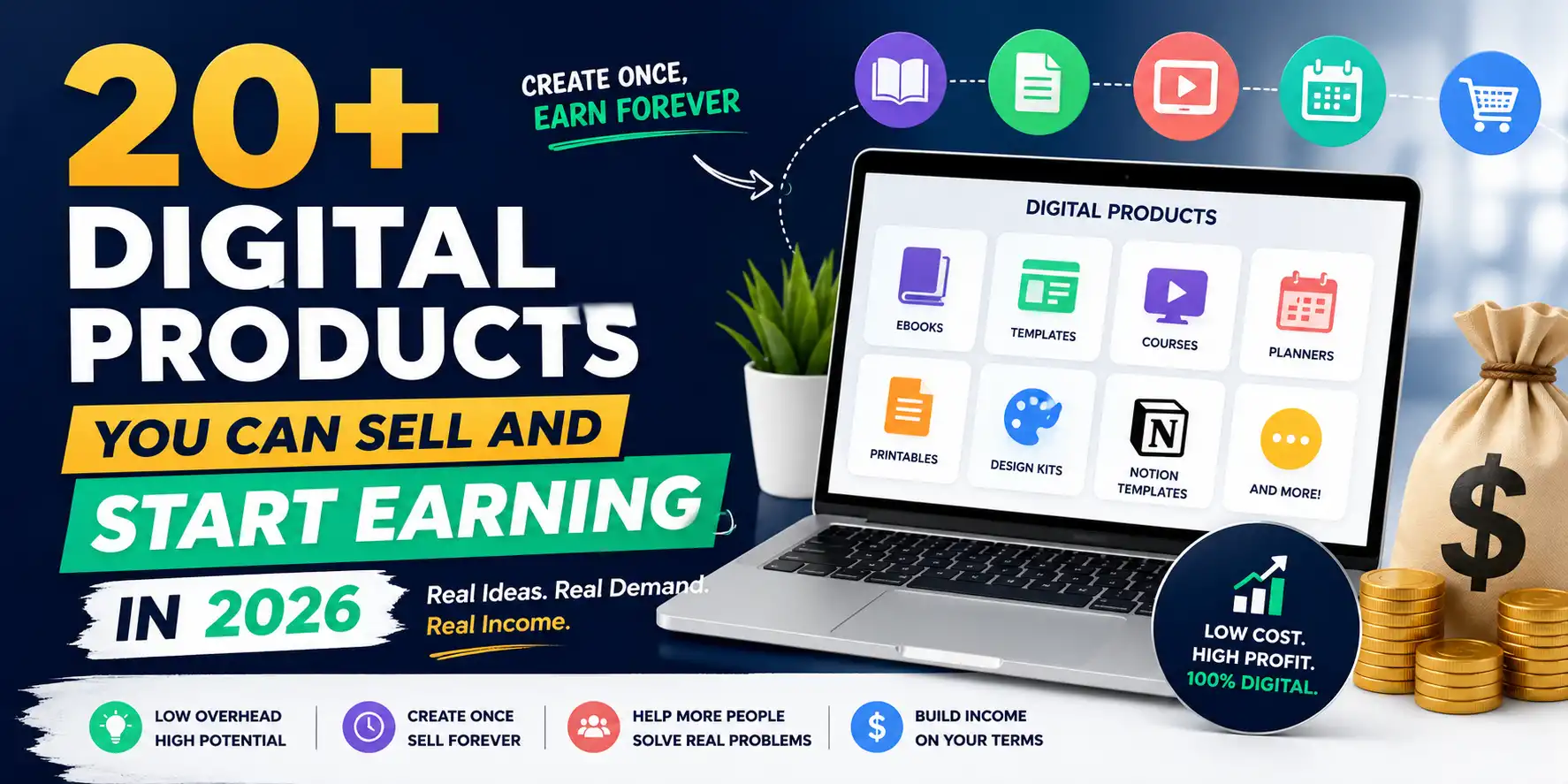
Digital products to sell in 2026 are templates, ebooks, courses, planners, and digital tools that solve a clear problem and can be delivered instantly. The reason most people fail is not lack of ideas, but choosing without understanding the demand. Random digital product ideas rarely work. The digital products that sell well are the ones built around specific problems people are already trying to solve. If you are confused about what digital products to sell, where to sell digital products, or how to sell digital products that actually make money, this guide breaks it down step by step so you can choose the right idea, validate it, avoid wasting time on products that do not sell and what digital products to sell.
20+ Digital Products to Sell with Real Insights
This is not just a list of digital product ideas. Each and every digital products to sell below shows what it is, why it sells, who should sell it, and how to create it. Some of these are among the most profitable digital products to sell, because they solve repeated problems and are easy to scale.
If you are a beginner, start with templates, planners, or simple guides because they are easier to create and sell faster. If you already have experience, you can move into courses, systems, and bundles that take more effort but generate higher returns.
Templates and simple tools are low effort and quick to launch, while courses and advanced systems take more effort but scale better over time. From what I’ve seen, simple digital products to sell, like templates, planners, and swipe files, tend to get their first sales faster because they solve immediate problems and don’t require long explanations.
1. Notion templates
A set of ready-made pages inside Notion used for planning, tracking, or managing work.
Why does it sell?
People don’t want to build systems from scratch. They want structure without thinking too much.
Who can sell it?
Students, freelancers, and anyone already using Notion regularly.
How to make it?
Create simple dashboards inside Notion. Start with one use case like “daily planner” or “content planner”, and duplicate it into variations.
2. Instagram content templates
Pre-designed layouts used for creating posts, carousels, and reel covers.
Why does it sell?
Creators struggle with consistency and design. Done-for-you formats save time.
Who can sell it?
Content creators, designers, or social media managers.
How to make it?
Go to Canva, build 10–30 reusable post designs with editable text and themes.
3. Ebooks (niche-specific guides)
A short digital book focused on solving one specific problem.
Why does it sell?
People want fast answers, not long learning journeys. It varies according to different niches.
Who can sell it?
Writers, niche experts, creators with experience in one area.
How to make it?
Pick one problem, then break it into steps, write 20–40 pages focusing only on the solution according to your niche.
4. Resume and CV templates
Pre-designed resume formats used for job applications.
Why does it sell?
Job seekers want better chances of getting shortlisted. ATS-friendly resumes improve visibility.
Who can sell it?
Designers and HR professionals.
How to make it?
Create clean and simple resume formats.
5. Mini online courses
Short video or text lessons that teach one specific skill.
Why does it sell?
People don’t want long courses anymore. They want fast results where they can easily understand the concepts.
Who can sell it?
Creators with skill-based knowledge.
How to make it?
Record 3–7 focused lessons around one result.
6. Digital planners
A structured file used to plan daily, weekly, or monthly tasks.
Why does it sell?
People feel unorganized and want control over their routine.
People want control over their routine and clarity in planning.
Who can sell it?
Productivity creators.
How to make it?
Design simple planners in Notion or PDF.
7. Canva design kits
A bundle of editable templates used for branding and social media.
Why it sells?
Small businesses need visuals without hiring designers.
Who can sell it?
Designers and Canva users.
How to make it?
Create themed packs like “Instagram business kit” or “startup branding kit.”
8. Caption and hook packs
A collection of ready-to-use captions and opening lines for content.
Why it sells?
Writing content takes time. Pre-written hooks increase speed and engagement.
Who can sell it?
Content creators and marketers.
How to make it?
Create categorized hooks like viral, storytelling, and sales.
9. Email swipe files
A set of pre-written email sequences used for marketing or sales.
Why it sells?
People want conversion-ready emails without writing from scratch.
Who can sell it?
Copywriters and marketers.
How to make it?
Write 5–10 email sequences for one goal, like “sales”, “pain points”, or “welcome flow.”
10. UI kits/website templates
Pre-designed layouts and components used to build websites.
Why it sells?
Developers and startups prefer speed over designing from scratch.
Who can sell it?
Designers and developers.
How to make it?
Create reusable sections or full-page layouts in Figma or Web tools.
11. Printable trackers
A downloadable sheet used to track habits, goals, or finances.
Why it sells?
People want simple systems to track progress.
Who can sell it?
Productivity creators.
How to make it?
Design simple printable sheets with tracking columns.
12. Stock photo packs
A collection of images sold as a downloadable bundle.
Why it sells?
Creators need visuals without shooting content daily.
Who can sell it?
Photographers and creators.
How to make it?
Take themed photos and organize into downloadable packs.
13. Freelance proposal templates
A ready-made document used to pitch services to clients.
Why it sells?
Freelancers struggle to close clients confidently.
Who can sell it?
Freelancers and copywriters.
How to make it?
Build structured proposals for different services.
14. AI prompt packs
A collection of prompts used with AI tools to generate results.
Why it sells
People want results without trial and error.
Who can sell it
AI users and creators.
How to make it
Group prompts by outcomes like content or business ideas.
15. Business starter kits
A bundle of templates and guides used to start a business.
Why it sells?
Beginners want direction instead of scattered information.
Who can sell it?
Creators with business knowledge.
How to make it?
Combine 3–5 related resources into one structured pack.
16. Pricing calculators/sheets
A tool used to calculate pricing for services or products.
Why it sells?
Pricing decisions feel confusing for beginners.
Who can sell it?
Freelancers and consultants.
How to make it?
Create simple Excel/Notion calculators with formulas.
17. Study notes/exam guides
A simplified document used for quick revision.
Why it sells?
Students prefer clear and short preparation methods.
Who can sell it?
Students and educators.
How to make it?
Compress complicaed topics into a simplified revision format in the document.
18. Personal branding kits
A set of templates used to build an online presence.
Why it sells?
People want to look professional and build authority.
Who can sell it?
Designers and creators.
How to make it?
Include bios, banners, and content templates.
19. Video editing presets
Pre-made settings used to apply a specific editing style.
Why it sells?
Creators want faster editing workflows.
Who can sell it?
Video editors and creators.
How to make it?
Create reusable presets for editing tools.
20. Sales funnel templates
A structured flow used to guide a customer from interest to purchase.
Why it sells
People don’t know how to structure the buying journey.
Who can sell it
Marketers and strategists.
How to make it?
Design step-by-step marketing funnel flows with pages and email sequences.
21. Landing page templates
A pre-designed page used to convert visitors into buyers.
Why it sells?
Many creators struggle more with selling than creating.
Who can sell it?
Designers and marketers.
How to make it?
Create simple layouts with offer and benefits.
22. Content repurposing kits
A system used to turn one piece of content into multiple formats.
Why it sells?
Creators want to save time and reduce content pressure.
Who can sell it?
Social media managers and creators.
How to make it?
Build frameworks for repurposing content.
23. Digital product launch kits
A set of templates and steps used to launch a product.
Why it sells?
Beginners don’t know how to launch properly.
Who can sell it?
Creators and marketers.
How to make it?
Bundle launch steps, content ideas, and templates.
24. Client onboarding templates
A workflow used to onboard new clients.
Why it sells?
Freelancers want to save time and look professional.
Who can sell it?
Freelancers and agencies.
How to make it?
Create structured onboarding flows using documents or Notion.
Which Digital Products are Easiest and Most Profitable?
Most people think easy digital products to sell mean no effort. Just pick the most profitable digital products to sell and start earning. But that is not how it works. Easy means simple to understand and simple to use. When something is easy to understand, people decide faster.
Easy doesn’t mean no effort
A lot of beginners confuse “easy” with “lazy income.” That’s why they end up picking the wrong things, like complex courses or big builds, thinking it will bring more money. But easy digital products to sell are not about effort; it is about clarity. If a product takes too long to understand, people leave. If they understand instantly, they stay long enough to buy. That is why something like a template often works better than something creating complex products.
Profit comes from repetition, not price
Most people focus on pricing too much. They think higher price means more profit. But that’s not how digital products to sell work. A small digital product that sells every day will always outperform a high-priced product that sells rarely. What matters more is how often people need it and how fast they decide. If someone sees value quickly, they buy without delay. If they need time to think, they usually don’t come back.
Products that solve small repeated problems sell faster
The easiest and most profitable digital products to sell usually sit in simple problems people face again and again. Not big life-changing problems but a small problem that people are facing daily.
Things like:
- Not knowing what to post
- Struggling to start writing
- Needing structure for work
- Saving time on repetitive tasks
That’s why templates, planners, swipe files, prompt packs, and checklists work so well. Because they don’t require explanation, people see them and immediately understand what problem the product will solve. Once they understand easily, there are more chances to buy the product.
Courses feel harder in the beginning
Courses can make money, but they are not easy to start with. Because they need trust, audience, explaining complex topics into simpler and consistent effort. Most beginners struggle here because they try to start big, thinking bigger product equals bigger income. But bigger products take longer to prove value to your audience. And in the beginning, you don’t have that time or trust from the audience. That’s why many people quit before they even get traction.
Simple starting path
The easiest way to begin is not to overthink product types. Start with something small. Something that solves one clear problem. Don’t wait for it to be perfect. Start a simple product. Once people start using it, you will understand what they actually need. Then you improve based on real feedback and not guesses.
How to Choose the Right Digital Product Fast
Many people get stuck when choosing the right digital products to sell. Because there are too many digital product ideas, it creates confusion. I will break this down for you so you can choose the right digital products to sell faster.Look for demand, not trends
When you chase trending digital products to sell, they fade after some time. But when you focus on in-demand digital products, they stay. Do not chase viral ideas blindly. Trends give short attention, but demand brings consistent sales.
Start with a problem, not a product
Most people start with product ideas, and that’s where confusion begins. When you start with a product, you guess, overthink and choose the wrong digital products to sell. First, pick your audience, list down pain points, then start with a problem, one pain point, and one situation. When you solve a problem, it creates FOMO, and it is no more; maybe it becomes necessary. When the problem is clear, the product becomes easy to choose.
Pick something you can create fast
Speed is more important than perfection in the beginning. Because if you take time to create a product, you lose interest in creating and launching. The right digital products to sell should be easy to create, launch and improve it later. Simple products often reach markets fast.
Choose based on outcome, not content
Instead of asking what I should create, ask what problem this will solve? A clear outcome makes your digital product to sell more powerful than adding more content. When the outcome is strong and specific, the product becomes easier to sell.
If you are still confused after reading this, go back and look at what problem you understand best, and your product is already there.
How to Confirm Your Idea Before Creating?
Most people get stuck here because they skip this important step. Let’s break down how to confirm your idea before you waste time building what no one wants.
Most people fail because they skip checking
Most people usually jump directly into building a product once they get an idea. It feels productive at first, but fast action does not mean progress. For example, Someone sees a viral digital product idea online, maybe like templates, ebooks, or courses.
Then, they start building it immediately. But the problem starts right here. No one checks if anyone actually wants that product right now. They finish, launch, and then nothing happens. The problem is not about the effort. The problem is that they skip checking the product demand. So make sure that before you create a product, check for the demand rather than guessing.
Many beginners feel excited when they get an idea and immediately start creating. But after building everything, when no one buys, that’s when they realise the mistake. The problem is not effort; it is skipping validation.
Check if people are already searching for this idea
Wondering how to find whether people are searching for this product? Imagine you are the buyer. Open Google and type normally for your product. If Google starts suggesting related phrases, that means people have searched it before. For example, “how to design Instagram templates”, “how to sell ebooks online”, “digital product ideas for beginners”.
If search suggestions appear like this, related to your product, it means demand already exists in behaviour. Search results are not ideas. They are proof that people are already looking for answers. If nothing shows up, it might mean either low demand or an unclear problem.
Look for proof of demand, not opinions
Most beginners get confused between opinions and demand behaviour. For example
You tell your idea to a few people, and they think it is good. You feel confident and try, but none of the people are actually buying or searching for it. Later, when you launch silence happens. Opinions are emotional, but Demand is behavioural.
With the following behavioural signals, you could find whether it is an opinion or in demand.
Behaviour signals:
- People ask the same question repeatedly
- People already spending money on similar solutions
- people keep complaining about the same issue on different platforms
If behaviour exists, demand exists. If only opinions exist, then the idea is still untested.
Check if similar digital products are already selling
This step removes your fear of competition, because when you search your idea on marketplaces or platforms, you can find similar products that are already selling. Some even have reviews or rankings. Many people panic here and think the idea is crowded.
But the reality is, if nobody is selling anything similar to your product, then that is actually more risky than the competition. Competition is proof that money is already moving in that space. If there is no competition, then it means there is no demand or there is no buying behaviour found. So the goal is not to avoid competition, but to confirm the market exists.
Quick 2-minute Reality Check Before You Start Building
This is the final filter before creation. Before you build anything, pause and check your idea in a simple way. Ask, Is this problem repeated by different people? Are people already searching or discussing it somewhere? Are similar solutions already getting attention or sales? If yes, the idea has direction. If no signals exist everywhere, it might be just personal interest, not the market demand. Demand always leaves traces. Find the traces before you start creating.
Pricing That Makes People Buy Your Digital Products
Pricing is the most important place where most people lose sales or make it easy to buy. It is not just about how much you charge; it is also about how you present. Many beginners make this mistake; they keep a very low price, thinking it will sell faster or keep a very high price without giving a reason to trust. But both fail because buyers don’t just look at price; they compare values.
Different digital products work with different pricing. Templates and small tools work better with lower prices and higher volume. Courses and bundles can be priced higher because they offer deeper value. If your pricing is confusing, people don’t decide. If your pricing is clear, they decide faster. There are 5 simple rules of pricing strategy to make people buy your product.
Rule 1:
Give 3 options, because when you give one option, they accept or leave. But when you give 3 options, people start comparing. According to psychology, people choose the second option. Not too basic and not too expensive. This is where most of your sales will come from.
So the second option has to be balanced and smart.
Rule 2:
If you show a higher-priced option first, the next option feels more affordable even if the price has not changed. People compare based on what they see first. For example, when someone sees a higher price and then a mid-level price, the second one feels reasonable. If you reverse it, the same price can feel expensive. So always expensive should be first and normally second option will feel affordable.
Rule 3:
When you add something like a free trial, bonus resource, or money-back guarantee, it reduces risk in the buyer’s mind. People don’t feel like they are losing money if something goes wrong. It is not about giving things for free. It is about building trust before asking for payment. This grabs attention and builds trust.
Rule 4:
If your product feels expensive, then how you present the price is important. Instead of showing one full price, you can break it down. For example, per day, per use, or per outcome. When people see smaller numbers, it feels more affordable.The total price stays the same, but the way they understand it changes.
Rule 5:
The biggest mistake in pricing is overcomplicating it. Too many options, unclear differences, or confusing structure slow down decisions. When people don’t understand what they are paying for, they leave. Don’t complicate it, keep it simple. So the customer decides easily.
Pricing is not about making it cheap. It is about making it easy to understand and easy to trust. When people clearly see what they get and feel confident about the price, they don’t hesitate, and that’s why pricing strategy is important.
Where to Sell Digital Products?
We have covered about how to sell digital products and what digital products to sell, but you might have a question about where to sell digital products. Many sellers create and make it perfect, but sell it on a random platform. Not because the product is bad its because no one sees it.
Even a good product looks useless when it has no visibility.There are platforms where buyers are already searching. And there are platforms where you have to bring your own audience. If you don’t understand this difference, you end up uploading and waiting.
Sell on platforms where people are already searching
If you want faster results, start where buyers already exist. Here, they are not just browsing; they are searching with buying intent. Amazon Kindle works best for ebooks. People go there with one intention: to read or buy books. Amazon itself reported that Kindle book sales crossed physical book sales early on, which shows people are already comfortable buying digital content.
Etsy works well for templates, planners, and printables. Buyers don’t randomly scroll there. They search. That’s why products like Notion templates, budget planners, and trackers keep selling. You are not convincing people here. You are showing up where they are already looking.
Sell on platforms that handle everything for you
If you don’t want technical setup, use platforms like Gumroad, Lemon Squeezy, or Payhip. Where you can upload your digital product, set pricing, and start selling without any tension. But there is one thing to understand. These platforms don’t bring traffic.
Even creator data shows that most products don’t get sales unless people are already coming from outside. Which means these platforms work only when you bring attention and audience here. They are simple to use, but they depend on your visibility.
Sell through your own website for the long term
If you want full control, your own website works better. You are not competing with other sellers on the same page. You control pricing, branding, and how your product is shown. But it takes time. Without traffic, a website won’t generate sales. That’s why most people move here after they understand what works. But this is not recommended if you are a beginner.
Use Social Platforms to drive sales
People don’t usually buy as soon as they see something. They notice it first. Platforms like Instagram, LinkedIn, Twitter, and YouTube are where discovery happens. Reports show more people are finding products through content and recommendations, not just direct search. This is where you show how your digital product works. Not just “buy this”, but show it like “this solves this problem”. This builds trust and increases sales.
When your product is ready, visibility is what makes it sell. Sometimes organic reach is slow, and this is where outreach matters. If you are selling to businesses or a specific audience, tools like Jarvisreach can help you find the right people and reach them directly instead of waiting, reach them directly instead of waiting for them to find you.
Choose platform based on your product
If you think that I will post my product on any of these platforms, wait. Not every digital product works everywhere. Ebooks perform better on Kindle. Templates and planners perform better on Etsy. Business or career-related products perform better through LinkedIn or your own website. Same product can fail or succeed just based on where you sell it.
Keep it simple in the beginning
You don’t need five platforms to sell. You just need 1 platform to sell and 1 platform to promote. That is enough to start getting sales. Digital products don’t fail because they are bad. They fail because they are not in front of the right people. Where you sell decides who sees your product. And that decides whether it sells or not.
If you are starting, begin with one marketplace where people are already searching and one platform where you can promote your product. That combination is enough to get your first sales.
How to Create Your First Digital Product in 48 Hours?
Creating a digital product in 48 hours? Is it even possible? Yes, but you have to understand one main thing. Creating a digital product in 48 hours is not about creating a perfect one, it is about building something, learning from it, and testing.
Day 1: Find one problem that people already have
Don’t guess random digital product ideas. Instead, start thinking differently. Don’t think about what to create or what will sell. Think about what problems people are struggling with. Focus on repeated problems, things people ask often, and things people complain about.
Day 1: Create a simple version, not a complete product
Don’t try to create a perfect product. Instead, create a simple version first. Don’t add everything in your first digital product. It should solve one problem clearly. Adding more content does not mean more value. So start simple and upgrade it later.
Day 2: Make it easy to understand
If people don’t understand your product, they won’t buy it. Keep your product simple and understandable. Don’t use complicated names. Make sure you clearly show the outcome. Instead of saying “buy this product,” show what they will gain from it.
Day 2: Publish even if it feels incomplete
A product that is not visible will never sell. Instead of waiting for the perfect time or perfect product, start publishing. Upgrade your product later using customer feedback. People who delay launch usually never launch.
Get your first response, not perfection
Your first version teaches you what to improve from your users’ feedback. Then upgrade the version and publish again. This creates a learning loop and helps you build better digital products.
What 48 hours actually look like
Pick a problem, create a simple solution, publish it, and analyze the response after publishing. This is how to create digital products fast without overthinking.
How to Get Your First 10 Sales Without Ads?
You don’t need high-budget ads, but you can’t stay invisible. When your product is invisible, no one sees it, and if no one sees it, no sales will happen. People think that if there are no ads, sales will not happen, but sales come from trust, not ads. Ads are for the short term, but without ads, you can achieve long-term sales through effort, clarity, and consistency. But it is not possible instantly.
Start with people you already have
Your first sales don’t come from strangers, they come from your closest circle like friends, a small audience, or your existing network. Don’t blindly wait thinking someone will come and buy. Instead, first introduce your product to your close circle, collect feedback, upgrade it, and keep posting. One day, you will find your audience.
In many cases, first sales come from people who already know you or have seen your content before. Strangers usually don’t buy first unless they have seen your product multiple times.
Use content to show, not sell
People buy your product when they understand it, not when they are told. If you say, “Buy this product,” no one buys. Instead, show how it works, what problem it solves, and what they gain. This helps them understand your product. From audience, they turn into buyers.
Focus on one platform, not everywhere
Don’t try to be visible on all platforms at the same time. Focus on one platform. Don’t try LinkedIn, Instagram, and YouTube at once. Consistency is important. In the beginning, it will be difficult to manage everything. Instead, focus on one platform, and after you reach a specific audience, then build another platform.
Talk about the problem more than the product
Don’t talk only about your product. Instead, your content should focus on the problem, situation, and solution. Because people don’t relate to a product, they relate to a problem. When they relate to the problem, they stay and look for a solution.
Repeat your product, don’t just post once
Don’t just post once and disappear. People don’t buy when they see the product for the first time. Keep reminding them, show it, and repeat it. Psychology says when people often see a product or brand, next time their subconscious mind chooses it because of familiarity. This is called the mere-exposure effect in marketing.
Your first 10 sales don’t come from reach, they come from clarity and consistency. Focus on showing your product, solving real problems, and staying visible. This is how you start to sell digital products without ads.
How to Turn One Product Into a System?
One product is not just one income. One product means multiple opportunities. That is how one product becomes an income engine.
One product, multiple formats
You can turn one digital product into multiple formats, which saves your time. For example, an ebook can be turned into a video or a template. Same idea, but different formats. Don’t create new, just start expanding what already works.
One product, multiple price points
One product does not have to be set at one price. The same product can be sold in different versions. For basic versions, keep a low price. For advanced versions, add more value and keep a medium price. For bundles, keep high value with a higher price. Not everyone can pay the same price, but many are ready to pay something.
For example, if it is an ebook, keep a basic price. If it is an ebook + templates, keep it at a mid-level price. If it is an ebook + templates + guide, keep a premium price. This increases conversions and total income. Same product, different value levels, different buyers. The same digital product can be sold in different versions.
One product, multiple audiences
One product does not have to be sold to one type of person. The same product can be sold to different types of people with different versions like beginner, intermediate, and advanced. For example, a content planner for beginners, a content planner for business owners, and a content planner for creators. Different audience, but the same product. You don’t need a new product. You need a different angle and positioning.
Tools to Create, Sell and Scale Faster
Tools dont make money but how you use tools does.The right tools don’t replace your effort, they just make your work faster and easier. When you are creating, selling, and scaling digital products, you don’t need too many tools, you just need the right ones.
Tools to create digital products
To create digital products, you need tools that are simple and quick to use. For writing, tools like Notion or Google Docs help you organise and write content easily. For design, Canva makes it simple to create ebooks, templates, and planners without design skills. If you are creating videos, tools like CapCut help you edit quickly without spending too much time.
Tools to sell digital products
Selling becomes easier when the platform handles the process for you. Platforms like Gumroad, Payhip, or Etsy allow you to upload your product, set pricing, and start selling without technical setup. But these platforms don’t bring traffic on their own, so visibility still depends on your effort.
Tools to scale faster
Once your product starts getting attention, scaling becomes important. This is where tools help you save time and reach more people. Email tools like Mailchimp help you stay connected with your audience. Automation tools reduce repeated work and keep your process smooth. When you are trying to reach the right audience instead of waiting, tools like Jarvisreach can help you find the right people and connect with them directly.
Tools can make the process faster, but they don’t replace clarity. Many people try new tools expecting results, but without a clear product and audience, tools don’t change anything.
Real Timeline To Your First Income
Most people enter digital products to sell with the wrong timeline. They think they will create, publish, and start earning immediately. But real income doesn’t work like that. It happens in phases. When you understand this timeline, you stop overthinking and start focusing on what actually matters.
What makes this confusing is that everyone’s timeline looks different from outside. Some people show fast results, but for most beginners, it takes a few weeks of consistent effort before anything starts to move.
Week 1–2: Learning and building your first product
This is where most people spend time thinking, researching, and trying to decide what digital products to sell. You test ideas, pick one problem, and create your first simple version. It is not perfect, and it should not be. This phase is about starting, not finishing perfectly.
Week 3–4: Publishing and getting visibility
Now you publish your product and start showing it. You post content, explain what your product does, and try to reach people. At this stage, you may not see sales. This is where most people feel like nothing is working, but in reality, this is where visibility is building.
Month 2: First sales and real feedback
This is where your first few sales usually happen. Not big numbers, but enough to validate your product. You start understanding what people like, what they don’t, and what needs improvement. These first buyers are not just customers, they are feedback for your next version.
Month 3: Consistency and improvement phase
Now you improve your product based on feedback and keep promoting it. You start showing it in better ways, explaining it clearly, and reaching the right audience. Sales may still be small, but they become more consistent compared to the first month.
Month 4 and beyond: Growth through repetition
This is where things start to build. Not because of one post or one product, but because of repeated effort. Your content improves, your product improves, and your visibility increases. This is where digital products to sell slowly turn into a steady income source.
Your first income from digital products is not about one launch. It is about staying consistent through each phase until your product is seen, understood, and trusted.
Why Do Most Digital Products Fail?
Most of the digital products to sell fail not because of the common reason that everyone thinks. Digital products to sell that succeed follow a pattern, and most people miss that. What I’ve seen is most beginners don’t fail because their product is bad.
Most Creators Start With Wrong Idea
You would have seen people launching their digital product and making sales fast. But on the other side, some people launch their digital product to sell and get stuck. They both sell digital products, but why does one succeed while the other stays stuck? It’s because of using generic ideas.
For example, “how to lose weight” is too generic. On the other hand, “how to lose weight without extra workouts” shows a clear shift. That shift matters because generic feels optional, but when you solve a specific problem, it feels relevant and solves something real. So, a product that focuses on a specific outcome for a specific person gets more attention.
When your digital product solves a specific problem, it connects faster. Instead of creating generic digital products to sell, beginners should focus on the most profitable digital products to sell and look for digital product ideas that solve one clear problem.
Viral products follow a pattern that most people ignore
Products that sell well and gain traffic follow a pattern. But most creators do the opposite. There are 3 rules behind this pattern, and missing even one breaks it.
Rule 1:
Create curiosity before explaining. Before explaining, your title should create curiosity. For example, “learn how to sell digital products” vs “how to sell digital products like a pro in 2026.” The first one is normal, but the second one shows it is updated and outcome-focused. Curiosity works because people decide in seconds whether to click or skip. So remember to create curiosity before explaining in detail.
Rule 2:
Solve a specific pain point. When you sell a generic digital products to sell, it feels normal, and you become one among many. But when you sell a solution for a specific pain point, it stands out as a best-selling digital products to sell because it feels necessary. Specific pain makes the product feel urgent and no longer optional.
Rule 3:
Promise a clear and fast outcome. Fast outcomes reduce hesitation and increase trust. So, the digital products that sell well should emphasize time and clarity in results.
Most products fail because they are confusing
People are not avoiding digital products to sell; they find them confusing. This happens when there is,
- No clear purpose- People don’t understand what they’re getting and they scroll instead of buying.
- No clear problem- This creates confusion and stops them from taking decisions.
- No clear value- When there is no specific value or outcome shown they automatically leave.
Confusion delays decisions, but with clarity, they buy faster.
For example, when you sell like Instagram templates and content planner, people feel confused because they do not know what they gain. But when you present it to them as 90-day content templates for beginners who struggle to stay consistent, with ready-to-use posts and a simple posting plan, the value becomes clear, people understand clearly on what they gain and what problem is getting solved.
Digital products to sell clearly show value in seconds. If you cannot show the value clearly, people move on easily.
More Content Does not mean More Value
People think that adding more content means more value, but that is not true. Value comes from a clear order, a clear outcome, and a clear action. Buyers want to know the next step, not everything. So instead of creating more content, even if it is small, it should be clear and useful. Focus on creating popular digital products that deliver value. Too much content creates confusion, but structured content creates results.
Common Mistakes to Avoid in Selling Digital Products
Most people make the same mistakes, and if you are one of them, stop doing them. Even one of these mistakes would end up in zero sales.
Creating before finding demand
People start building digital products to sell before even understanding what buyers need and what is in demand. This is why many digital product ideas fail before launch. Before you create a product, always find the demand for that product.
Trying to target everyone
People try selling to everyone, thinking it might reach more people. But what really happens is when you target everyone, your message becomes generic and feels optional. No one connects with it. People buy when they feel it is made for them. So it is important to focus on a specific audience. When you try to reach everyone, you end up reaching no one.
Focusing only on creation, not selling
People focus only on creating a product. But if only creation is done, how will sales happen? They learn design, tools, and build the product, but do not learn how to sell digital products or understand marketing. Most people spend time creating, but ignore what actually brings sales. A good product without selling stays invisible, and selling is a skill you have to learn. Creating products may feel productive, but selling brings results.
Overcomplicating the product
People try to add too much to their digital product. But when the digital products to sell are overloaded, the buyer feels confused, does not know where to start, and loses interest. Clarity is more important than quantity. Keep it simple and easy to understand, focus on one outcome, and guide step by step. Buyers don’t want more content; they are looking for a clear direction. Too much content creates confusion; structured content brings results.
Ignoring distribution
Just uploading digital products to sell does not mean it will lead to sales. When your product is not visible to everyone, sales will not happen.
Expecting instant results
People are often influenced by others and expect instant results. When results don’t come, they quit and think it is not working. Results takes time, and the early phase is the learning phase where patience and consistency matter. Most people quit before their product even gets a chance to work. Early results are slow, but they build the foundation.
Copying without understanding
People copy what is already working and think it will work for them too. What happens when you copy is that you don’t understand the audience or the user intent, and your digital products to sell feel forced. Same idea, but different results. That happens because there is a lack of understanding. Analyze why it works, adapt it, but don’t copy it as it is. What works for others may not work for you without context. Use it in your own way. Copying the idea is easy, but understanding the reason brings results.
What To Expect Before You Start Selling?
Most people start digital products to sell with wrong expectations. They think create, publish, and that’s it; they will start generating money, but it does not work this way. You will uncover the uncomfortable truths that no one tells you about digital products.
You won’t make sales immediately
Many influencers set the wrong expectations. After posting, you cannot expect to start selling immediately. It takes time and patience. You need to learn how to sell digital products the right way, build authority, and gain visibility. Only then your products will start selling and not right after you post.
Early sales come from effort and not just from uploading. In most cases, the first few weeks feel silent. You post, you share, but nothing happens. That phase is normal. This is where most people think it is not working and quit, but this is actually where visibility is slowly building.
Your first product will not be perfect
Many think the first product that they post will bring sales, but that is not the truth.Your first product is not for earning, it is for learning, because learning comes from selling. If you don’t know how to sell digital products, your first product will teach you. It will not be perfect, but it helps you understand how things work.The real feedback will make you to improve your product.
You will spend more time thinking than selling at first
Most people fall into the trap of overthinking before they even start digital products to sell. They keep thinking about what digital products to sell, the most sold digital products, the best digital products to sell, and the top-selling digital products. You will spend more time thinking about what to sell than actually creating or learning how to sell digital products, but clarity does not come from thinking; it comes from starting.
How to Create Side Income with Digital Products?
Creating side income with digital products is possible, but not instantly. Let me break this down clearly for you:
One product can create multiple income streams
Most people think one product equals one income, but that is not how side income grows. A single product can turn into multiple versions, multiple offers, and even sell at multiple price points.
For example, take an ebook. It starts as a single product, but when you create more ebooks and combine them, it becomes a bundle version. When you add images, templates, or extra resources, it becomes a premium version. Like this, you can turn a single product into multiple income streams. Side income grows faster when you expand what works, not when you keep starting new products
Consistency builds Side Income
One product launch is not enough; one post will not bring sales. The harsh reality is that your side income grows when you keep showing up, keep improving and keep promoting, not from one post and waiting.
When you start posting regularly, improving your product based on user feedback, and repromoting the same product, you begin to see your digital products finally selling. Most people quit before their product gets enough visibility, but consistency builds visibility, and that turns into sales.What usually happens is people post a few times, don’t see results, and stop. But consistency is where the shift happens. After a certain point, the same product that was not getting attention starts getting clicks and saves, just because people have seen it multiple times.
Digital products scale differently from services
Services and digital products are different from each other. In services, you work and earn, but in digital products, you create once and sell multiple times. In services, you have limited time and can handle one client at a time. But in digital products, one product can be sold to multiple buyers. And there is no direct time limit. It works only if the product has demand. If there is no demand, then scaling will not happen. Digital products don’t scale automatically; they scale with distribution.
Side income depends on distribution, not just product
It does not mean that if your product is good, it will sell well. There is one more truth hidden behind it: if people do not see your product, it will not sell. Distribution means showing your product to your audience across different platforms and making it familiar. This familiarity creates opportunity. Visibility turns a product into a side income.
Wrap Up
Digital Products won’t work just because they are created. It works when the problem is clear, positioned right, and you keep showing up consistently. Most people don’t fail at creation; they fail at consistency and visibility. You don’t need a big setup or multiple products to start. One simple product, one clear problem and a smart solution with strong effort is enough. There is no perfect idea or perfect timing. The faster you start, the faster you learn what actually works. Once your product is ready, the next step is reaching the right people. Instead of waiting for discovery, you can directly connect with the right audience using tools like Jarvisreach. It helps you find and reach people who actually need your product, so you’re not just posting, you’re positioning it in front of the right eyes.
FAQs
1) What kind of digital products can i sell?
You can sell many types of digital products depending on your skills and audience. Some of the most common digital products to sell include templates, ebooks, online courses, planners, swipe files, and design kits. The best approach is to choose a product that solves one clear problem instead of creating something generic. Digital products that solve repeated problems tend to sell more consistently.
2) Best digital products to sell online?
The best digital products to sell online are the ones that are simple, solve a specific problem, and can be used immediately. Examples include Notion templates, Instagram content templates, resume templates, and digital planners. These are considered some of the most profitable digital products because they are quick to create and easier to sell compared to complex products like courses.
3)What kind of digital products could I sell as a beginner?
If you are just starting, the best digital products to sell are simple and quick to create. Instead of trying complex products, start with templates, planners, checklists, or short guides. These digital products are easier to build, require less time, and help you understand how to sell digital products without getting stuck.
Many beginners try to create large products like courses, but simple digital products usually get faster results because people can use them immediately. The goal is not to create the biggest product, but to start with something clear, useful, and easy to sell.
4)What is the easiest digital product to make?
The easiest digital products to make are templates, checklists, and swipe files. These require less time to create and do not need advanced skills. If you are starting, focus on simple digital products that people can understand and use instantly. Easy products often get faster sales because buyers don’t have to think too much before purchasing.
5)What digital goods can you sell?
Digital goods include anything that can be delivered online without physical shipping. This includes ebooks, templates, courses, design assets, presets, planners, and tools like calculators or trackers. Digital products to sell online are growing because they can be created once and sold multiple times without extra cost.
6)What’s the best digital product I can create and sell easily for a good profit?
The best digital product to create depends on your understanding of a problem. However, for beginners, templates, planners, and small guides work best. They are easier to build and have high demand. The most profitable digital products are not always expensive ones, but the ones people buy repeatedly because they solve everyday problems.
7)Are digital products easy to sell?
Digital products are not automatically easy to sell. A good product alone is not enough. You need visibility, clear positioning, and consistency. Digital products become easier to sell when they solve a specific problem and are shown to the right audience multiple times. Without visibility, even the best product will not sell.
8)How do I start selling digital products?
To start selling digital products, first choose one problem, then create a simple solution. After that, upload your product on a platform like Etsy, Gumroad, or your own website. Then focus on promoting it through content. Learning how to sell digital products is more important than just creating them. Start small, launch fast, and improve based on feedback. If you want a full guide on how to start an Etsy shop read here.
9)Can I make money from selling digital products?
Yes, you can make money from selling digital products, but not instantly. Income depends on demand, visibility, and consistency. Many people start with small products and gradually increase their earnings by improving their product and reaching more people. Digital products create income over time, not overnight.
10)Can I sell online without GST?
In US, whether you need GST depends on your total income and how you sell. If your turnover crosses the required threshold, GST registration becomes mandatory. If you are just starting and earning small amounts, you may not need it immediately. It is always better to check current GST rules or consult a professional to stay compliant.
11)How much you can realistically earn in digital products?
Earnings from digital products vary widely. Some people make a few hundred dollars in the beginning, while others scale to thousands or more over time. A simple product priced at $299, selling daily, can generate consistent income. Realistically, your income depends on how well your product solves a problem and how consistently you promote it.