
The AI bubble is a financial phenomenon where the market value of ai companies has skyrocketed far beyond their actual earnings. Driven by a mania, investors have poured trillions into tech stocks, betting that artificial intelligence will revolutionize every industry overnight. However, this growth is often sustained by a circular flow of capital and massive capital expenditures rather than true profitability. When the hype fails to meet the financial reality, an AI bubble burst occurs, leading to a sharp market correction. In the short term, this creates a volatile environment where “cool tech” isn’t enough to justify a high price earnings ratio.
What is AI Bubble?
To put it simply, the AI bubble is what happens when everyone decides a new technology is going to save the world and they start throwing money at it without checking if it actually makes a profit. Right now, ai companies are valued at astronomical levels. We are talking about trillions of dollars in market cap added over the last couple of years.
The core of the AI bubble is the gap between how much it costs to run these models and how much money they actually bring in. It costs a fortune to train a large language model. You need thousands of chips, massive amounts of electricity, and a lot of smart people. But then, the companies sell the service for maybe $20 a month. That math does not always add up, which is why people are starting to talk about an AI bubble burst being right around the corner.
AI Bubble Fear
The AI bubble fear is not just about a few green numbers turning red on a trading app. It is about a fundamental anxiety regarding what happens to the global economy if the hype cycle finally runs out of gas. By 2025, we already saw a grim preview with over 100,000 job losses tied directly to “AI restructuring.” The concern is that ai companies are convincing corporations to fire seasoned staff to fund massive capital expenditures on chips and data centers. If those chips do not deliver the promised productivity, businesses will be left with no workers and no profits, a recipe for a nasty AI bubble burst.
The Iceberg Index
To understand why the AI bubble fear is so widespread, we have to look at the Iceberg Index. Most news reports only focus on the visible tip, about 2.2% of the labor market that is obviously affected. But when you look underwater, roughly 11.7% of all US wage value is actually “exposed” to AI. We are talking about $1.2 trillion in wages sitting on a fault line. This Ai driven exposure hits hardest for the people who did everything right: the college-educated professionals.
The White-Collar Reckoning
This particular AI bubble fear is concentrated in office spaces rather than factories. If your workday is built around reading, writing, and analyzing data, you are in the crosshairs.
- Administrative Roles: HR coordinators and legal secretaries are seeing their routine tasks automated.
- Financial Services: Analysts are being replaced by algorithms that can process spreadsheets in seconds.
- The “Wrapper” Risk: Many ai companies are just building thin interfaces over existing models. In the short term, they look innovative, but they offer no real job security for their employees or value for their clients.
When Hype Meets Reality
As investors look at the price earnings ratio of the big tech giants, they are starting to ask if the $20-a-month subscription fees can ever cover the billions spent on infrastructure. This is where the circular flow of money becomes a problem. If the only people buying AI tools are other ai companies using investor bubble cash, the whole system is a closed loop. Once that loop breaks, the AI bubble fear becomes a reality, potentially dragging down even the most stable tech stocks and forcing a pivot toward safer defensive stocks.
Is AI Bubble Real or Fake?
Is there an AI bubble? It depends on whom you ask. From the standpoint of capital investment by major technology companies, it looks like they are investing hundreds of billions of dollars into constructing data centers. In particular, the struggle between Microsoft, Google, and Amazon is enormous. Some say that it is an actual investment in the future of mankind.
Nevertheless, the opponents of such an opinion highlight that everything is based on a circle of cash. Thus, for instance, an investment of some large technology company into a startup in the sphere of artificial intelligence. That startup then uses that exact money to buy cloud services or chips from the big tech company. This circular flow makes it look like the ai companies have huge revenue, but no actual “new” money entered the system. It is like moving twenty dollars from your left pocket to your right pocket and saying you made a profit. Because of this, many believe the AI bubble is very real and very inflated.
AI Bubble vs. the Dot-com Bubble (2000)
Everyone loves comparing our current situation to the year 2000, and for a good reason. During the dot-com era, you could basically triple your valuation just by adding “.com” to your business name, causing tech stocks to reach levels that defied gravity. Today, we see a very similar pattern where ai companies add “AI” to their pitch decks to attract a flood of bubble cash. The “mania” feels identical, but when you look under the hood, the engine is actually quite different.
The Valuation Trap
In 2000, we had a sky-high price earnings ratio for businesses that did not even have a revenue stream, let alone a profit. We see that same aggressive pricing today. Investors are betting on future dominance rather than current reality. However, unlike the Pets.com era—where many startups were basically just expensive ideas with no actual product—today’s leaders like OpenAI or Anthropic have millions of active users. The technology is real and it is being used every single day. The problem is not that the tech is a “fake-out”; the problem is that it is incredibly expensive to maintain.
Real Tech vs. Sustainable Business
The AI bubble is unique because the capital expenditures required to stay competitive are unlike anything we saw in the nineties. Back then, you just needed a website and a server. Today, ai companies need tens of billions of dollars for specialized chips and massive data centers.
- The Circular Flow Issue: A big worry today that mirrors the 2000 crash is the circular flow of money. In the dot-com days, it was called “vendor financing.” Today, it is big tech giants investing in startups who then use that money to buy cloud services from those same giants. It inflates revenue numbers without adding real value to the economy.
When Will The AI Bubble Burst?
So, when does the AI bubble burst actually happen? Some analysts thought it would happen by early 2026, and as we look around this April, the “check engine” light is definitely flashing. Investors have moved past the honeymoon phase; they are no longer satisfied with “cool demos” that generate images of cats in space. They are starting to demand that ai companies show real, cold-hard profits. If the revenue generated from these tools does not start matching the astronomical capital expenditures spent on GPUs and data centers soon, the market is likely to pull back sharply.
The Profitability Gap
The math currently looks a bit scary. Some reports suggest that for every dollar spent on AI infrastructure, only a few cents are being returned in actual revenue. This massive gap is the primary fuel for the AI bubble fear.
- Diminishing Returns: It is becoming clear that it might cost five times more money and energy to make a model only twice as good.
- Burn Rate: Companies like OpenAI are projected to face massive operating losses, potentially billions, through 2028. Without a clear roadmap to profitability, the bubble cash provided by venture capitalists will eventually dry up.
Is the Crash Already Here?
We are seeing “cracks” in the form of tech stocks becoming incredibly sensitive to any news about spending. Even a slight increase in projected costs can send a company’s valuation tumbling. This is why many investors are pivoting toward defensive stocks, businesses with proven cash flows that do not rely on a circular flow of hype to survive. While the AI revolution is likely real in the long run, the 2026 version of the AI bubble is currently facing a massive reality check. If the “productivity paradox” persists, where we spend billions but do not see a massive jump in GDP, the AI bubble burst will be the defining economic event of the year.
Jarvis Reach
If you are a business owner looking to navigate this digital mess, you should check out Jarvis Reach. Jarvis Reach provides specialized B2B lead generation and data enrichment services to help you find real customers without relying on hype. You can visit Jarvis Reach to see how they handle the heavy lifting for your sales team.
How to Prepare for the AI Bubble
When the market becomes too Ai driven, the smart money usually starts looking for an exit or a shield. Here is how you can insulate yourself from the volatility of high-flying tech stocks:
- Pivot to Defensive Stocks: Look for companies that provide the “must-haves”, utilities, healthcare, and consumer staples (like Procter & Gamble or Walmart). These defensive stocks tend to hold their value because people still need to eat and keep the lights on, even if ai companies are crashing.
- Audit the Price Earnings Ratio: Do not just buy the hype. If a company has a price earnings ratio that looks like a phone number but their actual revenue growth is stalling, that is a massive red flag.
- Watch the Capital Expenditures: Big tech is currently in a “spend or die” phase. If you see capital expenditures rising while profit margins shrink, the company might be over-leveraged.
- Keep Your “Bubble Cash” Ready: In the short term, the best move might be no move at all. Having a pile of liquid bubble cash, savings that are not tied up in the market, allows you to stay calm during a dip and buy quality assets at a discount after the dust settles.
- Beware the Circular Flow: Be skeptical of revenue numbers that come from a circular flow of investments. If a tech giant is essentially funding its own customers to buy its products, that growth is not organic, it is a countdown.
The reality of 2026 is that we are seeing a massive amount of debt used to fund data centers and infrastructure. While the technology is impressive, the financial structure underneath it can be fragile. By diversifying into defensive stocks and keeping a healthy amount of bubble cash, you can navigate the AI bubble without losing your shirt when the cycle finally turns.
Why Everyone is Hunting for the “next NVIDIA.”
NVIDIA has reigned as the undisputed king of this Ai driven market, acting as the primary shovel-seller in a digital gold rush. Their H100 and B200 chips are the literal backbone of every major model, from GPT-5 to local enterprise tools. Because their tech stocks sky-rocketed, everyone is now hunting for the “next NVIDIA.”
Investors are pivoting toward energy firms and custom silicon designers, realizing that an AI bubble cannot run without massive amounts of power. However, replicating their software moat is nearly impossible in the short term. Most Ai driven gains remain concentrated in just a few hands, which makes the AI bubble fear feel even more justified. When a handful of ai companies hold up the entire market, the risk of a sharp AI bubble burst increases. Without broader participation, the market feels less like a solid foundation and more like a precarious peak built on high capital expenditures.
What Are The 7 Companies in The AI Bubble?
You have probably heard of the “Magnificent Seven.” These are the giants driving the AI bubble. They include:
- Microsoft
- Apple
- NVIDIA
- Alphabet (Google)
- Amazon
- Meta (Facebook)
- Tesla
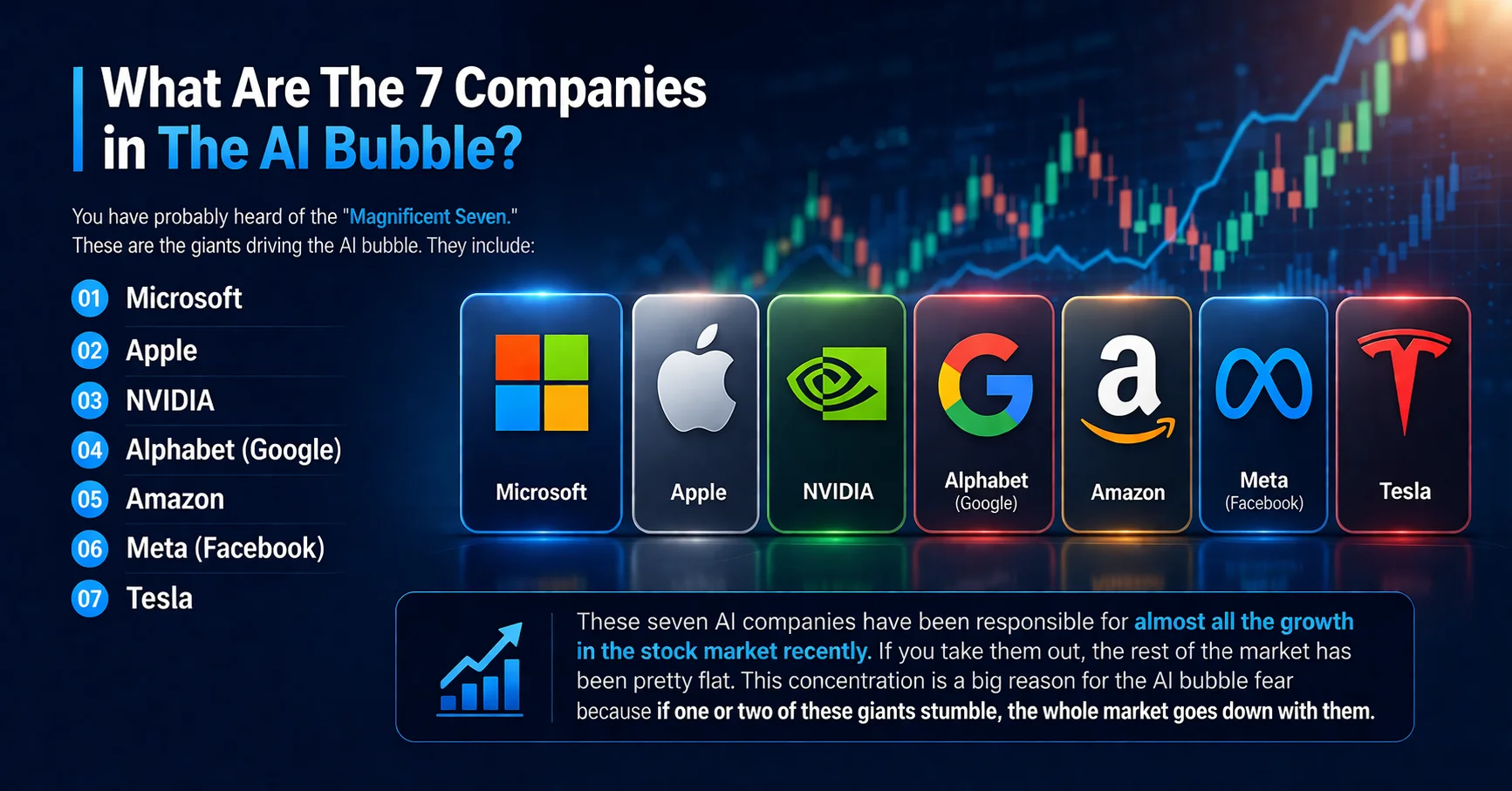
These seven ai companies have been responsible for almost all the growth in the stock market recently. If you take them out, the rest of the market has been pretty flat. This concentration is a big reason for the AI bubble fear because if one or two of these giants stumble, the whole market goes down with them.
What Is The $3 AI Stock Everyone Is Talking About?
There is always a “cheap” stock that influencers on TikTok or Reddit try to push as the next gold mine. In the short term, these penny stocks can jump 50% in a day, but they are often the most dangerous neighborhood of the AI bubble. Right now, tickers like SoundHound AI (SOUN) or C3.ai (AI) often dip into that low-price territory, attracting a lot of “get rich quick” energy.
Many of these $3 stocks are what the industry calls “wrappers”, companies that do not actually own any unique technology. They just changed their name or added an AI feature to an old product to trick investors into a frenzy. Be very careful with these plays. Without a solid price earnings ratio or a list of actual, paying customers, these speculative bets are the first to vanish when the AI bubble burst finally hits.
AI Market Realities and Bubble Indicators Table
Table 1: Big Tech or The Magnificent 7
| Entity Name | Market Impact | Financial metric or indicator | Future Outlook or Risk |
| Microsoft | Participant in a massive data centre arms race; involved in a circular flow of cash with startups. | Hundreds of billions in capital expenditures. | High risk if circular revenue flows fail; could drag the entire market down due to high concentration. |
| Alphabet (Google) | Arms race participant in data centres; potential to disrupt smaller ‘wrapper’ startups by releasing free features. | Hundreds of billions in capital expenditures. | Likely to survive by absorbing market share from smaller startups during a correction. |
| NVIDIA | ”King’ of the market; sells the ‘shovels’ (chips) for the gold rush. Essential infrastructure backbone for major projects. | ———– | Difficult to replicate success; precarious if AI project demand or capital expenditure slows. |
| Apple | One of the seven giants driving the AI bubble and responsible for almost all market growth. | ———– | If it stumbles, the whole market risks going down due to heavy index concentration. |
| Amazon | Major investor in data centres and cloud services; core driver of AI-led market growth. | ———– | Vulnerable to a broader market downturn if the AI bubble bursts. |
| Meta (Facebook) | Key player in the Magnificent Seven driving the current market cycle. | High price-earnings ratio. | Significant risk to the broader economy if its stock value stumbles. |
| Tesla | One of the seven companies responsible for nearly all recent stock market growth. | ———– | High concentration risk; failure impacts the entire market. |
Table 2: startup & investment
| Entity Name | Market Impact | Financial metric or indicator | Future Outlook or Risk |
| OpenAI | Large-scale model developer with millions of users; recipient of Big Tech investment. | High training costs (thousands of chips, massive electricity). | Must prove real profits over ‘cool demos’ to survive investor demands. |
| Anthropic | Major AI model developer with a significant user base. | ———– | Vulnerable if capital expenditures continue to outpace revenue. |
| Wrapper Startups | Companies that add a user interface on top of existing models like ChatGPT. | ———– | Expected to fail when Big Tech releases similar features for free; first to lose ‘bubble cash’. |
| $3 AI Penny Stocks | Speculative assets often driven by social media hype (TikTok/Reddit). | $3 share price; often lacks solid price-earnings ratios. | First to disappear or go to zero when the bubble burst occurs. |
FAQ
1. Which 3 jobs will survive AI?
While no job is 100% “safe,” three areas that seem very resilient are:
Skilled Trades: Plumbers, electricians, and carpenters. AI cannot fix a leaky pipe in your basement.
Healthcare Professionals: Doctors and nurses require a level of physical empathy and complex physical tasks that AI is nowhere near doing.
High-Level Strategy and Ethics: People who have to make the final “human” call on big moral or business decisions.
2. Is a financial crash coming in 2026?
Nobody has a crystal ball, but many economists are worried. With the price earnings ratio of tech giants so high and the AI bubble fear growing, a major correction is possible. If the AI bubble burst happens, it could trigger a broader market downturn, especially since the market is so concentrated in those seven big companies.
3. Did Bezos say the AI bubble is real?
Jeff Bezos has been more focused on the long-term potential of the technology. While he has not explicitly called it a “fake bubble,” he has often spoken about how the “hype” usually precedes the real, stable growth. Most big tech founders will not call it a bubble because their own wealth is tied to the tech stocks staying high, but their actions—like selling off large chunks of stock, sometimes tell a different story.
4. Is AI bubble real or fake?
The bubble in AI is seen to be very real when one considers how stocks are hyped and overvalued compared to the level of implementation, with several analysts likening it to the dot-com bubble of the 1990s. Whereas AI technologies have truly been revolutionary, the present-day valuations of numerous AI companies and “reciprocal investments” by tech behemoths are believed to be unsustainable.
5. What are the 7 companies in the AI bubble?
The “Magnificent 7” tech companies are Alphabet, Apple, Amazon, Microsoft, Meta, Tesla, and Nvidia.
Conclusion
In the end, the AI bubble is a mix of incredible technology and insane financial mania. We are using tools today that felt like science fiction five years ago. That part is real. But the idea that every company is worth 100 times its earnings just because it uses a chatbot? That is the part that feels like a bubble.
Make sure you keep some defensive stocks in your mix and do not get caught up in the AI-driven madness without doing your homework. The AI bubble burst might be messy, but the companies that actually provide value will be the ones left standing when the smoke clears. Just try not to be the one holding the bag when the circular flow of money finally stops spinning. Keep your head on straight, watch your capital expenditures, and do not let the FOMO get the best of you in this weird, AI-driven year of 2026. And if you’re betting on AI, bet on tools that actually drive results, like Jarvis Reach.