With the fast changing digital world, one of the most important decisions a developer or a business owner can make is the location and method of hosting the applications. Although Google cloud computing is a giant in the market, with powerful tools to achieve worldwide expansion, it is not the only way to success. Nowadays, democratization of technology has resulted in the fact that deployment has become more affordable, be it a huge cloud infrastructure or a specialized AI server.
Learning about the subtleties of the IaaS PaaS SaaS hierarchy is key to cutting on cloud and server expenses. The possibilities are limitless between the proven abilities of an aws cloud environment and the specialized abilities of oracle cloud computing. This guide discusses the way to such environments, so that your software is delivered to the user in an efficient and cost-effective manner.
What is Deployment?
In its simplest sense, deployment is the process of getting a piece of software that is in a local development environment into a live and functional state in which users can interact with it. It is not merely uploading files, but a complex lifecycle which has environment configuration, code integration, and live monitoring. This process may be automated in a modern cloud infrastructure with the help of CI/CD pipelines to make sure that updates are smooth and free of bugs.
Constraints to Deploy a Website
Before you can unlock the potential of Google cloud computing or any other large provider, you need to know the technical and financial challenges that may hinder a seamless introduction. The only way to manage these traditional constraints in order to have a consistent cloud and server connection is to navigate these limitations.
Hardware and Maintenance Overheads
Management of physical or virtual infrastructure is one of the greatest challenges. Traditional constraints are the constant maintenance of servers, which involves time and specialized skills.
- Upfront Capital Expenditure: Hardware is very costly to get into and this can be a big hurdle to startups and individual developers.
- Infrastructure Management: Patching operating systems and hardware lifecycle management processes may consume resources in a cloud infrastructure model, even though they are not directly related to core product development.
- Scaling Friction: Cloud and server capacity can be slowed during manual scaling to satisfy traffic, especially when you do not have costly automation software.
Technical Complexity and Tooling
A steep learning curve is common with professional backend management software used by developers. These tools are effective yet very specialized and they need a lot of specialization to be effectively used.
- Database Administration: To master relational database management with the help of sql server management studio, a lot of training and knowledge on schema optimization is required.
- Security and Identity: Developers are often troubled by the administration of purchasing domain names and setting up of the SSL certifications to have secure traffic.
- Environment Parity: It is always a challenge to make the code run identically on a local machine to how it would in an aws cloud environment or a live AI server.
The Management vs. Control Trade-off
The most strategic constraint is perhaps the selection of the appropriate service model. The choice of IaaS PaaS SaaS models requires a deep understanding of the abilities of your team.
- Decision Fatality: This is about deciding the extent to which you want to have granular control over the cloud and server environment as compared to how much management you are comfortable delegating to the provider.
- Operational Complexity: IaaS (Infrastructure as a Service) appears to be a more complex choice, necessitating a specific DevOps position.
- Vendor Lock-in: Selecting a very controlled SaaS or PaaS service may result in increased expenditures and less adaptability in case you desire to change your cloud platform to oracle cloud computing or another host.
How Google Cloud Computing helps to deploy an application?
Google cloud computing offers an integrated environment that is meant to make an application out of a simple idea into a worldwide sphere. GCP provides developers with a choice of abstraction by providing a range of services within the IaaS PaaS SaaS framework.
Key Features of GCP Deployment
- Google App Engine (PaaS): This can be deployed serverlessly, meaning that Google manages the underlying cloud infrastructure, and you only need to focus on the code.
- Google Kubernetes Engine (GKE): When more control is required, GKE offers a controlled environment to use in containerized applications that is between cloud and server management.
- Compute Engine (IaaS): This provides bare virtual machines onto which you can install your own stack such as an AI server stack or a custom database engine.
- Cloud SQL: This service is also managed and does not require the manual configuration of the sql server management studio, with automatic backups and updates.
Through these tools, business entities can be guaranteed of high availability and low latency although it is usually accompanied with a complicated pricing scheme which may require a professional invoice generator to monitor the spending made monthly among the different API calls and storage buckets.
11 Essential Tips for Deploying Applications Without Google Cloud Computing
Moving away from google cloud computing opens up a world of diverse cloud infrastructure options. These are the professional tips to managing your cloud and server environments to make sure that your deployment is successful and cost-effective.
1. Embrace Containerization with Docker:
To be able to run your application in the same manner whether in an aws cloud environment or on a local server, adopt Docker.
2. Leverage AWS Elastic Beanstalk for Automation:
In case you desire a hands-off experience like the App Engine on GCP, AWS Elastic Beanstalk has performance capacity provisioning, load balancing, and auto-scaling automated.
3. Prioritize Stateless Design:
You should not store user data on your AI server. Use third-party databases or object storage. This will greatly simplify the process of scaling your cloud infrastructure horizontally in the event of traffic spikes.
4. Implement CI/CD Pipelines:
Deploy GitHub Actions or GitLab CI/CD. By automating your builds and tests, you can be sure that each deployment to your cloud and server infrastructure has been checked and is safe.
5. Explore Oracle Cloud Computing for Databases:
In case your app is data-intensive, oracle cloud computing has high-performance autonomous databases which in many cases offer a more cost-effective enterprise-level IaaS PaaS.
6. Utilize Managed AI Services:
You don’t always need to build your own AI server from scratch. Platforms like Heroku or specialized AI hosting providers offer managed inference engines that simplify the integration of machine learning models.
7. Master SQL Server Management Studio (SSMS):
Even when hosting outside of Google, sql server management studio is the best tool for managing SQL databases across different cloud infrastructure providers.
8. Use a Digital Invoice Creator for Budgeting:
Cloud costs can spiral. Monitor your expenditure with various providers with an automated invoice creator to prevent bill shock at the month’s end.
9. Adopt Blue-Green Deployment Strategies:
To reduce downtime, have two identical environments. Divert traffic to the Green (new) environment on passing all checks and have the Blue (old) environment as a backup.
10. Optimize Your Cloud and Server Latency:
Select data center locations that are most proximate to your major users. In the typical aws cloud environment, most providers will enable you to choose particular geographic locations.
11. Test Locally Before Pushing:
Always debug your application in a local environment. This saves time and reduces the number of failed attempts recorded in your logs.
Consequences of using Google Cloud Computing
While google cloud computing is undeniably powerful, it is not without its drawbacks. For small startups or individual developers, the complexity of the GCP console can be overwhelming. The “pay-as-you-go” model, while flexible, can lead to “bill shock” if services are not monitored correctly. Unlike an aws cloud environment, which has a very mature “Free Tier,” GCP’s free credits can disappear quickly when testing an intensive AI server. Furthermore, the proprietary nature of some Google services can lead to “vendor lock-in,” making it difficult to migrate your deployment to oracle cloud computing or another provider later on.
Popular 3 Alternatives for GCP Platforms
In case you want to switch out of google cloud computing there are a number of strong options available, each has its own benefits in terms of cloud infrastructure and convenience of use.
Amazon Web Services (AWS)
The aws cloud environment is the market leader for a reason. It offers the most extensive array of services, from Lambda (Serverless) to EC2 (IaaS). For those accustomed to high-performance computing, AWS provides specialized instances that act as a powerhouse AI server, often outpacing competitors in raw GPU availability.
Oracle Cloud Computing
In recent years, Oracle cloud computing has taken a big step especially in the case of database requirements in enterprises. In case your application is highly dependent on complex relational data, the combination between the cloud infrastructure provided by Oracle and their autonomous database services cannot be matched.
Heroku and Managed Platforms
Heroku offers a PaaS model that eliminates the requirement to comprehend the underlying cloud and server infrastructure, to those developers who desire the simplest deployment possible. Although it is more costly at scale, the time saved in configuration can be worth the cost when prototyping quickly.
At Jarvis Reach, we believe in empowering your outreach through smart tech. If you’re building tools to find leads, ensure your hosting is as reliable as your data. Check out Jarvis Reach for your B2B needs.
| Feature | Google Cloud Computing (GCP) | AWS Cloud Environment | Oracle Cloud Computing | Heroku (Managed PaaS) |
|---|---|---|---|---|
| Core Model | IaaS, PaaS, SaaS | IaaS (EC2), PaaS, SaaS, Serverless (Lambda) | IaaS, PaaS, Strong SaaS for databases | PaaS (abstracts cloud and server infra) |
| Strength in Deployment | Fast Kubernetes-based deployment | Extensive services for scalable deployment | Autonomous database for complex relational data | Simplest deployment; no cloud infrastructure management needed |
| AI Server & GPU Power | Strong AI/ML tools (TPUs) | High-performance AI server instances; top GPU availability | Solid for enterprise AI with databases | Limited; focuses on app deployment, not raw AI server power |
| Database Management | Cloud SQL; integrates with SQL Server Management Studio | RDS; broad SQL support | Unmatched autonomous databases | Add-ons for Postgres/MySQL; no native SQL Server Management Studio |
| Cloud Infrastructure Scale | Reliable global network | Market leader in extensive cloud infrastructure | Enterprise-grade for heavy relational workloads | Costly at scale; ideal for quick prototyping |
| Pricing Example | Pay-per-use; competitive for AI | Volume discounts; invoice creator tools available | Aggressive free tiers for databases | Usage-based; higher for production-scale cloud and server needs |
| Best For | Balanced AI/ML and multi-cloud | Power users needing vast services | Database-heavy enterprise apps | Developers prioritizing speed over cost |
How AI is replacing Deployment tools (Vercel, Antigravity, Lovable, Cursor)
The world of deployment is undergoing a radical shift thanks to Artificial Intelligence. We are moving away from manual configurations in an aws cloud environment toward “Vibe Coding” and AI-driven hosting.
The Rise of AI-Native Environments
New platforms like Lovable and Antigravity allow users to describe an application in plain English, and the AI handles the IaaS PaaS SaaS selection automatically. Tools like Cursor (an AI code editor) integrate directly with cloud infrastructure, allowing you to fix server errors and redeploy without ever leaving your IDE. This practically makes the AI a virtual DevOps engineer to control your cloud and server health 24/7. The barrier to entry to complex machine learning projects has already been reduced by the possibility of setting up a specialized AI server through prompt-based instructions.
How Are Invoices Generated After Deployment?
Once your application is live on google cloud computing or an aws cloud environment, the billing cycle begins. Managing these costs is a vital part of the deployment lifecycle.
Understanding Cloud Billing
Most providers use a metered billing system. Every gigabyte of traffic and every hour of AI server uptime is tracked. To make sense of this, many companies use an automated invoice creator that integrates with their cloud’s billing API. This ensures that you aren’t surprised by costs associated with your cloud infrastructure. Whether you are using oracle cloud computing or a smaller VPS, having a transparent invoice creator helps in maintaining a healthy “burn rate” for your startup.
Checklist before you publish a website
Before hitting the final button on your google cloud computing console or aws cloud environment, ensure you have checked the following:
- Security Protocols: Are your SSL certificates active?
- Database Connectivity: Does your sql server management studio have a secure remote access configuration?
- Scalability: Have you selected the appropriate IaaS PaaS SaaS model to support a traffic spike?
- Monitoring: Do you have logs being sent to your cloud and server monitoring dashboard?
- Billing Alerts: Have you set up your invoice creator or billing limits to avoid overspending?
- AI Server Health: If running models, are the GPU temperatures and memory usage within limits?
Choosing the Right Service Model: IaaS, PaaS, or SaaS?
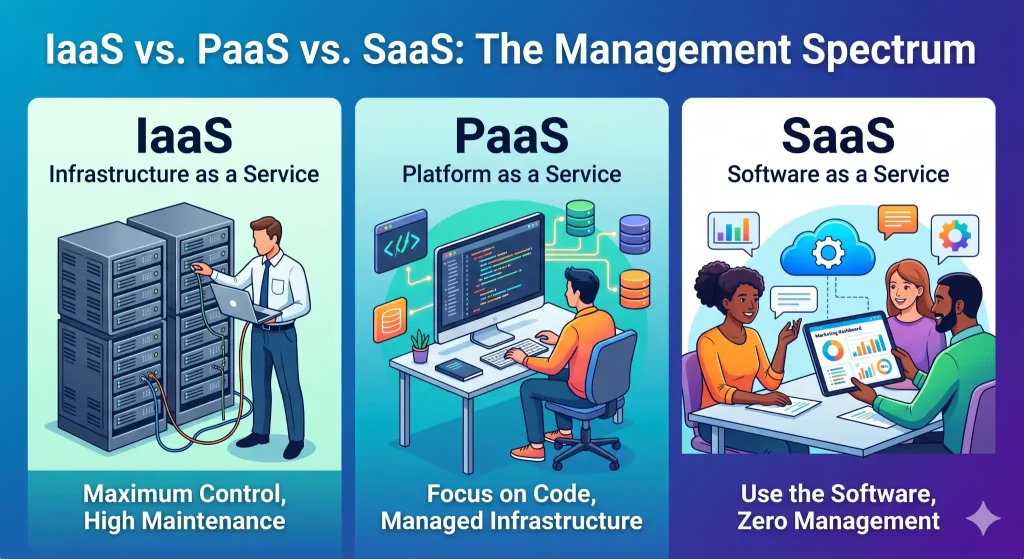
The most crucial step in cloud infrastructure planning is making the choice between IaaS PaaS SaaS.
- IaaS (Infrastructure as a Service):
Provides the greatest level of control. You lease the cloud and server computers but control the OS and middleware..
- PaaS (Platform as a Service):
Ideal to developers. You manage the app; the provider manages the server. This is the sweet spot for many google cloud computing users.
- SaaS (Software as a Service):
You simply use the software. A digital invoice creator like Quickbooks is a perfect example of SaaS.
Leveraging SQL Server Management Studio in the Cloud
Even when the SQL databases are in an aws cloud environment or oracle cloud computing, SQL database management is still done using the gold standard, the SQL server management studio (SSMS). Connecting SSMS to your cloud-hosted database, you have the ability to have a granular control on your data structures, and this is crucial to any application that needs to have complex data manipulation and reporting.
Optimized Cloud and Server Management
Balancing your cloud and server resources is a continuous task. If your AI server is sitting idle, you are wasting money. Modern platforms now offer “auto-pausing” features, which shut down your cloud infrastructure during periods of inactivity. This is particularly useful in oracle cloud computing environments where enterprise resources can be costly. By optimizing these connections, you ensure that your google cloud computing bill stays manageable.
Ready to scale your business? Just as you optimize your cloud, optimize your sales funnel with Jarvis Reach. Start your free trial today!
Conclusion
The world of Google cloud computing and its numerous alternatives is a strategic area of deployment. Knowing the distinctions between an aws cloud and oracle cloud computing, and the right IaaS PaaS SaaS model, you can create a strong and affordable cloud infrastructure. The integration of AI into the cloud and server management process is only going to accelerate, making tools like an automated invoice creator and AI-driven coding editors indispensable. Whether you are managing a database via sql server management studio or launching a high-powered AI server, the key to success lies in preparation and the right choice of tools.
Stop manually searching for leads and let AI do the heavy lifting for your business growth. Explore Jarvis Reach now to revolutionize your outreach!
FAQs
1. Which platform is best for deployment?
The most appropriate platform is based on your needs. Google cloud computing and the aws cloud environment are leading in the industry to provide high scalability and worldwide reach. When you value ease of use and developer experience, Vercel or Heroku are good choices to quickly deploy. Oracle cloud computing is usually preferred to those who require heavy integration of databases.
2. What are the 5 steps of deployment?
- Planning: Choose your IaaS PaaS SaaS model and cloud infrastructure.
- Development & Build: Build your code and dependencies (usually with Docker).
- Testing: Check the code on a testing system that should resemble your cloud and server configuration.
- Release: Test the code to production, perhaps with a Blue-green or Canary strategy.
- Monitoring: Monitor performance using tools and make sure your invoice generator is representative of actual usage.
3. Which cloud service is best for deploying applications?
A PaaS ( Platform as a Service ) is preferable to most of the current web applications since the cloud infrastructure is managed. Popular are Google App Engine and AWS Elastic Beanstalk. But when you have heavy machine learning models running you might need a specific IaaS PaaS SaaS configuration that contains a specialized AI server.
4. Is Google Cloud necessary?
No, it is not a necessity that one uses Google cloud computing. There are numerous applications that have been successfully deployed on an aws cloud platform, oracle cloud computing, or even smaller platforms such as DigitalOcean. This is dependent on your budget, how well your team knows software such as the sql server management studio and the technical needs of your cloud and server setup.
5. How can I manage database tasks without complex tools?
Although the sql server management studio is a powerful tool, it is now being supplanted by web-based consoles that are offered by many cloud providers, making the administration of databases easier. These tools also enable you to do simple queries and schema operations without installing heavy software, although SSMS is the best when performing a comprehensive administrative operation.
6. What is the role of an invoice creator in cloud computing?
An invoice generator can assist in automating the billing process of your users or your own accounting department in a complex cloud infrastructure. Given that the cost of using the cloud computing services of Google and other vendors depends on fine-grained usage, these tools assist in converting technical records into financial statements.