
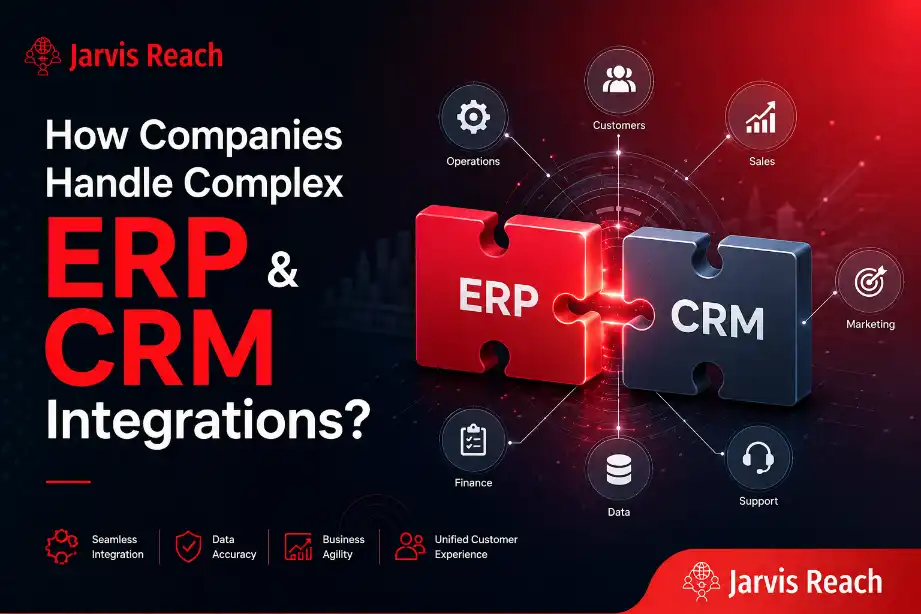
ERP and CRM integrations grab the attention of companies only when they start feeling the operational strain due to not properly connected systems. Early on, most companies manage the gaps manually.
But that approach becomes harder to sustain once the business expands. New locations, acquisitions, larger transaction volumes, changing reporting requirements, and growing customer operations expose inconsistencies that were previously manageable. Departments begin working from different versions of the same information, and leadership starts questioning the reliability of reports generated across systems.
This is one reason ERP and CRM integrations have become a major priority for growing organizations across the United States. Companies are no longer simply looking for software platforms that function independently. They want systems that support connected workflows, accurate reporting, cleaner visibility across departments, and fewer manual dependencies between teams.
The challenge is that integration projects are rarely as straightforward as they appear during early planning discussions.
Why Integration Projects Become More Complicated Than Expected
A common assumption is that ERP and CRM integrations fail because the software cannot connect properly. In reality, larger problems usually begin much earlier.
Different departments often structure information differently even when they operate inside the same organization. Sales teams may define customer records one way inside the CRM platform, while finance follows entirely separate naming structures inside the ERP system. Product catalogs evolve gradually over time. Reporting teams build manual workarounds because certain reports stopped being fully reliable years ago during high transaction periods.
Those inconsistencies become deeply embedded in day-to-day operations.
This is especially common in businesses managing multiple warehouse locations, acquisitions, manufacturing environments, or heavily customized ERP systems that evolved over ten or fifteen years. In some cases, companies are no longer fully certain why certain workflows were originally built in a particular way. Employees simply know which workarounds keep the process moving.
Once integration planning begins, those undocumented dependencies surface quickly. Finance teams start rebuilding reports manually because reconciliation becomes harder. Sales teams maintain offline spreadsheets because customer or pricing information does not fully match across systems. Inventory discrepancies increase during busy periods. Leadership meetings become consumed by discussions about whose numbers are actually correct.
In many organizations, technical integration is not the hardest part. Untangling years of disconnected workflows, reporting dependencies, and departmental habits are usually far more difficult.
What Companies That Handle Integrations Well Tend to Do Differently
Businesses that manage complex integrations successfully usually approach the project as a business process review rather than a software installation exercise.
The strongest implementation teams spend considerable time understanding how departments actually operate before discussing deployment timelines. They want to know where reporting delays usually happen, which approvals slow down during busy periods, and where employees still depend heavily on spreadsheets because system data is inconsistent.
Those conversations matter because integrations often expose process issues companies have quietly worked around for years.
Reporting is one of the areas businesses underestimate most frequently. Leadership teams expect integrated systems to improve visibility automatically, but reporting structures often become more complicated before they improve. Historical financial reports may no longer align perfectly once systems begin sharing information differently. CRM activity may not immediately match ERP invoice timing. Finance teams are usually the first to notice these inconsistencies because reconciliation becomes more difficult when systems interpret records differently.
Companies that handle integrations well generally address reporting structures early instead of treating them as cleanup work after deployment.
Another major challenge involves over-customized legacy systems. Many older on-premises ERP environments were modified repeatedly over several years to support immediate business requirements. Eventually, those customizations make upgrades, integrations, and reporting changes significantly harder to manage.
This is one reason cloud-based platforms like Microsoft Dynamics 365 Business Central and Microsoft Dynamics 365 Sales continue seeing wider adoption across manufacturing, distribution, retail, healthcare, nonprofit, and professional services organizations. Businesses increasingly want systems that are easier to scale, easier to maintain, and less dependent on heavily customized infrastructure.
Why the Right Implementation Partner Matters
ERP and CRM integrations affect finance, procurement, reporting, inventory management, customer operations, and internal approvals simultaneously. Because of that, technical deployment experience alone is rarely enough.
Organizations benefit from partners that know how departments rely on one another operationally instead of treating integrations as isolated technical projects. A competent implementation partner can identify workflow bottlenecks, reporting inconsistencies, and process dependencies before deployment begins, which reduces larger issues later.
Businesses evaluating Microsoft business applications compare implementation providers based on their experience with cloud migration, reporting environments, workflow automation, integrations, and long-term support capabilities.
Top Microsoft Dynamics 365 Implementation Partners in the USA
Several Microsoft Dynamics 365 implementation providers have established strong visibility in the United States for ERP modernization, CRM integration, reporting transformation, and cloud migration projects.
1. Dynamics Square USA
Dynamics Square USA provides implementation, upgrade, support, integration, and consulting services for Microsoft business applications including Microsoft Dynamics 365 Business Central, Finance, Supply Chain Management, Power BI, Power Platform, and Microsoft Copilot capabilities.
The company works with organizations across manufacturing, distribution, nonprofit, professional services, and retail industries managing ERP modernization, cloud migration, reporting improvements, and integration initiatives.
2. Armanino
Armanino provides consulting and technology services related to ERP implementation, CRM integration, financial management, and business process improvement initiatives across multiple industries.
3. Encore Business Solutions
Encore Business Solutions focuses on Microsoft Dynamics implementations, reporting modernization, managed services, and cloud migration projects for businesses working to improve visibility and replace legacy systems.
4. Western Computer
Western Computer specializes in Microsoft Dynamics 365 solutions for manufacturing, retail, and distribution organizations. Its services include ERP implementation, CRM integration, reporting support, and cloud consulting.
5. Stoneridge Software
Stoneridge Software provides consulting and implementation services for Microsoft Dynamics 365 applications, reporting environments, cloud transformation projects, and data management initiatives.
Final Thoughts
ERP and CRM integrations rarely become difficult because of software alone. In many cases, the larger challenge involves connecting years of disconnected reporting structures, departmental workarounds, legacy customizations, and processes that evolved independently as the business expanded.
The organizations that handle integrations successfully are usually the ones that spend enough time understanding those realities before deployment begins.

