Most SEO efforts focus on getting traffic to your website. That means more clicks, more impressions, and more page rankings, because that leads to more revenue for you. But in B2B, traffic alone doesn’t move deals forward. A visitor who is only exploring a topic is very different from someone who is ready to make a purchase decision, and treating them the same leads to content that attracts attention but does not convert. That’s why working with an SEO company or SEO service provider is important; they can help you improve visibility and convert traffic to keep everything in your sales funnel aligned.
What Alignment Between SEO and the Sales Funnel Means
Every search has a different intent. Some people are learning about the product, some are comparing the options, and others are ready to act. If you are unable to match the intent to the right content, it creates friction. For instance, a detailed service page shown to someone who is still researching will feel too early. On the other hand, a general blog shown to someone ready to decide feels incomplete.
That’s where aligning SEO and your sales funnel comes into play. It connects the right type of content to the right stage in the buying process. Instead of only focusing on keywords, the focus should shift to how those keywords fit into the funnel.
Understanding the B2B Sales Funnel Stages
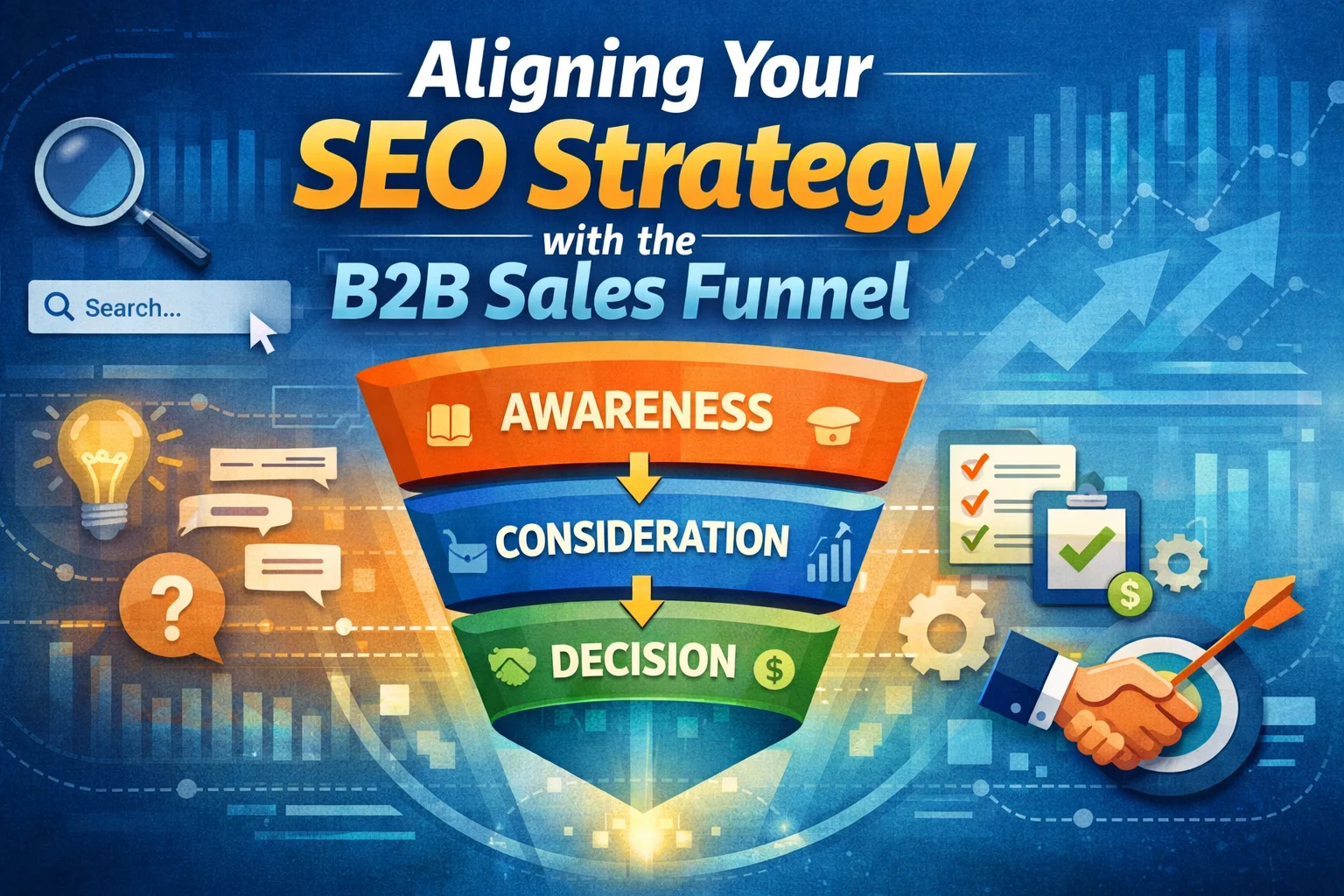
The B2B funnel is longer and more layered than the B2C sales funnel. Decisions take time, involve multiple people, and often require research before action. It can be broken into three main stages:
- Awareness. At this stage, the buyer is identifying a problem or trying to understand something new. They are not looking for a provider yet.
- Consideration. In this stage, they are exploring options. They understand the problem and want to see how it can be solved.
- Decisions. Here, the customer is ready to make a decision. They are comparing providers, pricing, and specific offerings.
Each stage requires a different type of content that speaks to the buyer accordingly.
Mapping Search Intent to Each Funnel Stage
Search intent is what sits behind every search query. People aren’t just typing words into a search bar. They’re trying to solve, understand, learn, and decide about something. At the awareness stage, searches are usually broader in nature. They often begin with questions, because the goal is to understand a topic, not take immediate action.
As the user moves forward towards the next step, the searches become more focused. At this point, businesses start comparing options or looking for different ways to solve a problem.
By the time they reach the decision stage, the intent becomes direct. Searches often include services, providers, pricing, or location. You can usually tell where someone is in the funnel just by how specific their search is. The more information they seem to have, the further along they’ve made it.
Creating Content That Matches Each Stage
Once you understand the search intent, the next step is mainly adjusting your content to match the stage. Each stage requires a different approach; the tone, depth, and purpose all shift depending on exactly what the reader is looking for.
Top of Funnel (Awareness Content)
At this stage, your content should help the reader understand a topic without pushing a service too early. This includes informational blog posts, guides, and other educational content. The focus is more on explaining problems, breaking down concepts, and answering common questions. Rather than promoting a service, you need to explain what a problem is and why it matters, because that’s how you build trust and awareness. It shows that you understand the space without immediately trying to sell something.
Middle of Funnel (Consideration Content)
In this stage, the reader is looking for a direction. They’re now aware of the problem and want to explore solutions. When you’re creating content at this stage, try including more comparisons, detailed explanations, and method-based articles, and explain how readers can work towards a solution. Content must be helpful and guide the reader closer to the decision. Here, positioning yourself as a knowledgeable, trustworthy name can make a significant difference in bringing a user to the end of the funnel.
Bottom of Funnel (Decision Content)
This stage is where clarity is necessary. The readers are ready to take action, but they need confirmation. That means all your content needs to be direct and specific, from your service pages to your case studies. Don’t be broad or generic; your focus is now on outcomes, so your content should explain what the process looks like, what results to expect, and how you solve the problem.
Where Most SEO Strategies Go Wrong
Strategy is key to a successful SEO campaign. Without a proper plan in place, you may make a mistake such as:
- Focusing only on traffic: Chasing ranking without thinking about what happens after the click. If the traffic comes in but there is no clear next step, the effort becomes meaningless.
- Content that ranks but does not guide: A lot of pages are written to match the keywords and answer the question, but these do not help the reader move to the next step or lead anywhere.
- Too much top-of-funnel content: Awareness content is easier to produce, so it often takes over the strategy. But in the absence of mid and bottom funnel pages, users have no path to continue.
- Repetition without new value: The same topics get rewritten again and again. Nothing new is added, so users skim and leave instead of engaging.
- Ignoring search intent: Keywords are targeted, but intent can get overlooked. If the content does not match what the users actually want, it will not lead to conversions, no matter how well it ranks in the search results.
Many people make these mistakes. But by learning to recognize them, you can keep your campaign focused on producing results.
How to Build an SEO Strategy Around Your Funnel
Start by mapping your existing content. Look at what you already have and identify where it fits in the funnel. You may find gaps, for instance, strong awareness content, but very little that supports decision-making. Next, plan content based on intent. Instead of creating random topics, build them around the funnel stages. Each piece should have a clear role.
Finally? Connect your content. Internal linking plays a big role here. A reader starting with an awareness article should have a clear path towards more detailed content and eventually decision-focused pages. Consistency also matters because publishing one piece at each stage is not enough; you need to sustain your strategy over time.
How to Measure Whether Your SEO Funnel Is Actually Working
To determine if your SEO funnel is actually working or not, you need to assess:
- Traffic: High traffic can look good on paper, but it does not tell you what users are doing once they land on your site.
- User movement: Look at how people move between pages, are they exploring further, or leaving after one visit?
- Engagement: Metrics like time on page and pages per session give you a clearer picture of how your content is being used.
- Conversion rates: Form fills, inquiries, and clicks hold more value than raw visits. These actions show that users are moving forward.
- Content progression: When users move from awareness content to deeper pages, your funnel is doing its job. If they drop early, something is off.
All of these indicate real, measurable performance and give you valuable information about whether your SEO campaign is actually working.
Conclusion
SEO becomes more effective when it is built around how people make decisions, not just how pages rank. When content is mapped to each stage of the funnel, users don’t land on a page and stop. If your strategy feels disconnected, the issue is usually not visibility; it’s structure. If you can align your content with intent, your website stops being a collection of pages. It starts functioning as a system that supports real decisions and leads to real results.