The Social Selling Index can still be checked in 2026, but LinkedIn is changing how users access it. Free LinkedIn users are starting to see a message about SSI access ending soon. This has left many users wondering what happens next.
Is the SSI score gone? Do you need Sales Navigator to view it? What happens to the old SSI dashboard?
This guide explains the latest update. You will learn about how SSI works and what the score means. We also look at why LinkedIn is shifting its focus toward sales intelligence and measurable sales results.
How to Check Social Selling Index Score in 2026
The Social Selling Index score can be checked from LinkedIn’s SSI page. Sign in to your LinkedIn account first. Then open the page to see whether your SSI dashboard is available.
There is an important change in 2026. Some free users now see a notice saying that access to the SSI page will be discontinued soon.
So, opening the SSI page does not guarantee that your SSI score will appear. The screen you see depends on the access available to your account.
Checking Your Score Through LinkedIn
If your account still has access to the SSI dashboard, the process is simple:
- Sign in to LinkedIn.
- Open the SSI page.
- Look for your SSI dashboard.
- Review your overall score and the information shown with it.
If the dashboard appears, you can check your current score there.
However, the experience is different for accounts that have received the new access notice.
The SSI Page Looks Different for Some Users
Earlier, opening the SSI page could take you directly to your score. The dashboard showed your overall SSI score along with information about your social selling activity.
Now, some users are seeing a different screen. Instead of opening the score dashboard, LinkedIn displays a notice. he notice states that access to the Social Selling Index page will end soon. It says that in order to maintain access to SSI, you must obtain the Sales Navigator feature
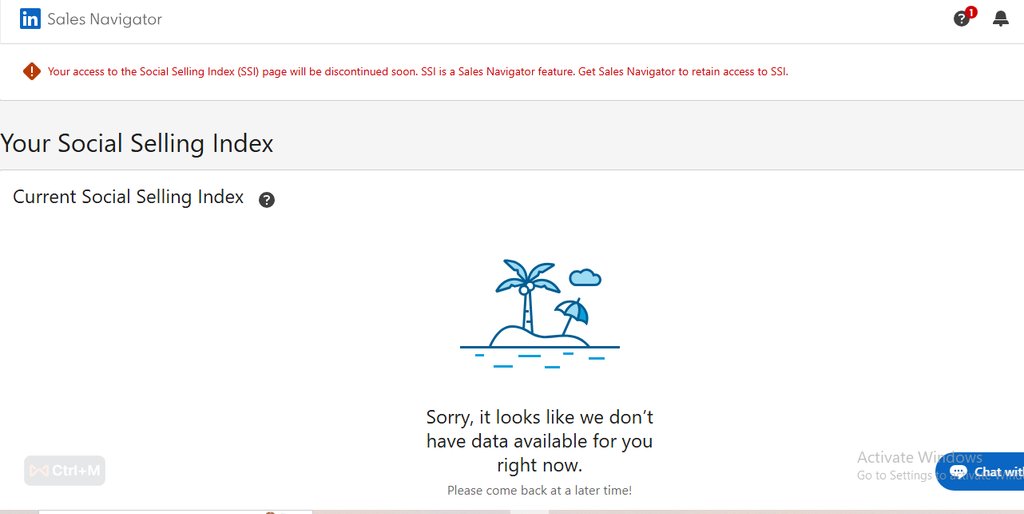
This creates an important gap for anyone searching for an SSI checker. The page may still open, but the score may not be available.
What the Change Means for Free Accounts
For free LinkedIn users, there may no longer be a reliable way to access the traditional SSI dashboard.
If your account still shows the score, you can use the existing page while that access remains available. If you receive the discontinuation notice, there is no separate free setting that can bring the old dashboard back.
LinkedIn’s current From SSI to AI resource also shows its approach to the metric is changing. SSI is being connected more closely with its wider sales technology and AI-powered tools.
This also explains why different accounts may show different screens during the transition. The change is not necessarily happening at the same time for every user.
Where Sales Navigator Fits In
The message shown to affected users points directly toward Sales Navigator.
LinkedIn’s current SSI resource places the metric within a broader sales environment. Sales Navigator helps you to find the right prospects. You can also use it to understand accounts and spot buying signals.
That makes the transition more than a simple change to where you find a number. The focus is moving toward using LinkedIn for actual sales work.
What to Do If Your Score Is No Longer Available
If the SSI dashboard has disappeared from your account, use LinkedIn’s own page to confirm your access status. Avoid trusting on third-party websites that claim to recover your private SSI score.
You can still apply the principles behind the metric. Build a credible LinkedIn profile. Improve your sales prospecting. Share useful information. Develop genuine business relationships. These activities remain relevant to social selling, even if the SSI score is no longer available to you.
What Is Changing With LinkedIn Social Selling Index in 2026?
The Social Selling Index is changing in 2026. LinkedIn is moving away from the old SSI experience and placing greater emphasis on Sales Navigator and AI-powered selling. The shift matters because SSI was designed to measure social selling activity, not the full picture of sales success.
LinkedIn now says a high SSI score does not always represent a seller’s effectiveness or connect with measurable sales outcomes. A high score alone will not help to close deals. LinkedIn is now pushing sellers to focus on the prospects and conversations that can lead to real business.
For free users, the change is already visible. Some accounts receive a notice that the SSI page will be discontinued soon. To keep access, you have to get Sales Navigator.
From SSI Scoring to AI-Powered Selling
The change is bigger than moving a dashboard behind a paid product.
LinkedIn’s current SSI resource is titled “From SSI to AI.” That wording reflects the direction of its sales platform. The company is putting more attention on AI tools that can reduce manual work and help sellers identify useful opportunities.
SSI once gave sellers a simple number to track. The newer approach is more focused on what sellers can do with the information available to them.
That includes researching accounts, finding relevant contacts, spotting buying signals, and preparing more useful outreach.
Why SSI Is No Longer Enough to Measure Sales Success
A score can show activity. It cannot tell the entire sales story. Someone may have an active LinkedIn profile, engage with industry content, and maintain a large network. That does not mean they are creating qualified opportunities.
LinkedIn itself points to this limitation. Its current SSI page says that a high score doesn’t always link with measurable sales outcomes.
That is an important difference. Social selling can support sales work. SSI can measure certain behaviours around it. Neither one should be treated as a replacement for actual sales performance.
The Move Toward Sales Navigator
This is where the 2026 change becomes more important. Sales Navigator is mainly built around active selling tasks. It gives sellers tools for prospect discovery, account research, relationship mapping, and sales intelligence.
LinkedIn is also adding AI features to help sellers work through these tasks more efficiently.
The focus is moving from:
“How high is my Social Selling Index score?”
to:
“Am I finding the right people and creating better sales opportunities?”
That is a much closer connection to lead generation and revenue-producing work.
What the SSI Transition Means for Free Users
Free users are the group most likely to notice the change first.
The traditional SSI page may no longer show the familiar score dashboard. Instead, some users now see LinkedIn’s message explaining that access will be discontinued soon and that SSI is a Sales Navigator feature.
This creates a main problem for older guides. A tutorial published when SSI was freely available may still tell readers to open the SSI page and expect the four-part dashboard.
That advice may no longer match the experience of every account.
SSI Is Changing, but Social Selling Is Not
The disappearance or restriction of a score does not make the underlying skills useless.
A credible LinkedIn profile still matters. So does professional branding. Relevant B2B networking can help sellers build trust before sales conversion starts.
The same applies to customer engagement and business relationships.
These activities can support prospecting even when there is no SSI number to track.
The Bigger Shift: From Measuring Activity to Measuring Outcomes
This is probably the most useful way to understand the change. Sellers analyzed social selling behaviour easily with Social Selling Index. The newer direction asks a harder question: Did those activities create something valuable?
That could mean a qualified lead. It could be a meaningful conversation with a prospect. It could become an opportunity, pipeline, or closed deal.
For sellers, that means sales analytics and real business outcomes may become more useful than chasing a score.
Why Is LinkedIn Changing the Social Selling Index?
The Social Selling Index was useful for showing how actively someone used LinkedIn for social selling. But a score cannot show whether those activities actually lead to sales. LinkedIn now says a high SSI does not always reflect a seller’s effectiveness or connect with visible sales outcomes.
SSI Measures Activity, Not the Whole Sales Story
A seller can have a strong LinkedIn profile, an active network, and regular engagement. That still does not guarantee qualified leads or closed deals.
Real sales performance depends on what happens after those activities. Did the seller find the right prospect? Did a conversation start? Did it create an opportunity?
That is where the focus is changing.
From Social Activity to Sales Opportunities
LinkedIn is putting more attention on actions that can support lead generation and revenue. Finding relevant prospects matters more than simply increasing a score.
This means sales prospecting, account research, and meaningful business relationships become more important parts of the selling process.
The Role of AI in Modern Selling
AI can reduce repetitive work and help sellers find useful information faster. AI is changing how sellers use Sales Navigator. Sellers can use AI to find promising prospects. It can also help uncover useful sales insights. The main goal is not to be more active. It is to sell more effectively.
Why Sales Navigator Matters More
Finding prospects is only the first step. Sales Navigator also helps sellers understand accounts and find useful sales signals. This gives sellers information they can use during the buying journey rather than another activity score to chase.
How Was the Social Selling Index Score Calculated?
The social selling index was built around four areas of LinkedIn activity. Each pillar looked at a different part of the selling process. Together, they produced an SSI score from 0 to 100.
LinkedIn used account activity and engagement signals to assess these areas. The exact formula was not presented as a simple public equation. Instead, LinkedIn described the types of activity used in the calculation.
Establish Your Professional Brand
This pillar looked at how effectively your LinkedIn profile presented your professional identity. LinkedIn considered profile completeness and endorsements. Published articles and the followers gained from those articles were also part of the data used.
For sellers, the idea was straightforward. A credible profile gives prospects a reason to take you seriously.
Find the Right People
SSI also considered how you used LinkedIn to discover potential prospects. People searches, profile views, and the number of days you were active were among the signals LinkedIn used.
This pillar connected the score with sales prospecting. The focus was not only on having a large network. Finding relevant people mattered.
Engage With Insights
The third pillar measured how you interacted with information and conversations on LinkedIn.
LinkedIn included activities such as shares, likes, comments, and reshares. Messages and response rates also mattered. Group participation and engagement were included as well.
This reflected the idea behind social selling. Sellers could stay visible by contributing something useful rather than repeatedly promoting a product.
Build Relationships
The final pillar focused on relationship-building activity. LinkedIn measured connections and the response rate of connection requests.
That distinction matters. SSI was not designed to reward connection volume alone. The quality of your network and your ability to establish relevant relationships were part of the picture.
How the Four SSI Pillars Worked Together
The four pillars represented different stages of a social selling approach.
A strong professional brand could create credibility. Finding the right people helped identify prospects. Engaging with insights created opportunities for conversation. Building relationships helped turn those interactions into professional connections.
LinkedIn’s historical SSI dashboard showed these areas separately. Users could see where they were stronger and where they had room to improve.
For example, someone might have a polished LinkedIn profile but weak prospecting activity. Another seller could be active in conversations but struggle to build relevant connections.
That made the SSI score more useful as a diagnostic tool than as a simple popularity score.
Sales Navigator Activity Could Also Influence SSI
For Sales Navigator users, LinkedIn also used activity within the platform when calculating SSI. This included people searches, advanced searches, profile views, saved leads, and saved accounts.
This is important when looking at older explanations of SSI. The score was not based only on posts and likes. Prospecting behavior inside Sales Navigator could also contribute.
Industry Rank and Network Rank
The historical SSI dashboard gave users more context than a single number. It showed how their score compared with people in their industry and within their LinkedIn network.
This helped users understand whether their social selling activity was relatively strong or weak.
However, a rank is always a comparison. It does not prove that one person will generate more revenue than another.
SSI Score History and Trends
LinkedIn also allowed users to track how their SSI changed over time. The purpose was to help sellers benchmark their activity and set improvement goals.
That historical view added useful context. A score of 62 meant something different when it was rising steadily than when it had fallen from 75.
Still, the trend measured LinkedIn activity. It did not directly measure sales performance, revenue, or closed deals.
That distinction becomes especially important in 2026. LinkedIn states that the SSI score does not always reflect seller effectiveness or link with visible sales outcomes.
In short, SSI measured selling behavior on LinkedIn. It was never the same thing as measuring actual sales results.
What Is a Good Social Selling Index Score?
There is no universal SSI score that guarantees strong sales performance. LinkedIn historically described 70+ as a strong benchmark, while scores of 30 or below represented a lower level of social selling adoption. These figures came from LinkedIn’s earlier research. They are not a current 2026 grading scale.
| Social Selling Index score | Historical context | Practical interpretation |
| 0–30 | Lower range | More room to develop social selling habits |
| 31–69 | Middle range | Moderate adoption of LinkedIn selling practices |
| 70–100 | Higher range | Stronger adoption of social selling practices |
Reading Your SSI Score in Context
The real value of an SSI score lies in tracking progress over time. Moving from 45 to 60 is consisidered improvement. Even when the score is still below the historical 70 benchmark.
Your role matters too. A salesperson focused on lead generation may use LinkedIn differently from someone whose work centers on professional branding or business relationships.
Why 70+ Should Not Be Treated as a Rule
The old 70+ benchmark is useful when reading historical SSI advice. It should not become a target that sellers chase blindly. LinkedIn now states that a high SSI does not always reflect seller effectiveness or connect with visible sales outcomes.
So a more effective question is not “Is my SSI score high enough?”
It is “Is my LinkedIn activity helping me create better sales opportunities?”
How to Increase Your SSI Score and Social Selling Performance
Improving your social selling index starts with better activity on LinkedIn. But the main focus should not be to chase points. Build habits that can also support real sales performance.
Strengthen Your Professional Brand
Start with your LinkedIn profile. Keep your headline clear. Show what you do and mention what you solve. Add relevant experience and evidence of your expertise.
Credibility grows when your profile matches the value you share.
Find Relevant Prospects
Good sales prospecting begins with the right people. Search for prospects who match your target market. Look beyond connection counts.
Relevancy is more important than volume.
Share Useful Insights
Post information your audience can use. Discuss industry changes, common problems, or lessons from your work. Then join conversations where your expertise adds value.
This creates genuine customer engagement instead of passive visibility.
Build Stronger Relationships
Do not treat every connection as a lead. Start conversations naturally. Follow up when there is a relevant reason.
Strong business relationships take time to develop. The same approach supports lead generation. A useful profile attracts attention. Relevant conversations create openings. Consistent relationship-building can turn those openings into sales opportunities.
The best way to improve your SSI score is to become more useful, more relevant, and more intentional on LinkedIn.
Case Study: How Microsoft Used SSI to Track Sales Activity
LinkedIn published a case study on Microsoft’s social selling program in 2015. The company used SSI as a way to measure social selling adoption across its sales team. Microsoft combined SSI tracking with executive support, coaching, webinars, and CRM reporting.
The results were notable. LinkedIn reported that Microsoft’s SSI leaders received 34% more profile views than other team members. They also connected with 74% more decision-makers. Microsoft found that every 10-point increase in SSI was associated with an average of 4.3 additional opportunities for its team.
These figures show why SSI became useful as a sales activity indicator. A stronger score was linked with greater connectivity and more opportunities within Microsoft’s program.
Anyway, this case study needs some context. It was published in 2015, not 2026. The results came from Microsoft’s own social selling initiative and were reported by LinkedIn. They do not prove that increasing SSI directly causes more sales.
That distinction matters today. LinkedIn’s current SSI guidance says a high score does not always represent seller effectiveness or connect with visible sales outcomes. The score is better treated as a diagnostic measure of social selling activity rather than a replacement for actual sales metrics.
What Does Sales Navigator Offer Beyond SSI?
Sales Navigator is more than a replacement place to view your SSI score. It is a prospecting platform built around finding potential buyers, researching accounts, and developing relationships. SSI mainly gave sellers a measurement of their LinkedIn activity. Sales Navigator gives them tools to act on that activity. LinkedIn now describes this shift as moving from “less scoring” toward “more selling.”
Prospect Discovery
Finding the right prospects is a key part of LinkedIn sales. Sales Navigator makes the process easier. Sellers can search for people and companies that fit their target market. You can narrow searches using professional and company criteria. This is useful when a seller needs to move beyond a broad LinkedIn network and create a focused prospect list.
Advanced Search
Sales Navigator provides more than 50 advanced search filters. These help sellers refine searches instead of relying on general LinkedIn results.
For example, a seller can narrow potential prospects by factors such as role, company, geography, or other available professional attributes.
That makes sales prospecting more deliberate.
Sales Intelligence
The bigger advantage comes from context. Sales Navigator gives sellers more insight before they reach out. They can research prospects and accounts first. This makes it easier to decide which leads deserve their attention. This supports better lead generation and prioritization.
Buyer and Account Insights
Modern B2B selling rarely involves one person alone. LinkedIn notes that sellers may need to engage with up to 11 people within a target account during a sales cycle.
Sales Navigator therefore puts greater emphasis on account-level research and buyer signals.
A seller can investigate the company, identify relevant people, and understand potential buying activity before starting outreach.
Lead Generation
Sales Navigator allows sellers to save leads and accounts for continued research. This creates a working prospect list rather than a one-time search result.
That matters because lead generation is not finished when you find someone’s profile. The next steps include qualification, engagement, follow-up, and eventually opportunity creation.
Relationship-Building Tools
Relationships are another major part of the platform. Sales Navigator can help sellers identify existing connections within a target account. A LinkedIn study found a 16% higher chances of closing a deal among sellers with four or more connections within a target account.
Having more connections alone does not create the value. It is finding useful paths into the right accounts.
AI-Powered Selling Features
LinkedIn is also adding AI to the selling workflow. Sales Navigator is bringing AI into the selling process. Sellers get more context while researching prospects and accounts. LinkedIn says sellers can save an average of 65 hours per year through its AI-powered platform.
From SSI Scoring to Actual Selling
This is where the difference becomes clear. Social Selling Index measured activity. Sales Navigator supports action.
SSI could show whether your social selling habits were developing. Sales Navigator helps you find prospects, research accounts, identify useful signals, start relevant conversations, and manage relationships.
That is a meaningful shift in focus. Instead of spending all your effort asking “How can I increase my SSI score?”, the better question becomes “Which activity can help me create a qualified opportunity?” That is much closer to measurable sales performance.
What Should You Measure Instead of Social Selling Index?
The social selling index can show how actively you use LinkedIn. It cannot show whether that activity is producing business results. For a clearer view of sales performance, track what happens after prospecting and engagement.
Qualified Leads
Count prospects that match your target customer and show genuine buying potential. This gives lead generation a quality measure rather than a volume number.
Sales Prospecting Activity
Track meaningful prospecting actions. Look at new prospects researched, relevant outreach, and follow-ups completed.
More activity is not automatically better.
Customer Engagement
Measure replies, meetings, conversations, and meaningful interactions. These signs show how well your outreach is getting attention.
Opportunities Created
Record how many prospects move into genuine sales opportunities. This connects social selling with the pipeline.
Pipeline Generated
Measure the potential revenue attached to those opportunities. It shows whether your prospecting is creating commercial value.
Conversion Rates
Compare each stage. How many leads become meetings? How many meetings become opportunities?
Closed-Won Deals
Track the opportunities that actually become customers. This is stronger evidence than an SSI score.
Revenue and Sales Performance
Revenue remains the clearest outcome. Pair it with conversion rates, deal value, and win rates to understand overall sales performance.
SSI measures activity. These metrics show whether that activity is actually moving the business forward.
SSI vs. Sales Navigator: What’s the Difference?
| Comparison point | Social Selling Index (SSI) | Sales Navigator |
| Primary purpose | Measures how effectively you use LinkedIn for social selling | Helps sellers find, research, and engage with potential buyers |
| What you get | A score from 0 to 100 | Search, prospecting, account and relationship tools |
| Core function | Diagnoses social selling activity | Supports active selling |
| Main focus | Professional branding, prospect discovery, engagement, and relationships | Prospect discovery, account research, buyer insights, outreach, and relationship building |
| Prospecting | Indicates activity related to finding prospects | Helps identify and narrow relevant prospects |
| Search capability | Historically reflected search activity | Offers 50+ Advanced Search Filters |
| Sales intelligence | Does not function as a sales intelligence platform | Provides buyer and account insights |
| Lead management | Measures related activity | Allows sellers to save and manage leads and accounts |
| Relationship building | Measures relationship-related behavior | Helps identify connections and relationship paths |
| AI capabilities | Not designed as an AI selling tool | Includes AI-powered prospecting and selling features |
| Business outcomes | Does not directly measure opportunities or revenue | Supports activities that can contribute to opportunities and sales |
| Best use | Assessing LinkedIn social selling habits | Finding prospects and moving them through the selling process |
SSI is a Measurement
The Social Selling Index measured how well someone used LinkedIn for social selling. It gave users a simple way to assess their activity. Its 0 to 100 score made activity easier to understand. A seller could use it to spot areas that needed attention. But SSI stopped at measurement. It did not become a prospecting workspace or a pipeline management system.
Sales Navigator Supports the Selling Process
Sales Navigator takes a more practical approach. Sellers can search for specific prospects and accounts. They can save leads, research companies, examine available buying signals, and identify relationship paths. LinkedIn also highlights AI-powered features for prospect discovery and personalized selling.
That makes the platform more closely connected to sales prospecting, sales intelligence, and lead generation.
The Key Difference in 2026
The distinction becomes especially important with LinkedIn’s current SSI transition.
LinkedIn now says the SSI score does not always reflect seller effectiveness or align with specific sales outcomes. Its current direction emphasizes AI-powered selling and measurable results instead.
So the simplest way to understand the difference is:
SSI tells you how your social selling activity was performing. Sales Navigator lets you take action based on that activity.
From Social Selling Index to Real Sales
The biggest mistake is treating your social selling index as the destination. A strong SSI score may reveal how regularly you use LinkedIn. The score does not show what happens after your activity. You cannot see whether prospects respond or whether those conversations lead to opportunities. The better approach is to use LinkedIn activity as the starting point.
Turn Social Selling Activity Into Conversations
A post alone does not create an opportunity. Share something useful. Notice who engages with it. Look for relevant prospects. Continue the conversation when there is a genuine reason to do so.
More LinkedIn activity does not mean more progress. How people respond to your activity matters too. This makes customer engagement an important part of social selling.
Find Prospects Who Actually Matter
Good sales prospecting is selective. A large network may look impressive. A connection does not simply become a customer. The right prospect should fit your target market. There should also be a real need for what you offer. That creates a stronger path from social selling to lead generation.
Measure What the Activity Produces
Do not stop at your SSI score. Track the leads you qualify. Note how many people reply and how many meetings you book. From there, look at the opportunities created. Track your conversion rate. Then look at the value of your pipeline. Closed-won deals show the final outcome.
These numbers show whether your LinkedIn efforts are contributing to real sales performance.
A useful way to think about it is:
LinkedIn activity → Relevant prospects → Conversations → Opportunities → Revenue
Each step tells you more about business impact than a single score.
Where Jarvis Reach Fits In
This is also where Jarvis Reach can become useful. The goal is not visibility alone. Your content should reach the right people and give them a reason to engage.
Your content should do more than building your professional brand. It should keep people interested and help turn that interest into leads. Content works better if it connects with your audience. It should give people a reason to engage and start a conversation.
SSI can tell you how active your social selling approach was. The real win is turning that activity into conversations with potential business value.
If you are building that process, Jarvis Reach can help you move from simply publishing content to creating a more focused path from content and engagement to leads and business opportunities.
Conclusion
The social selling index still has value as a way to understand your LinkedIn activity. The score itself should not be your primary goal. LinkedIn’s 2026 shift makes that even clearer. SSI can show social selling behaviour. The score does not show how many qualified leads you created or how much revenue you generated.
Focus on the full journey instead. Build a credible LinkedIn profile. Find relevant prospects. Start useful conversations. Strengthen business relationships. Then measure opportunities, conversions, and sales performance. This separates simple LinkedIn activity from activity that leads to real lead generation.
For businesses that want to turn consistent content into audience engagement and potential leads, Jarvis Reach can help bring the content and growth side of that process together.
Do not chase the score. Build the system behind the sale.
FAQ
How do I find my social selling index?
You can find the Social Selling Index at LinkedIn’s SSI page. However, in 2026 LinkedIn is phasing out access for users without Sales Navigator. Some free users are seeing a notice. The notice states that SSI access will end soon.
How can I check my LinkedIn Social Selling Index (SSI) score?
You can check your SSI score on the LinkedIn page. Access may vary by account in 2026. LinkedIn’s current update says SSI access is moving toward Sales Navigator. The score measures areas such as your professional brand, prospect finding, engagement, and relationships.
What is a good SSI score on LinkedIn?
A 70 or higher was traditionally considered a strong SSI score. This is a historical benchmark, not a current LinkedIn target. Your SSI score should be viewed in context because LinkedIn now says a high score does not always reflect sales effectiveness.
How do I improve my LinkedIn SSI score?
Your LinkedIn profile can be the starting point. Then focus on relevant prospects and useful content. Build genuine business relationships. These four areas formed the basis of the traditional LinkedIn SSI score.
What is the Social Selling Index?
The Social Selling Index gives users a score ranging from 0 to 100. It was created to measure a person’s use of LinkedIn for social selling. The score looks at four main areas. Your professional brand and prospecting are two of them. Engagement and relationships make up the other two.
What does SSI stand for in LinkedIn?
SSI stands for Social Selling Index. LinkedIn created SSI to show how people apply the platform to social selling. The score gave sales professionals a simple way to track that activity.
Where do I find my SSI score on LinkedIn?
The traditional SSI page is available on LinkedIn. Access is changing in 2026, though. LinkedIn is moving SSI access toward Sales Navigator, so some free users may no longer see their score.
Are there platforms offering social selling index benchmarking for teams?
Yes. LinkedIn Sales Navigator provides team-level SSI reporting for eligible customers. Sales Navigator admins can view SSI scores and related usage metrics to compare activity across team members.
How can I improve my social selling index score effectively?
Focus on relevant activity instead of trying to increase the score alone. Improve your LinkedIn profile, research the right prospects, share useful insights, and develop meaningful business relationships. These actions support social selling while also helping with sales prospecting and customer engagement.
Is the Social Selling Index discontinued?
LinkedIn is phasing out the traditional public SSI access in 2026, but SSI itself has not simply disappeared. SSI access is now moving toward Sales Navigator. LinkedIn is moving toward AI tools that support the sales process.
What is the URL for the LinkedIn Social Selling Index (SSI) score?
The traditional SSI URL is on LinkedIn. Whether the score appears depends on your account’s current access. LinkedIn is now directing users toward Sales Navigator for continued SSI access.
What does LinkedIn Sales Navigator do?
Sales Navigator adds more depth to LinkedIn sales prospecting. You can research potential buyers and learn more about the accounts they work for. As they proceed through the sales process, sellers can also handle leads and accounts. It also provides sales intelligence and AI-powered features that go beyond the traditional SSI score.