Have you ever wondered how some businesses always seem to be one step ahead of the competition? The secret to this move lies in the understanding of how competitive intelligence can help businesses make smarter and more strategic decisions supported by strong market intelligence.
In this article, we will look at what competitive intelligence is, why it’s crucial for business success, and explore various practical ways in which you can use it for effective strategic execution.
What do you mean by Competitive Intelligence?
Competitive intelligence focuses on collecting and analysing information about your competition to gain an advantage in the industry. There is no need for disguises or undercover agents for this form of research, as competitive intelligence isn’t the same as corporate espionage.
Espionage must be carried out in secret, whereas competitive intelligence is open, honest, and built on legal compliance. It’s similar to going through a competitor’s garbage to look for clues on their future plans.
The value of CI is in helping you save decision-making time and helping your organization align with its growth strategy. Businesses can leverage product analytics while simultaneously tracking how they interact with market dynamics to discover crucial competitive intelligence and competitor insights, which will help to transform strategic business growth.
For instance, if a business sees that a competitor employs a unique marketing approach on its website, teams can also respond with their growth strategy very quickly with little resistance, because they are empowered by Market Intelligence and Competitive Intelligence data.
How does the Competitive Intelligence cycle work?
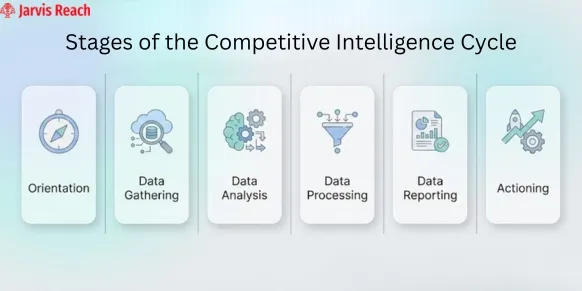
Competitive Intelligence is not one task that can be one-and-done. It is instead a series of tasks built on Market intelligence and actionable competitive insights.
New information about your competitors resurfaces all the time. The company’s job here is to capture it, analyse it, and figure out what it means for the business. From there, you have to deliver the insights in the format that is best suited for internal customers.
The stages of the cycle have been outlined below:
– Orientation
– Data Gathering
– Data analysis and processing
– Data reporting
– Actioning
First stage: Orientation
The first stage involves aligning Competitive Intelligence efforts with business needs, leadership goals, and the needs and wants of your internal customers.
While it is not necessary to repeat the entire orientation process every time one goes around the CI cycle, it’s important to gather feedback from the teams you have served for future improvements.
The next few stages: Gathering, Analysis, and reporting involve gathering data and using analysis tools to spot market dynamics trends.
The final stage: The Actioning stage ensures that strategic execution occurs based on insights while adhering to legal compliance standards. This step turns Competitive Intelligence into a measurable tool for strategic business growth and a strong growth strategy.
What are the 7P’s of Competitive Intelligence?
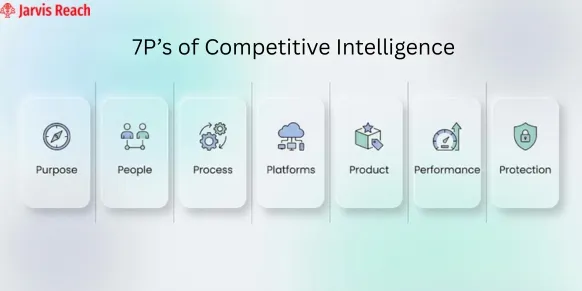
The “7P’S” of competitive intelligence refers to analysing a competitor’s Product, Price, Place, Promotion, People, Process, and Physical Evidence. This in turn, offers a structured lens to assess and benchmark rival strategies across marketing, operations, and customer experience.
How to gather Competitive Intelligence
In this section, we will be looking at ways in which you can gather competitive intelligence for your own marketing campaigns:
Customer review sites: find your competitors’ strengths/weaknesses through a Competitive Intelligence analysis.
Use specialized tools: you will need advanced product analytics for monitoring market dynamics and generating competitive insights.
Analyze competitor websites: if you can track changes to a rival site, can you leverage that for strategic business growth?
SEO tools: ROI and your key Performance Indicators (KPIs) for impact assessment can be derived from Competitive SEO analysis, which is a crucial data set to support both your overall Market Intelligence and growth strategy.
Why is Competitive Intelligence Important?
Informed decision-making: CI can provide meaningful insight into strategic planning and help to reduce uncertainty in making strategic business decisions. Risk reduction: Companies can take steps to try to avoid future problems by assessing threats and market dynamics.
Opportunity recognition: It helps companies in identifying unmet customer needs and strategic opportunities.
Competitive advantage: When companies analyze competitors, they can improve their own strategy, pricing, and positioning in a way that helps maintain an advantage.
Performance improvement: Understanding the competitive landscape will allow companies to improve their own performance, pricing, products, and positioning in their market.
What are the types of Competitive Intelligence?
Companies usually use two types of competitive intelligence:
Strategic Competitive Intelligence that helps companies to understand and act on long-term market dynamics, such as technological changes, the marketplace, and environmental shocks.
Tactical Competitive Intelligence, on the other hand, is a short-term process. It contributes to decisions about issues that can be measured in quarterly reports and operational strategic execution.
Both methods involve Market Intelligence, competitor insights, and product analytics to ensure legal compliance, while still fostering strategic business growth, but only half of them use it to make business decisions.
Companies that are empowered by Competitive Intelligence tend to do better than their competitors, because they prioritize competitive insights versus relying on assumptions.
Here is an example of how companies use competitive intelligence to make a difference in their final results:
The competitive intelligence analyst had a sign-off authority on major business decisions. This means that the focus was not on the deck of PowerPoint slides but on the analyst presenting the information.
FAQs
1. What is meant by competitive intelligence?
Collectively defining, collecting, analyzing, and sharing intelligence related to the product, customers, competitors, or any facet of the environment related to supporting executives and managers in the strategic decision-making process for the organization.
2. What are the 7 P’s of competitive intelligence?
In competitive intelligence, we commonly point to the “7 P’s”, which specifically frames the process of gathering information on a competitor’s Product, Price, Place, Promotion, People, Process, and Physical Evidence. It is a structured means of looking, thinking, and assessing thinking and benchmarking rivals’ strategies related to marketing, operations, and customer experience.
3. Why is competitor intelligence important?
Competitive intelligence has proven valuable when it comes to understanding market dynamics and competition’s activities and trends in the industry. Collectively, this data can assist organizations when making informed strategic decisions on how to optimize favorable opportunities, mitigate risks, and stay ahead of the competition.
Summary
Companies that weave Market Intelligence and Competitive Intelligence into a core strategic approach gain visibility to market activities, market dynamics, and market trends like no other.
By using advanced tools and technologies to analyse the data, it can provide valuable competitor insights, in compliance with legal guidelines, and transform competitive insights into actionable paths.
Discover how JarvisReach transforms Competitive Intelligence into actionable strategies that keep your business one step ahead.