Sales teams are often told that growth begins with more leads. More names enter the pipeline, more outreach goes out, and the assumption is that more revenue will follow. Sometimes that is true. In other cases, the real problem is not a shortage of opportunities but an inability to determine which existing leads, prospects, and customers deserve attention first.
The Best CRM Should Help Reps Decide Where to Spend Their Time
Salespeople rarely have enough time to pursue every possible opportunity equally. A distributor may have hundreds or thousands of existing accounts, open quotes, prospects, dormant customers, and buyers whose purchasing behavior has recently changed. When evaluating the best CRM for distributors, one useful question is whether the system helps representatives identify where attention could create the most value. A database that stores information is helpful, but a system that helps prioritize action can be considerably more useful.
That distinction matters because sales capacity is finite. A representative can make only so many calls, send so many thoughtful emails, and hold so many meaningful conversations in a day. When every account appears equally important, reps often default to the loudest customer, the easiest contact, or the opportunity they happen to remember. Those choices may not align with the best revenue opportunities.
More Leads Can Actually Create More Noise
Adding leads to an already disorganized pipeline can make the underlying problem worse. Reps end up with longer lists, more notifications, and additional data to review. If nothing distinguishes a high-value opportunity from a weak one, increasing volume simply increases the amount of sorting required. Activity rises without necessarily improving productivity.
This is common when organizations focus heavily on top-of-funnel metrics. Marketing celebrates lead volume, sales tracks call volume, and management monitors pipeline size. Those numbers can be useful, but they do not automatically indicate quality. A smaller pipeline containing well-qualified opportunities may outperform a large one filled with weak prospects. Sales teams should therefore ask whether they need more names or better information about the names they already have.
Existing Customers Often Provide Stronger Signals
New prospects are appealing because they represent fresh potential, but existing customers provide information that new leads cannot. The company already knows what they have purchased, how often they order, what they have asked about, and how the relationship has developed. That history can make account prioritization much more precise. It may also reveal opportunities that are easier to pursue than entirely new business.
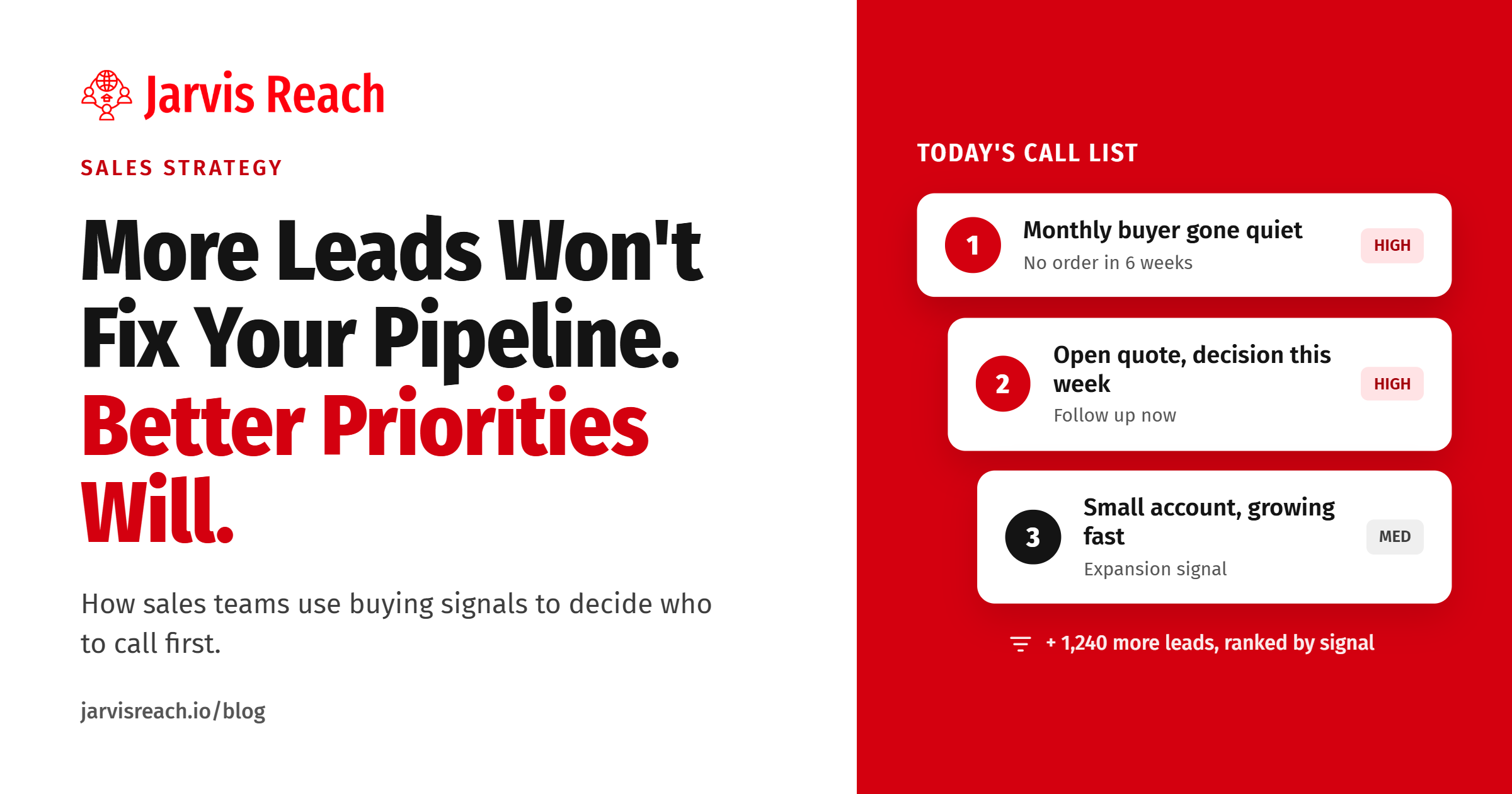
A customer who normally orders every month but has suddenly gone quiet may warrant a call. Another customer may consistently buy one product family while similar accounts purchase several. A previously small account may be growing rapidly and deserve more attention. These are not speculative leads; they are signals grounded in an existing relationship.
Prioritization Should Be Based on Signals, Not Just Deal Size
It is tempting to prioritize purely by revenue. Large accounts naturally receive attention because losing them would hurt. Yet size alone can obscure other valuable signals. A medium-sized account with rapidly increasing purchases may deserve more attention than a large, stable account that requires little intervention.
Timing also matters. A customer approaching a typical reorder point may be more actionable today than a much larger account with no immediate need. An open quote may deserve follow-up because the buying decision is active. A dormant customer may become high priority if historical spending suggests meaningful reactivation potential.
Reps Need Context Before They Reach Out
Prioritization is only the first half of the problem. Once a rep knows whom to contact, they need enough context to make the conversation useful. Generic outreach can undermine the advantage created by good data. A customer should not receive a message asking whether they are interested in something they purchased last week.
Before contact, reps may need recent orders, open quotes, service issues, previous conversations, product interests, and account notes. Gathering that context manually takes time, particularly if the information lives in several systems. When relevant details are easy to see, the rep can spend more time thinking about the customer and less time searching for information.
Better Priorities Improve the Entire Sales Process
Prioritization affects more than individual productivity. Managers gain a clearer understanding of why representatives are focusing on certain accounts. Marketing can learn which lead characteristics tend to produce worthwhile conversations. Leadership can see whether growth is coming from acquisition, retention, expansion, or reactivation.
It can also improve coaching. If a salesperson is struggling, the manager can examine not only how many calls were made but whether the right opportunities were pursued. A rep may not need to increase activity. They may need better account selection, stronger preparation, or more effective follow-up.