Smart workflow automation: Smarter Data Strategy 2026 Guide
AI automation can assist strategists in all phases of the strategy development process. Segmentation is foundational to any go-to-market growth plan, but when you are working across multiple regions, industries, and product lines, manual segmentation becomes a load. Smart workflow automation helps revenue teams overcome this problem by making segmentation quicker, and accurate, and dynamic. It can be categorized based on the size or industry, technology used, and real-time intent signals. This gives away faster campaign activation, more relevant messaging, and less budget wasted on the wrong sectors, demonstrating the power of cognitive automation tools in optimizing the Sales workflow.
Understanding AI and Cognitive automation tools
Smart workflow automation utilizes advanced technology to manage tasks and processes by programming computer systems to review data, recognize patterns, and make logical choices. It can take over manual work that is time-consuming. From simple data entry to customer invoicing or complex inventory management, shifting to AI agents gives people more time to focus on highly valued work. This shift is a prime example of leveraging AI and automation to streamline operations.
Smart workflow automation uses Machine Learning (ML) and Natural Language Processing (NLP) that understands and responds to human language, analyzes large sets of data, and makes quick decisions. This powerful blend is at the core of modern data-driven management and data integration.
The Role of AI in Data-Driven Strategy
Integration of AI in automation into the market revolutionized the way businesses approach competitive intelligence. By leveraging AI technology, organizations can analyze vast amounts of data to extract actionable insights, predict trends, and make more informed decisions. Evolution of AI in data-driven strategy allows businesses to stay alert and ahead of the current trends, identifying engaging market opponents, understanding customer behavior, and optimizing product development.
AI-driven strategy fosters a personalized experience for consumers by understanding their preferences and tailoring product offerings accordingly. By analyzing and predicting customer behavior, businesses can forecast future trends and understand customer needs, leading the industry. However, with the evolution in tech, AI in automation carries its own risks and challenges, like ethical concerns, data privacy, and the need for data governance in a robust data strategy.
Integrating Smart workflow automation into Your Growth plan
The most difficult aspect of cognitive automation tools and AI adoption is data integration. From latency and performance concerns to incompatible systems, to scaling, data quality, and maintenance, getting an AI model into a live system can be challenging.
1. Data silos and quality
AI requires good, up-to-date data to succeed in data-driven management. Yet most companies are still dependent on older data systems that are slow and keep models outdated. If your model is not keeping pace with predictions, it may be time to look at automating your pipelines and moving toward real-time or near-real-time data ingestion, a key step in implementing any successful data strategy combining AI in automation.
2. Security and access control
AI tends to contain sensitive information customer data, transactions, internal metrics, and each integration point is a security vulnerability. To make sure you do not expose data strategy or model endpoints by accident, use least-privilege access, encrypt everything, and track endpoints.
3. Model interpretability
AI must be able to be interpreted by your teams. If your model is so complicated and advanced that you can’t say why it made certain choices (or at least pose the correct questions to determine why), this is a significant challenge to responsible cognitive automation tools and sustainable data-driven strategy.
4. Interoperability and maintenance
AI must plug into your current system: CRMs, ERPs, databases, APIs, cloud services. But legacy infrastructure is not always prepared to process real-time predictions or steady streams of data, making efficient data integration crucial for a successful data-driven strategy. Utilize lightweight APIs, middleware, or batch processing where real-time is not practical to link new-fangled ML outputs to old-fangled systems
5. Governance and Ethical AI
Adding AI and automation to your stack will only have an effect on your development day-to-day and your management issues. It will influence your legal team as well. You have to make sure you’re complying with government policies, and also that you’re dealing with any ethical issues that come up. A strong data-driven strategy involves addressing ethical AI and aligning with regulations in your Growth plan.
Enhancing the Sales workflow with AI and Automation
AI can supercharge sales workflow through automating lead qualification and scoring (identifying the best prospects using predictive models), personalization (participating in targeted messages or product suggestions), and even handling first customer touch points through chatbots.
Techniques include the use of machine learning to examine historical deals and customer interactions to identify which leads will convert, and natural language processing to inform sales email content or auto-respond to common questions.
1. Taking advantage of advanced applications and data analysis
Taking advantage of advanced applications and data analysis improves data-driven management and sales productivity. We found that 26% of business users employ it primarily to improve internal processes and procedures. Sales teams are suffering from information overload coming from different sources. AI can also be used as a filter that looks at customer demographics, history, and market trends and provides sales teams with richer customer insights, allowing them to target customers more effectively, prioritize leads, and score leads more efficiently.
2. Augmenting performance with AI-driven conversation intelligence
Conversational AI tools analyze sales calls and meetings, auto-transcribe conversations, identify key topics and objections, and measure sentiment, using cognitive automation tools techniques. One of the key applications of AI for sales is assisting representatives in understanding customer needs.
3. Simplifying sales enablement automation
AI enables automation of tasks like A/B testing approaches, data entry, meeting scheduling, and lead qualification, freeing up the sales reps to engage more with qualified leads. It also tailors training guides and coaching recommendations, which get the right skills into the reps’ hands at the right moment.
4. Enhancing the effectiveness of sales engagement
AI personalizes the sales experience, so every interaction is relevant to the buyer, allowing for stronger relationships, increased engagement, and increased conversion. AI suggests content by analyzing past behavior and interest, personalizes email campaigns, and determines the best communication channel to maximize sales.
Optimizing Data Integration Through Smart Workflow Automation
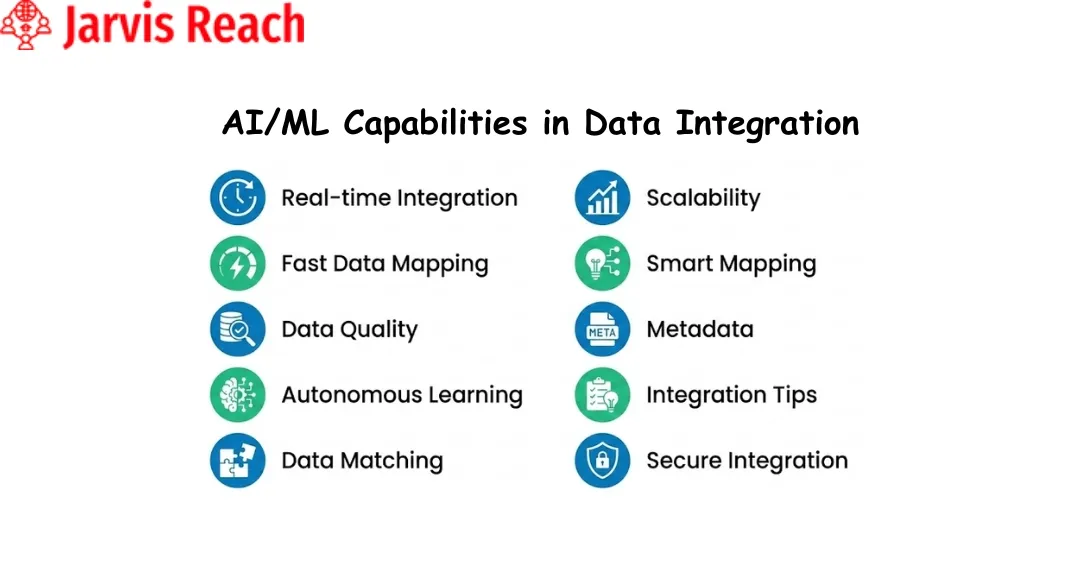
AI data integration applies machine learning (ML), natural language processing (NLP), and other AI methods to automate and improve the movement of data between systems. It exceeds conventional rule-based integration methods by adding algorithms that change as new data sources emerge, recognize anomalies, enhance data quality, and support enhanced decision-making, with minimal human involvement, which strengthens any solid data strategy.
Best practices to unlock value from cognitive automation tools include assessing team readiness, defining clear use cases, piloting projects, and selecting platforms with native AI capabilities that support the full lifecycle of AI and automation.
1. Test Your Infrastructure and Team Readiness
Evaluate your existing data infrastructure and team skills. Make your infrastructure AI-capable and empower your team with the right skill sets to deploy new AI capabilities successfully.
2. Define Clear Objectives and Use Cases
Right, define the problems you will solve with AI. Like data conversion automation, quality improvement, or error reduction. You achieve the best value with a clear methodology.
3. Begin small with a Pilot Project
Prove AI with a contained, low-risk pipeline. A successful pilot allows you to hone AI models, show effectiveness, and gain confidence to scale.
4. Select the Right Platform
Choose a platform with native AI capabilities, not simple, rudimentary automation. Ensure the solution supports the complete AI pipeline life cycle – deployment and training, monitoring, and optimization.
Practical Steps to Implement AI-Driven Data Strategy
Implementing an AI-driven data strategy is no longer a futuristic concept but a practical necessity for businesses aiming to stay competitive in today’s data-rich environment. By leveraging AI and automation, organizations can transform vast amounts of raw data into actionable insights, enabling smarter decision-making, improved customer experiences, and optimized operations under a modern Growth plan.
1. Start Small
Start small with small AI applications for internal use. Identify areas where AI can deliver value in the near term, for example, automated customer support responses or data entry automation. Keep it simple. Purchase or develop an AI application using limited resources. The idea is to get your staff through the complete cycle of AI adoption, from setup to ongoing usage.
2. Refrain From Over-Tooling
With the exponential growth of AI and novel AI tools, it’s simple to feel overwhelmed. AI development has tools at every step, pre-trained models and APIs, data labeling tools, MLOps platforms, model testing, deployment tools, and more. For pioneers, it’s good to begin with easy-to-use, pre-trained models instead of training models from scratch.
3. Begin with the Data You Already Have
Begin your AI journey by leveraging the data you currently have, particularly if it’s clean, well-structured data. This is precisely the reason why AI implementation is simpler for organizations that are already data-driven, since the groundwork of dealing with good data is already established. For instance, if your organization has inventory records or customer support logs, these are perfect places to begin projects such as predictive analytics or automated responses.
4. Utilize AI Responsibly
The moment you begin to play around with AI tools, make some plans for safe and responsible usage. It’s not too early to begin working on AI governance policies, particularly to tackle data security issues related to AI tools, is imperative. If your team members are using AI tools such as ChatGPT on company devices, your IT team must also be ready to address any data security issues related to the tool.
5. Establish a Cross-Functional AI Task Force
AI shouldn’t be an engineering team effort; it should be a company initiative. Build a cross-functional task force with champions from each department, IT, marketing, sales, operations, and even legal. This group can develop useful AI use cases and help non-technical teams feel empowered to drive AI adoption in their respective domains.
FAQs
1. What is Smart workflow automation?
Smart workflow automation is the combination of automation with artificial intelligence (AI) to complete tasks with human-like decision-making.
2. What are the 4 types of automation?
Per Universal Technical Institute, South Shore Controls, and Amplework, there are four main types of automation: fixed, programmable, flexible, and integrated.
3. What are the 4 types of AI technology?
Reactive machines, limited memory, theory of mind, and self-aware intelligence. Reactive machines have no memory and limited memory AI uses past data and calculations to make a decision, such as a self-driving car.
4. What is an example of AI workflow automation?
Some examples of AI workflow automation are chatbots that respond to a customer’s questions, automating repetitive tasks like data entry, and automating sales and marketing, such as lead scoring and personalized emails.
Conclusion: Future of Smart workflow automation in Data Strategy
The future of Smart workflow automation of data strategy is one of increased integration, where AI is not merely a tool but a collaborator in executing efficient real-time data integration that facilitates more efficient, real-time data pipelines, more complex predictive analytics, and democratized access to insights. Major breakthroughs will involve improved Natural Language Query (NLQ) functionality, Automated Machine Learning (AutoML), and explainable AI (XAI), all of which demand a solid data strategy with an emphasis on governance, quality, and integration to support AI efforts that deliver meaningful business value and growth.
AI will be an assistant to data analysis, pre-emptively finding the most significant results and simplifying the process of reaching a conclusion based on data. Smart workflow automation will transform data ingestion, transformation, and analytics to become more efficient, real-time data operations. Advanced AI systems will enable better prediction, allowing companies to lead in market trends and make informed strategic choices.