Sales Objections: Examples, Scripts & Winning Tactics
Sales objections are common in any sales management process. They’re the doubts, hesitations, or concerns a prospect raises that prevent an immediate “yes“. Although not outright rejections, they signal that the buyer needs greater clarity or assurance. Sales objections are not deal killing signals. Rather, they are opportunities to help establish trust, dig into needs, and better prepare the buyer to understand the value of your product. Successfully overcoming a sales objection means listening actively, getting to the root of the objection, and identifying a solution that is personal to the potential buyer.
When sales representatives become equipped at overcoming objections, they enable the sales process to be construed as an objection, providing the opportunity for deeper engagement. Masters of objection-based selling can handle objections at the point of conversation and simultaneously sell. And master sales professionals know that not only can handling common sales objections involve greater conversion, but it also builds long-term relationships and increases sales. Sales tools such as CRM platforms or AI-driven coaching solutions can very much help sales organizations identify, track, and respond to sales objections much faster and efficiently. More advanced sales tools would allow sales teams to train and overcome objections with role-plays or mimicking conversations, making salespeople better prepared for what happens in real-life situations.
What are sales objections, and why aren’t they deal-killers
Sales objections are raising doubts, concerns, and hesitations expressed by a customer during the sales process that prevent them from immediately agreeing to purchase.
The direct rejection or a “no” but a sign that the salesperson in the sales management needs to address certain doubts before the purchase. Sales objections can be related to price, fitting, timing, or trust.
Handling sales objections through effective sales objection handling shows they aren’t deal-killers as they address concerns and areas of improvement, offering an opportunity to build trust and close further deals. They open a door of opportunity to know and observe the prospect’s perception towards a product or a service, and overcome sales objections.
Common Sales Objections
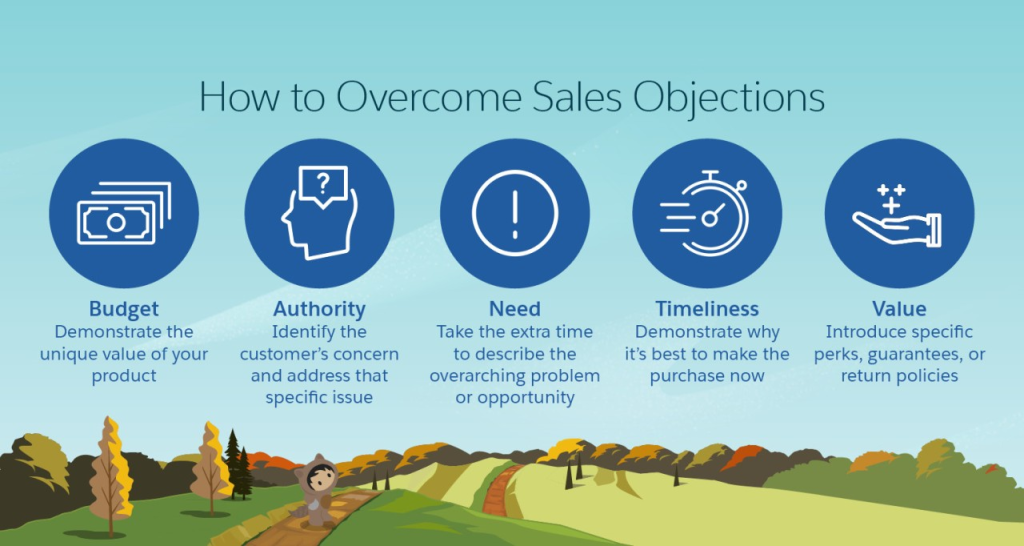
Most sales objections fall into four main categories: authority, need, budget, and trust, each requiring a different approach to overcome.
Lack of authority
In this sales objection, the prospect isn’t the final decision maker and needs to contact someone else for that matter. Sentences like “I need to ask my manager” or “I don’t have the access to do this” are common in this type of sales objection. This means that the customer has to contact the higher-ups or the actual decision-maker. Handling sales objections of this type involves identifying the decision maker quickly to avoid delays, a core part of objection handling skills in sales management. This relates to the “A” (Authority) in the BANT framework, reminding sales reps to target decision-makers early and focus on overcoming objections related to authority barriers.
Lack of Need (Urgency)
The prospect doesn’t show enough value or care for the product or service, as they might feel that the current situation is “sufficient”. Using the right objection handling techniques can help here by showing the hidden value and overcoming objections effectively, which is a key driver to increase sales in sales management.
Lack of Budget
Lack of budget is one of the most common sales objections. The buyer can raise concerns about affordability or claim that they lack in budget at the moment. This might delay or avoid the entire purchase. Overcoming sales objections related to budget may include offering different pricing plans or financing options. Moreover, overcoming objections in this area often requires flexibility and creativity.
Lack of Trust
The prospect might hesitate to move forward with the purchase due to concerns about the salesperson, or company, or the product’s reliability. They might have the fear of the uncertainty or negative outcomes of the purchase/ product. In these cases, handling sales objections requires building credibility and trust through testimonials, proof, and guarantees. Tackling trust-related issues is crucial for overcoming objections and can help increase sales in the long run.
These four common types of sales objections sum up the BANT Framework for objection types and guide structured sales objection handling for better results. The flowchart below gives you an overview of the objection handling techniques used for them.
Ways of objection handling
Here’s a simple seven-step approach that can help turn almost any objection into a constructive conversation
1. Prepare
The first step is to be well-prepared for the call. Do thorough research on the objections raised and keep a response template ready in case of cold calls.
2. Listen
Be an active listener and focus on the concerns the prospect has raised, and allow them to speak without interrupting.
Make sure you maintain your body language and facial expressions. When they complete, reply to them in a way that they feel heard and seen.
3. Understand
If you get confused regarding any objections raised, request them for clarification and ask them open-ended questions to understand the objection thoroughly.
4. Validate
Show and speak to them in a way that you feel that the objections are equally an issue and important concern to you and the company. This step is crucial for overcoming sales objections related to trust and credibility.
5. Act
Start executing solutions on the smaller concerns as they are easy and quick to solve. Do not let them go ignored unnecessarily. This is one of the more practical objection-handling techniques to maintain momentum in the discussion.
6. Plan
Ask for a follow-up call or a meet-up with your co-workers and higher-ups to address the concerns and understand what the next steps should be taken for handling objections.
7. Confirm
After the solution is executed successfully, ask the customer for feedback, as it will help with further corrections and related concerns if raised in the future. This will also make you alert about the area of improvement, and it shows the buyers that you really care and are serving them with utmost respect. Handling sales objections this way shows clients you care deeply about their satisfaction.
Propose a tailored solution
Connect your remedy to their needs: Once you understand the objection, indicate how your product or service serves that objection. Even in this situation, still keep the spotlight on the value created. If the situation is a price objection, indicate all the benefits of the return on investment (ROI) or the benefits of what they gain long term by considering your solution.
Provide a replacement: If your first option has not satisfied their needs or budget, you may suggest an alternative package, plan, or similar option that may better serve them. Using a replacement option provides flexibility and allows the process to continue in the absence of pressure.
Use evidence of social affirmation: In whatever is happening in the explanation, you provide proof with real customers similar to their concern, for example, real customer references (evidence), reviews and testimonials, case studies, or success stories. This holds when they see others like them have had similar concerns and were successful.
Identifying Smokescreens, Real Objections & Brick Walls
Smokescreens are sales objections used by prospects to mask real concerns, hesitations about a product or service. In sales management, identifying these is crucial.
To identify smokescreens, the salesperson should understand the prospect’s underlying needs and motivations rather than only taking their words at face value.
Brick walls are challenges that hinder and slow down the sales process. They manifest as resistance from potential buyers, internal block with the team, or market difficulty. Identifying brick walls I crucial for developing strategies to overcome them and improve sales performance.
Overcoming sales objections of both types requires listening carefully and using tailored objection-handling techniques to address deeper motivations. This helps in maintaining a good relationship and increases sales.
Pro Tips & Templates
Below are ready-to-use responses and strategies for handling the most common sales objections, covering price, authority, and need, so you’re never caught off guard.
1. Sales Objections About Price and Budget
“It is too expensive.”
Price objections are the most frequent pushback you’ll hear, even from prospects who fully intend to make a purchase. Be careful: once you make the discussion about price, there’s a risk of being perceived as no more than a transactional intermediary. Rather, you’ll redirect and refocus the dialogue around the value of the product. In addressing sales objections to the pricing, redirect to value, not cost, with the right sales tools to augment the value of what’s being sold.
You might respond with something like:
“I’d be glad to walk you through the key features of, and how they precisely address the issue at hand you’ve identified. I can also share with you a case study from another company in your industry that achieved real quantifiable return on investment.”
“We don’t have the budget for this.”
Oftentimes, a prospect’s business is just not large enough, or perhaps it doesn’t generate enough cash flow at the time to afford your product. If you see long-term strategic potential, maintain the relationship, stay in touch, track their growth, and look for ways to help them reach the point where your solution fits naturally into their operations. Also, a prospect may not have the budget now, but with the right objection handling techniques, you can keep the door open for future sales.
Your company could provide alternative financing options, flexible subscription tiers, or phased implementation plans that make your offering more accessible. Even an initial smaller purchase can build the foundations for future scaling. The budget available today may not reflect the potential of the sale.
You say something such as:
“I understand. Allow me to walk you through some other solutions that may be more suitable for your current stage of growth and budget.”
2. Sales Objections about Authority
“I’m not authorized to sign off on this purchase.”
It is a classic sales management tactic.
“No problem. Ask your prospect the name of the right person to speak to, and then redirect your call to them. Try responding this way: “Who is the right person to speak to regarding this purchase? Can you redirect me to them, please?”
“I can’t sell this internally.”
Your prospect might not foresee every objection, but you can. Ask them what challenges they expect and help build a strong business case for your solution. Provide ready-to-share materials like a “Business Case in a Box” with your value proposition, success stories, and offers to make it easier for them to advocate internally.
You might say:
“What objections do you think you’ll face? Can I help you prepare the business case for your decision-makers? I have some materials that can help.”
3. Sales Objections about Need
“I don’t see what your product could do for me.”
Sometimes a prospect’s request for more information is a disguised objection. Reconfirm the goals or challenges you’ve discussed and explain how your product can solve their specific problems.
Try responding with something like:
“Interesting. Could you share the specific challenges you’re facing right now? Maybe [product] offers a solution we haven’t yet covered.”
“I don’t understand your product.”
A request for more info can hide an objection. Restate their goals or challenges and show how your product solves them.
You might say:
“What challenges are you facing right now? Maybe [product has a solution we haven’t discussed yet.”
Closing & Next Steps
The closing scene is to address and resolve all the issues and concerns raised by the buyer, and understand and ask for a confirmation or feedback after the resolution. This shows that you and your company care aren’t only solely focused on revenue making but also care deeply about the buyer and their shopping experience. In sales management, acknowledging the buyer’s concerns with great objection handling keeps relationships alive, consistently increasing sales over time.
This builds a strong bond of trust and loyalty between the customer and the company, leading the buyer to visit the company often. Acknowledging and empathizing with the buyer’s concerns makes them feel seen and heard, resulting in a happy shopping experience. Sales tools that track buyer engagement help refine future approaches. Platforms like Jarvis Reach go beyond tracking; they enrich data, find decision-makers, and give AI insights so you can handle objections with facts and anticipate them early. The BANT method ensures no major sales barrier is overlooked.
How to use objections as conversion boosters
Sales objections shouldn’t be seen as roadblocks or deal-breakers during the sales process. One must view them as an opportunity to close more deals. Seamless and successful objection handling can benefit both the company and the buyer. Overcoming sales objections using the objection handling techniques, like listening to them and empathizing with them, and providing tailored solutions, can guide the conversation towards a positive outcome, increasing sales for the long term. With platforms like Jarvis Reach, you get the data and insights you need to handle objections smarter and convert more prospects into long-term customers.
FAQs
1. How to handle objections professionally and turn them into opportunities?
Techniques for effective objection handling include listening to the prospect’s concerns:
– Illustrate how your solutions have helped others.
– Use the opportunity to have a meaningful conversation.
– Recognize the objection and respond to the objection.
– Ask, don’t tell.
– Begin with the conclusion.
– Be genuine about your service or products.
– Follow the light.
2. How do you handle objections in sales?
Objection handling is the practice of addressing and resolving a potential buyer’s objections during a sale to bring the deal to a close. It involves listening to the prospect’s objection, why they made the objection, and responding in a way to establish trust and value. Common objections are price, need, time, and competition.
3. What are the 4 P’s of objection handling?
What are the 4 P’s of objection handling? Personalization, perceived value, performance value, and proof are considered the 4 P’s of objection handling. Personalization means to personalize your response for each individual prospect and the prospect’s needs.
4. What are the 4 methods for handling objections?
The 4 steps for perfect objection handling:
Step 1: Run an effective discovery process before objections arise.
Step 2: When objections are raised, thank your prospect.
Step 3: Provide empathy to put your prospect at ease.
Step 4: Ask open-ended questions to uncover the objection’s root cause.