What Makes a GTM Strategy Successful? Models and Tips
A GTM (Go-to-Market) strategy is an exhaustive blueprint describing the introduction of a new product or service to the market, customer interaction, and differentiation in the marketplace. It is a roadmap to bringing a product to market and encompasses defining the target market, creating a value proposition, formulating sales and marketing plans, and structuring distribution channels. Strong sales and marketing alignment ensures all these components work together smoothly. The goal of a GTM strategy is to obtain the most success for a product launch possible, with everything planned and in place. Every effective go-to-market strategy incorporates a detailed product launch strategy to ensure a successful entry.
Why every business needs a GTM strategy
All businesses need a GTM strategy to ensure effective product releases, prevent risks, and achieve sustainable growth through a clear plan of reaching customers, conveying value, and differentiating from the competition. A GTM strategy aligns teams, maximizes resource utilization, accelerates market entry, and ultimately accelerates revenue and profitability. Well-defined go-to-market strategies align teams with a shared objective, minimizing confusion in deployment. This happens best when sales and marketing alignment is intentionally built into the GTM framework.
Types of GTM Strategies
An excellent go-to-market strategy is not a template that fits all. Business goals, market conditions, and growth stages call for diverse GTM strategies. Achieving sales and marketing alignment makes it easier to execute these strategies consistently across teams. Whether the product enters an unfamiliar market, international markets, scales customer acquisition, or evolves product positioning, each GTM strategy delivers a roadmap to reduce risk, align stakeholders, and fuel growth. Companies need to select the go-to-market strategy that is appropriate for their own circumstances, particularly the product launch strategy and the market entry strategy.
1. Product launch strategy for new markets
New market product launch strategy in a GTM plan entails determining the targeted market, the new customer, coming up with distinct value propositions, devising targeted pricing and distribution channels strategies, and rolling out marketing and sales efforts while tracking performance. Here, sales and marketing alignment ensures messaging, timing, and execution stay consistent throughout the launch. The product launch strategy serves as the backbone of a successful GTM initiative, ensuring focus on key market needs and timing. The framework of the product launch strategy helps align the organization and minimizes risk in new market entries.
2. Market entry strategy for global expansion
A global expansion market entry strategy aligns with your go-to-market (GTM) strategy by selecting the right international entry strategy (e.g., exporting, licensing, joint ventures) and then crafting a tailored GTM strategy for each new market that involves localized market research, target customer profiling, competitive analysis, value proposition, channels of sales and distribution channels, and localized marketing and support to gain product-market fit and stimulate adoption in the new markets. Selecting a proper market entry strategy is essential to modifying your overall go-to-market strategy for global success.
3. Customer acquisition strategy for scaling
To scale your GTM strategy, identify clearly segmented customers and a strong value proposition and leverage a combination of scalable sales and marketing distribution channels such as AI tools, content marketing, and partners. Scaling requires a well-crafted customer acquisition strategy aligned with the broader go-to-market strategy. Metrics like CAC and LTV help fine-tune customer acquisition strategies for predictability and cost efficiency.
4. Product positioning and competitive differentiation
Product positioning in a GTM strategy creates a product’s distinctive identity and position in the market in the customer’s mind, and competitive differentiation creates the distinctive features and value proposition that distinguish it from others. Both are necessary: product positioning dictates what the product is and for whom, and differentiation explains why it is better than others and thus becomes desirable to the target audience and helps achieve its market goals. Effective product positioning also depends on strong sales and marketing alignment to maintain consistent value communication. A right product positioning enhances the effectiveness of go-to-market strategies.
Core Models of GTM Strategies
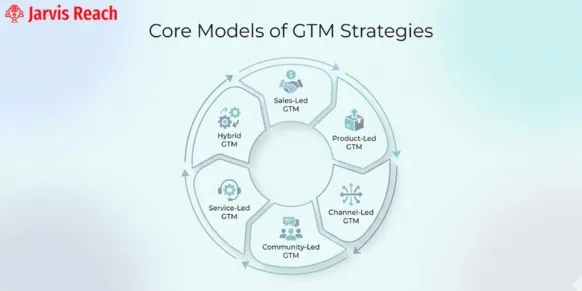
Popular GTM strategies are Product-Led, Sales-Led, Inbound, Outbound, Channel-Led, and Community-Led, which are usually combined. Selecting the right GTM strategies depends on your market environment and product type.
1. Sales-led
A sales-driven GTM strategy is a model of growth with the sales force being the key driver of customer acquisition and revenue, emphasizing tailored outreach, relationship-selling, and complicated solution selling over self-service product buying or heavy marketing. This approach works best for selling expensive, complicated products and business solutions that need a consultative selling style to showcase real value and return on investment (ROI) to purchasers.
2. Product-led
A Product-led GTM approach uses the product itself to drive acquisition, conversion, and expansion of customers, based on self-service models such as freemium or free trials instead of a conventional, sales-driven approach. Users get to experience the value of the product firsthand in this model, and it turns them into advocates via a good user experience, resulting in reduced acquisition costs, shorter sales cycles, and greater customer satisfaction. The key aspects are emphasizing the user experience, value delivery in-product, self-service, and data-driven optimization of the customer journey.
3. Channel-led
A channel-driven GTM strategy is a distribution-driven approach in which a business uses third-party partners, including resellers, distributors, and agencies, to sell and promote its goods or services to end-users. The strategy creates a roadmap for product delivery via established sales distribution channels, expanding market reach, and lowering initial distribution expenses by exploiting partners’ infrastructure and networks.
4. Community-led
A Community-led GTM strategy is a customer-advocacy-driven growth strategy in which a brand develops a user community, customer base, and fans who help fuel product awareness, engagement, and loyalty that leads to durable business growth. The strategy is centered on empowering customers to be ambassadors of the product, exchange knowledge, and deliver peer-to-peer support to build a scalable and trusted system that deepens the overall customer experience and minimizes friction in the buyer journey.
5. Service-led
A service-driven GTM strategy, or sales-driven GTM strategy, is a go-to-market strategy in which the sales organization is the major driver of customer acquisition and revenue expansion. The approach emphasizes personal, high-touch experiences like product demonstrations and consultations to foster relationships and close enterprise deals, especially large enterprise deals. It works well with intricate or high-value goods and services for which customers need substantial guidance and relationship building.
6. Hybrid
A hybrid GTM strategy combines the success of product-led growth (PLG) and sales-led growth (SLG), one-on-one engagement with each other, enabling customers to discover and onboard by themselves, and enabling sales teams to offer high-touch support for large deals and large accounts. This agile approach touches numerous customer segments, maximizes resource efficiency by concentrating sales efforts on high-potential targets, and has the ability to open up wider market access while giving a template for scaling revenue cost-effectively.
Distribution channels: choosing the right path
Channels of a GTM strategy are by which a company conveys its products or services to its customers. They are direct, connecting the customer directly via owned channels such as a store or website, or indirect, via intermediaries such as wholesalers, retailers, or partners, for serving the customer. Care must be exercised in selecting an appropriate distribution channel to access the target market effectively and make the buying process easy. An effective go-to-market strategy includes a well-defined approach to distribution channels that suit the product and audience.
1. Direct Channels:
Direct distribution channels are the company-to-consumer sale of products or services without intermediation.
Examples: Company website, direct sales force, company-owned retail stores.
2. Indirect Channels:
Indirect distribution channels employ third parties such as wholesalers, retailers, or distributors in an effort to resell to customers.
Examples: Retail outlets, online shopping websites, distributors, value-added resellers (VARs).
3. Hybrid Channels:
Hybrid distribution channels mix the direct and indirect distribution elements, allowing a firm to reach various customer segments using distinct channels.
Go-to-market strategy examples from leading brands
Top brands employ varied GTM strategies, like Apple’s product-first strategy with emphasis on high-end partnerships and high-end messaging, Fitbit’s subscription-based strategy utilizing influencer marketing for brand building and monetization, and Tesla’s direct-to-consumer (DTC) sales strategy to own the customer experience. Some other go-to-market strategy examples are Huawei’s differentiated branding across various segments of the market and Slack’s viral word-of-mouth and freemium strategy for high-growth. These Go-to-market strategy examples demonstrate how tailored GTM strategies apply to differing business models.
Apple (iPhone):
Apple pursued a high-end, selective distribution approach with exclusives like the AT&T iPhone exclusive, combined with positioning communications that positioned the communications as a “revolutionary mobile phone” in an effort to target early technology adopters and professionals. This Go-to-market strategy example highlights focused product positioning as key.
Tesla:
Tesla disrupted the traditional car model by employing a direct-to-consumer (DTC/ go-to-market) strategy. This allowed them to steer clear of dealerships, take ownership of the buyer’s journey, and give an innovative and streamlined buying experience, finally leading to higher customer satisfaction. Tesla’s go-to-market strategy leveraged direct sales as a significant part of its market entry strategy.
Huawei (India):
Huawei formed a multi-brand go-to-market strategy in order to sell into different market segments in India. They initiated a high-end brand in the mid to high-end market and simultaneously formed the “Honor” brand for competition in the low to mid-end market to achieve extensive market coverage. This Go-to-market strategy example highlights segmentation within a broader market entry strategy.
How to Build a GTM Strategy Step by Step
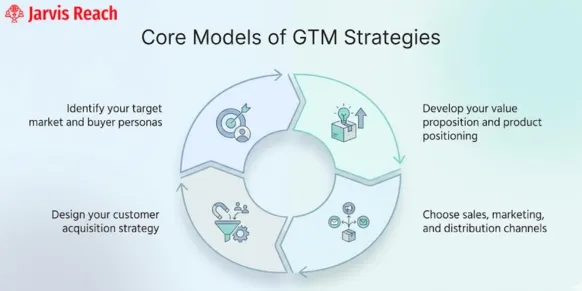
Building a GTM strategy needs a lot of studying and understanding the market and its buyers. We need to examine behavioral patterns and trends to build each step strategically.
1. Identifying your target market and buyer personas
To define your target buyer personas and markets for a Go-to-Market (GTM) strategy, construct your ideal customer profile (ICP) by segmenting your total addressable market across demography, psychographics, and behavioral data. The goal is to know their distinctive pain points, motivations, and mindset in order to position your sales and marketing efforts appropriately. This step influences your customer acquisition strategy and supports precise product positioning.
2. Developing your value proposition and product positioning
To develop a good value proposition and product positioning, research your target market and pain points, research your competitors, identify what the specific advantages of your product are and how they satisfy those needs, then develop short, compelling statements emphasizing these advantages and your differentiation. Corroborate your claims with existing customers and focus on making them ring and be able to convey your unique value, a process which also involves developing buyer personas for better customer insight.
3. Choosing sales, marketing, and distribution channels
To select sales, marketing, and distribution channels for a Go-to-Market (GTM) strategy, you need to know your target audience and their buying process, examine your product’s needs, examine your competition, and establish your value proposition. The choice of channels has a direct impact on your product launch strategy and overall go-to-market strategy.
4. Designing your customer acquisition strategy
Crafting a customer acquisition strategy within an overall go-to-market (GTM) plan includes identifying your target market and what they want, developing a value proposition that will entice them, building out a broad marketing and sales plan through the proper distribution channels, setting clear goals and metrics such as cost per acquisition, and building out a launch and post-launch plan with roles and budgets assigned. Effective customer acquisition strategies drive growth and ROI in any go-to-market strategy.
The Future of GTM Strategy
The GTM strategy of the future will be AI integration, product-led growth (PLG), and outcome-based selling. Companies are moving away from functional silos toward integrated, adaptive GTM strategies with AI to tailor, automate, and predict. PLG strategies are becoming more mainstream by offering self-serve value and accelerating sales cycles, and customer-first and omnichannel experiences guarantee the same in a fluid market.
Emerging GTM strategies are characterized more and more by AI-driven hyper-personalization, a rapid market adaptation through agile and iterative methods, and effortless omnichannel interaction across customer touch points. Decision-making that is data-driven and powered by predictive analytics to anticipate and automate, coupled with an emphasis on strong sustainability and customer-centricity, is the norm. Deep customer insights and internal alignment have to be developed by businesses as well to successfully ride changing market waves.
FAQs
1. What are the 4 P’s of GTM?
Another perspective on developing a GTM strategy is considering the four Ps of GTM—product, price, place, and promotion.
2. How do you measure the success of a GTM strategy?
Sales Conversion Rate – This is an important metric for determining how effective your sales strategy is. If your conversion rate is high, your sales strategy is working well. A higher sales conversion rate means more revenue from the same number of incoming leads, which means greater success for your GTM.
3. What is the 3-3-3 rule in marketing?
It’s simple but effective. For this rule, you: – Focus on only three brand or product messages – Choose three segments of your audience to target – Research and strategize to deploy three marketing media where your audience spends their Time.
4. What are the pillars of the GTM strategy?
Let’s break down each of these pillars further.
Pillar 1: Profile Your Customer. Given that the first pillar of a go-to-market plan is about profiling your customer.
Pillar 2: Select Your Accounts.
Pillar 3: Segment Your Accounts.
Pillar 4: Deploy Your Go-To-Market Plan.
Final Thoughts
A successful go-to-market strategy is not a cookie-cutter approach. Varied business objectives, market context, and growth phases require varied strategies. From new product introduction to a new market, global expansion, scaling customer acquisition, or product positioning optimization, each GTM strategy provides a roadmap to minimize the risk, unify the stakeholders, and fuel growth.