
What is Data Sourcing?
Data sourcing is the initial stage of the data pipeline where identification, collection, and procurement of relevant data from internal and external sources, such as databases, APIs, public records, and third-party vendors, occur.
The raw data collected is then used to build datasets for analysis, reporting, and decision-making, ultimately transforming it into actionable business insights that drive organizational growth and efficiency.
Effective data sourcing ensures high-quality data and data accuracy so that businesses can rely on their information assets.
Approaches for Sourcing B2B Data
To properly source B2B data, it is necessary to strike a balance between internal and external methods of collecting data in order to land on a complete and trustworthy database. Start by maximizing first-party data sources in your CRM, website analytics, and through customer interactions (however you define “customer”). This information is specific to your business and is incredibly accurate. Then look to strengthen the information by using external sources, including public business directories, professional networks (like LinkedIn), and third-party data providers who offer firmographic, technographic, and intent data. Lastly, develop your data ecosystem by creating secure partnerships to establish data-sharing agreements that enhance data, increase visibility, and uncover other go-to-market insights. The right combination of the aforementioned elements will lead to a well-rounded, actionable, and trustworthy B2B dataset.
Challenges in Data Sourcing
While data sourcing is the backbone of modern business, sourcing it comes with its own set of challenges that can affect high data quality, data accuracy, and usability.
1. Quality problems
Inconsistent high data quality in and of itself is one of the problems of data sourcing that might be avoided in the manner discussed earlier, and ongoing quality control measures.
Manually gathered data is prone to breaches, inconsistencies, and replication. Worse still, one error and your data will contradict true data accuracy. Quality problems with data must not be underestimated.
If you can afford it, you ought to always purchase B2B data from experienced sources. Low-quality, incorrect data can actually end up costing you more than paying for a B2B data vendor.
2. Legal issues
Another significant group of problems is the legal data management rules. Business is a global trend now, with markets in different countries opening up more and more. And the digital data does not recognize state borders.
But data regulation still falls short of the global nature that will be appropriate for the modern-day business environment, with recommendations differing in various states or provinces.
3. Security problems
Protection of sensitive data is another issue regarding the above. The enforcement of advanced data security features is needed to avoid unauthorized access and ensure that sensitive data is secure and not breached, which is why many organizations also rely on tools like an open source password manager to safely store and manage credentials.
The Role of B2B Data in Data Sourcing
B2B data is central to the process of data sourcing as it identifies and gives information on potential business customers, facilitating focused marketing, effective generation of lead data, segmentation of the market, and decision-making.
It assists companies in the development of Ideal Customer Profiles (ICPs), market trend analysis, customized approach, and the analysis of competitors’ strategies, thus resulting in more efficient selling, enhanced operational effectiveness, and effective customer relationships.
How Businesses Use B2B Data
Companies utilize B2B data to maximize marketing efforts using targeting and segmentation, improve the sales process using identification and prioritization of high-value lead data, gain a deeper insight into customers’ satisfaction levels, and make strategic decisions based on data with market intelligence.
By combining B2B data with firmographic, technographic, and intent data, companies can construct genuine buyer personas, forecast trends using AI and predictive analytics, and automate tasks, leading to efficiency and growth ultimately.
Challenges in Collecting and Managing B2B Data
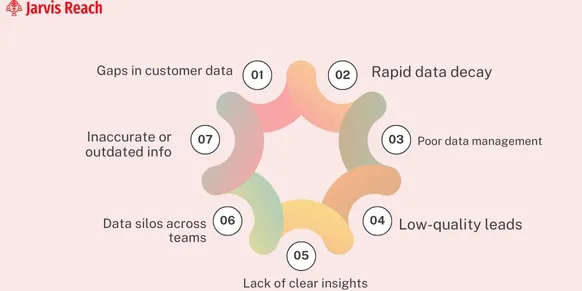
Collecting and managing B2B data may seem straightforward, but businesses often face hidden challenges that impact accuracy, compliance, and overall effectiveness.
1. Gaps in Customer Data
There is so much customer data available, but putting it all together can be a headache. From what your customers click on, to what they purchase, and how they feel, there is so much to monitor.
Marketers often find it difficult to bring all these sources of data together and link online and offline actions through proper data integration.
2. Handling Inaccurate or Obsolete Data
As a database of a company gets too big, it is not difficult to find yourself with old or wrong information, lowering data quality.
This usually starts during the process of gathering data and can be worse when data is extracted from different sources and types.
If there isn’t an organized way of gathering the data, then the marketers are going to have trouble analyzing it and making it useful information.
3. Data Silos
Data silos are a significant problem for B2B data companies with customer and corporate databases. Data silos are created when data is placed in separate databases that do not share information with one another.
Without having one source of truth for all departments, companies can be beset with poor execution, teams out of alignment, and little customer need knowledge.
4. Lack of Insight
With an information flood and various sources of data, it becomes challenging to assemble records accurately, and sales reps are left to deal with incorrect lead data.
This is challenging when attempting to develop successful retention models, correct customer personas, or make proper choices.
The problem usually starts when data is collected in a disorganized way from different channels.
5. Struggling with Low-Quality Leads
Handling poor-quality lead data is a typical B2B data sales challenge. It is reported that as much as 40% of the leads could be off-target or unreliable.
Thus, among every 100 lead data points that you collect, fewer than half could be worth pursuing. This would translate into wasting time and money on lead data that goes nowhere.
To correct this, focus more on the high data quality of your lead data than the quantity.
It’s not so much about getting the right number of lead data, but it’s about getting the right lead data.
6. Poor Data Management
Poor data management is something you ought to be aware of. Gathering B2B data relevant to your B2B audience is merely the starting point; the trap lies in leveraging that data effectively in your sales strategy.
Good data integration and upkeep of high data quality involves maintaining your records up-to-date and available to both marketing and sales.
Tools such as Customer Relationship Management (CRM) software can make this process much more streamlined.
7. Data Decay
Data decay is something that you need to be mindful of in your B2B data business. If you don’t work on your de novo data as soon as possible, it will go stale or outdated very rapidly.
The procedure, known as data decay, is such that your data may turn out to be useless if you procrastinate. Gartner even found B2B data decays by approximately 70% every year. In order to prevent this, try to work with new B2B data at the earliest moment.
Webscraping and Data Scraping in Data Sourcing
Data scraping is the action of pulling data from structured data sources such as databases or spreadsheets. Data scraping involves extracting data from specific columns or fields and exporting it in a structured format such as CSV, Excel, or JSON.
Data scraping can also be done manually, but most often through scraping tools or software.
Data scraping usually involves the use of tools or software such as SQL, Excel, or Google Sheets.
On the other hand, webscraping is referred to as getting unstructured data from websites. It is in the form of collecting data from web pages via web scraping tools or software.
Webscraping can extract product prices, customer reviews, and news articles. Information extracted is typically stored in a structured format such as CSV, Excel, or JSON.
Webscraping exists in the form of using tools or software such as Beautiful Soup, Scrapy, or Selenium.
Choosing the right web scraping company depends on several considerations, such as the type of data to be extracted, the source of the data, and legal concerns.
Below are some tips on choosing the best means for your data extraction needs:
Select the data type needed:
Data scraping may be suitable if you need structured data, such as product catalogues or financial reports.
Webscraping may be ideal for unstructured data such as news articles or social updates.
Consider the origin of the data:
If the origin of the data is within your organization or provided by a third-party vendor, data scraping may be the right method.
Webscraping may be the right method if the source of the data is publicly accessible on a webpage.
Understand the legal ramifications:
Before implementing either method, understand the legal ramifications and obtain permission where necessary.
Ensuring High data quality and Data Accuracy:
Accurate lead data information is the secret of effective sales and marketing campaigns.
Poor data quality can cost time and money, reduce conversion rates, and lead to missed opportunities, whereas quality lead data enables businesses to customize outreach efforts, identify high-value prospects, and close more deals.
The journey of obtaining quality lead data begins with the development of an ideal customer profile (ICP), which determines attributes such as industry, firmographic size, geography, and decision-maker roles.
Data Pipelines and Talend Data Integration in Data Sourcing
A data pipeline consists of a sequence of data processing procedures that transfer data from one system to another.
It provides an automated process for data movement from sources to destinations like data warehouses, databases, or data lakes.
Data pipelines enable automated movement and processing of data to provide data consistency and reliability. This enables real-time analytics, timely business decisions, and seamless data management.
Your company cannot handle increasing data volume and complexity without data pipelines, resulting in delays and possible data processing errors.
A Talend data integration pipeline is a more theoretical data pipeline that is used for extracting data from specific sources, transforming it to the correct format, and loading it into a target system.
This is needed when data is prepared to be analyzed, reported on, or used for business intelligence.
A Talend data integration pipeline functions like this:
1. Extract:
Extracting the data is all about gathering data from various sources like databases, applications, and flat files. The aim is to capture all the necessary data.
2. Transformation:
During the transformation process, the data extracted is cleaned, enriched, and transformed to a format suitable for the target system.
This process may entail a series of operations including removal of unwanted data, data aggregation, calculation computation, and data type conversion.
3. Load:
The last step is to load the changed data into the target system, i.e., data warehouse, database, or Data Lake.
Loading can be performed in batches on a fixed schedule or in real-time (according to your business needs).
FAQs
1. What do you mean by data sourcing?
Data sourcing is the process of locating, collecting, and integrating data from a variety of internal and external resources to create datasets for analysis, reporting and decision-making.
2. What is a data sourcing strategy?
It involves gathering structured and unstructured data from first-party (internal data), second-party (partner data), and third-party (purchased or public data) sources. Businesses use data sourcing to analyze market trends, enhance customer insights, and optimize operations.
3. What are the 5 steps of sourcing?
· Step 1: Identify Strategic Sourcing Opportunities.
· Step 2: Research and Identify Potential Suppliers.
· Step 3: Develop Sourcing Strategy & Evaluate Supplier Suitability.
· Step 4: Release RFI/RFP/RFQ & Analyze Supplier Proposals.
· Step 5: Negotiation & Supplier Selection (Award)
4. What is a data source and its types?
A data source refers to the origin of data that is analyzed. Data analysts utilize multiple internal and external data sources to gain an understanding of the business to make recommendations. These data sources can come from files, databases, and APIs.
The Future of Data Sourcing
Data sourcing is not just about gathering as much information as is manageable.
The real worth is the high data quality of how that information gets gathered, sorted out, and utilized to drive better decisions.
With strong pipelines, good validation methods, and a high data quality mindset over quantity, businesses know that clean, accurate, and timely data is what makes it possible for sales and marketing teams to reach the right individuals, at the right time, with the right message.

