
Introduction to DaaS
Data as a service (DaaS) refers to a business model in which data is available on demand and irrespective of the consumer’s location or infrastructure. In order to facilitate DaaS, companies offer cloud-based software to analyze and maintain the accessed data. Data as a Service, DaaS, is one of the newer cloud forms. Similar to how DaaS provides centralized access to information, IT Asset Management Software helps organizations efficiently track and manage their hardware and software assets.
DaaS is cloud-hosted and offers its data services as Software as a Service to the consumers. It is a strategic investment in consuming DaaS to centralize and manage your enterprise data in one location, then share it to support new and current digital initiatives involving cloud data management platforms.
Why businesses are shifting towards DaaS
Organizations today need immediate access to correct information for rapid, well-informed decisions, and responsive data solutions to respond to quickly shifting market conditions, and a foundation of strong market intelligence. Efficient data enrichment and real-time availability have become vital capabilities. Companies look for economical methods to handle increasing volumes of B2B data, often relying on data pipelines from cloud services integrated within their data management platform. DaaS provides the scalability and flexibility needed in data management platforms today.
Data-as-a-Service (DaaS) is now an innovative solution, transforming how companies access, manage, and leverage their data. These models have gained lots of momentum across all industries, with companies recognizing the strategic advantage of cloud-based data management leveraging real-time data and data enrichment techniques. Strong account management tools are integrated to provide clients with personalized and actionable insights. Efficient data integration also plays a crucial role in this transformation.
Key Components of DaaS
The main constituents of Data as a Service (DaaS) are data sourcing and integration, data processing and analytics, data storage, data security and governance, and a user interface or API for access. They are dependent on robust data architecture to govern these features efficiently. This entire system rests upon a sophisticated data management platform equipped with data pipelines.
1. Data Architecture: The foundation of DaaS
Data architecture prescribes the journey and steps through which data are brought together from various sources onto one common DaaS platform for users and applications to utilize. Good data architecture ensures data accuracy and consistency across the DaaS infrastructure. Data architecture provides the policies, standards, and security controls to protect sensitive data as well as comply with regulations that are essential to DaaS providers. It forms the backbone of any robust data management platform or DaaS solution. Proper data accuracy protocols embedded within the underlying data management platform ensure compliance and data reliability.
2. Data Pipelines: Data flow within DaaS
In DaaS (Data as a Service), a data pipeline governs data flow by first ingesting data from various sources, processing and cleaning it to make it consumable, and then loading it into a target system for consumption by analytics, applications, or AI services. The data pipeline is a core secondary component that optimizes data flows within the DaaS framework. These data pipelines handle massive b2b data sets efficiently within the DaaS ecosystem.
The process below shows how data flows within DaaS:
– Data Ingestion/Capture
Data is gathered from heterogeneous sources, which may include databases (structured data), APIs (structured and unstructured data), event streams (real-time data streams), cloud storage, and applications. This use of b2b data is typical in many DaaS implementations.
This first step is regarding extracting raw data from these systems. Managing these diverse sources requires a powerful data management platform configured to handle complex data pipelines.
– Data Transformation
After being consumed, the information is changed, filtered, and cleansed to meet some requirements. Data enrichment techniques are applied here to improve the overall quality and usability of the data, allowing higher data accuracy.
Standard conversions involve the removal of duplicates, date format standardization, data aggregation, joining datasets, and mapping fields to a pre-defined schema. This ensures data accuracy and reliability.
– Data Loading/Delivery
The changed and processed data is further uploaded into a specified destination.
Destinations may include data warehouses, data lakes, vector databases, or other cloud storage options. This last stage brings the data into a state where it can be used for its intended purpose, like driving dashboards, supporting AI model training, or offering up data for other uses.
Features That Make DaaS Valuable
Understanding the most important features of what makes DaaS worthwhile is crucial for understanding how it facilitates real-time insights, boosts data quality, and enables seamless integration in contemporary data management platforms.
1. Real-Time Data: Why instant access is important
Instant access to real-time data information is critical for Data as a Service (DaaS) because it enables instant, data-driven decision-making, enhances business operation effectiveness, and makes it possible for improved customer experience through personalization, and empowers faster market intelligence. Integration of real-time data makes it possible for DaaS to fulfill these requirements effectively.
2. Data Integration: Integrating many sources harmoniously
Data integration is also important to Data as a Service (DaaS) because it supplies a single, consistent view of data from different sources, supporting enhanced decision-making, increased efficiency through automation, enhanced customer experiences in the form of 360-degree views of customers, and enhanced data quality.
3. Data Enrichment: Turning raw data into actionable insights
Data enrichment is crucial for Data as a Service (DaaS) as it takes raw, incomplete data and turns it into a more comprehensive, accurate, and contextualized asset, which ultimately results in higher-quality data, better customer knowledge, more successful marketing and sales campaigns, enhanced risk management, and ultimately smarter, more efficient business decisions.
How companies use DaaS for market expansion
Businesses use Data-as-a-Service (DaaS) for market growth through the ability of the service to scale, be cost-effective, and possess high-quality, enriched data, which is used to guide expansion plans and implement them successfully. DaaS facilitates one-to-one marketing, reveals blind spots in the available data, and offers market insights for discovery of new markets, minimizing the use of expensive infrastructure and enabling concentration on growth projects.
– Account Management:
Account management personalizes and makes sense of client interaction in a Data-as-a-Service (DaaS) ecosystem through the leverage of the power of relationship intelligence fueled by AI, predictive analytics, and automation in order to offer personalized communications, anticipate needs, and maximize effectiveness. Insights from various touch points are united, forming comprehensive customer profiles to support tailored messaging, proactive issue resolution, and opportunity identification.
– Customer Insights:
Customer insights lead to more informed decision-making in Data-as-a-Service (DaaS) through profound customer understanding of needs and behavior based on enriched data to create personalized products, enhanced customer experience, and more efficient marketing campaigns. Through the examination of raw data, companies may identify actionable patterns and trends, giving rise to strategic benefits as well as heightened customer loyalty.
DaaS and Lead Generation Tools
Data as a Service (DaaS) facilitates lead generation solutions to leverage real-time, high-quality data to facilitate one-to-one communication, better lead qualification, and more accurate target customer identification. DaaS provides the level of granularity and predictive power that AI and machine learning require so that sales and marketing organizations can target their activities on high-value customers.
With enhanced real-time data for improved prospecting
The use of real-time and enhanced data within a Data-as-a-Service (DaaS) model significantly accelerates prospecting with the construction of rich profiles, observing live lead activity, and continuously scoring them to individualize engagement. Enabled through API-based DaaS platforms in the vast majority of cases, the approach provides up-to-the-second information about prospects, fueling more effective sales and marketing efforts, increased sales productivity, and smarter business decisions than fixed information sets.
Improve account-based marketing with DaaS
Data as a Service (DaaS) takes Account-Based Marketing (ABM) to the next level by providing the detailed, actionable information needed to find, know, and connect with target accounts. DaaS offerings aggregate and normalize various sources of data so that ABM programs can leverage firmographics, intent data, and account-level behavior to construct hyper-personalized programs, improve segmentation, personalize content, and measure ROI more conveniently and with less effort.
Benefits of DaaS in a Lead Generation Context
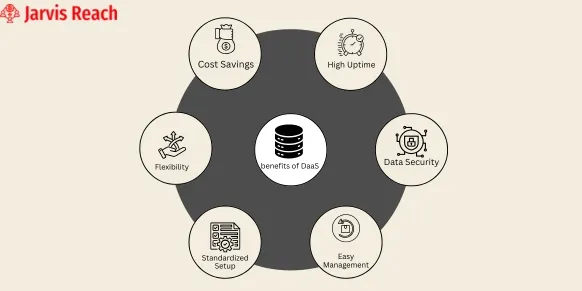
A quick look at how Data-as-a-Service (DaaS) transforms lead generation by making targeting sharper, nurturing smarter, and scaling more affordable.
1. Faster and smarter targeting
DaaS (Data-as-a-Service) supports faster and smarter lead generation through on-demand, real-time, and enriched data to support hyper-personalization of optimum customer profiles. By combining several sources of data such as firmographic, demographic, behavioral, and intent data, DaaS provides the insights required to move beyond generic “spray and pray” campaigns, allowing sales and marketing teams to precisely target, engage, and convert most promising opportunities with effectiveness and better conversion rates.
2. Improved lead scoring and lead nurturing
DaaS (Data-as-a-Service) enhances lead scoring and nurturing through rich, current data made readily available, hence leading to proper qualification of leads, one-to-one communication, and effective sales and marketing alignment. DaaS offerings augment lead information with behavioral, firmographic, and technographic information to deliver more accurate lead scoring and highly context-specific content during nurturing.
3. Scalable and cost-efficient data access
Data as a Service (DaaS) increases lead generation scalability and cost-effectiveness through subscription to data, avoiding costly on-premises equipment and hefty initial costs. DaaS delivers flexible access to current high-quality data, which supports fast scale up or down to address varying demands without hardware constraints.
FAQs
1. What is data as a service?
Data as a Service (DaaS) is a cloud-based framework that enables real-time access to data and data management services over the internet so that organizations can process, analyze, and otherwise use data without needing large amounts of infrastructure on-premises.
2. Data as a service examples?
Examples of Data as a Service (DaaS) are location intelligence platforms, lead enrichment platforms, customer segmentation datasets, and real-time financial market feeds.
3. Data as a service vs data as a product?
The key distinction lies in the emphasis: DaaS emphasizes delivery and access, whereas DaaP emphasizes a product mindset with attention to the consumer experience and usability in the long run.
4. Data as a Service business model?
The Data as a Service (DaaS) business model provides data access on demand through the cloud, so a business can consume the data without familiarity or dealing with the management of the infrastructure underneath.
Conclusion
Data-as-a-Service (DaaS) is critical for contemporary businesses because it offers precision-curated, real-time data to improve decision-making, increase agility, save costs through cloud infrastructure, ensure superior data quality through cleansing, and make it simpler to scale to accommodate dynamic requirements. DaaS, by disintegrating data silos, offers a unified, readily accessible perspective of business functions, enabling firms to streamline processes, customize customer experiences, and stay ahead in a fast-digitalizing world.
The future of Data-as-a-Service (DaaS) in lead generation lies in greater automation, personalization, and intent-based guidance, where AI and machine learning analyze enormous volumes of data to identify high-value leads and predict buying behavior. The key trends include frictionless cross-channel data integration, gamified engagement tactics, more focus on intent-based marketing compared to cold calling, and leveraging DaaS to provide hyper-personalized content and experiences that eventually enable sales teams to close deals.

