
Messy data makes selling harder. When records are thin or wrong, cold outreach falls flat, follow-ups miss the moment, and customer analytics lead to guesswork. First Party Data is the fix.
It is the information actually collected by your business directly from consumers and leads. If the basis of your selling and marketing campaigns is First Party Data, then every campaign is more specific, every lead is more worthwhile, and the team concentrates time where it can be used the most.
Types of Customer Data Explained
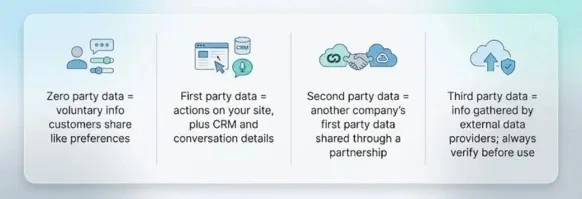
Zero-party data
Zero-party data is voluntary information that is contributed by customers, like preferences or product interests. It is high trust because the data comes straight from the customer.
First party data
First Party Data includes actions people take on your site, info from your CRM, and details collected during conversations.
Second-party data
Second-party data is another company’s First Party Data shared through a partnership. It can be useful, but requires clear agreements and verification.
Third-party data
Third-party data comes from external aggregators. Use third-party data carefully and always check it against your first party data.
Benefits of First Party Data and How to Collect It
Data collection: First party data is gathered directly from customers through their interactions on owned channels like website browsing, purchasing, app usage, email interaction, and loyalty programs.
Personalization: Harness this data to deliver hyper-personalized experiences on various channels, including product recommendations, unique email content, and personalized websites.
Privacy and trust: With third-party cookies going away, first party data allows brands to continue to comply with privacy regulations like GDPR and CCPA while building trust through transparency.
Campaign optimization: Activate first party data in ad platforms like Google Ads and Meta to build more impactful lookalike audiences and retargeting campaigns.
Which Data Works Best?
Pros and cons of each data type
Third-party data can broaden reach but often lacks recency. Zero-party data is rich but limited in volume. First Party Data balances quality and scale, especially when enriched and stitched correctly.
Why is First Party Data the better choice?
First Party Data connects directly to outcomes. When you layer data enrichment and identity resolution on top of first party data, your CRM enrichment becomes a source of truth that powers cold outreach, follow-ups, and customer analytics.
How JarvisReach Redefines First Party Data
Jarvis Reach starts with First Party Data and elevates it. Rather than dumping raw attributes into a CRM, JarvisReach applies smart data enrichment and validation so contact records become actionable.
See How It Works – Get started with 14 days free trial with all premium features unlocked, and 100 lifetime credit
What sets JarvisReach apart
· Trustworthy CRM enrichment. Records are deduplicated, validated, and scored so sales reps trust the data.
· Fast identity resolution. JarvisReach stitches signals across touchpoints so a single customer profile emerges from scattered events.
· Practical data enrichment. Beyond adding firmographics, JarvisReach supplies behavioral flags that make cold outreach and follow-ups contextually relevant.
· Privacy-first workflows and consent management. JarvisReach treats consent as a first-class input, not an afterthought.
· Integration and activation. The platform provides an enrichment API that flows clean data into your CRM and activation layer, so customer analytics feed real campaigns.
Navigating the Future of Data-Driven Marketing
As data-driven marketing keeps evolving, the real advantage comes from how well businesses enrich, unify, and activate their customer data in practice.
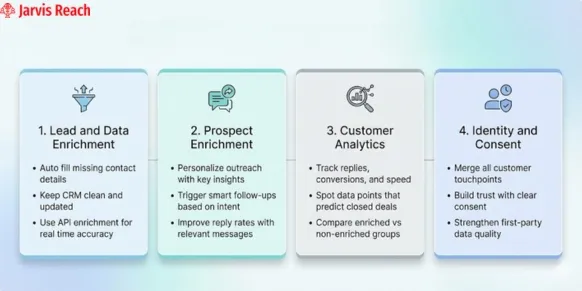
1. HOW LEAD AND DATA ENRICHMENT WORK IN PRACTICE
· Contact enrichment at scale
Contact enrichment completes empty fields such as phone number, occupation, and company details. When contact enrichment runs automatically, sales reps open profiles that are complete and ready for cold outreach.
· CRM enrichment workflows
CRM enrichment is the process of writing back verified fields into your CRM without manual work. This keeps your system tidy and your reports reliable.
· Enrichment API and automation
An enrichment API makes these updates real-time. When the API receives a lead, it calls out trusted sources, performs identity resolution, and gives enriched information that fuels the customer analytics and call-routing rules.
2. PROSPECT ENRICHMENT FOR BETTER OUTREACH AND FOLLOW-UPS
· Make cold outreach count
Use enriched fields to personalize subject lines and first lines. Prospect enrichment surfaces the details that make a cold outreach feel human. When personalization is relevant, reply rates climb.
· Automate follow-ups that matter
Enriched signals power intelligent follow-up sequences. Rather than making repetitive, blanket reminders, your system makes follow-ups when a contact indicates intent, making both response and efficiency better.
3. METRICS THAT MATTER: CUSTOMER ANALYTICS AND DATA ACTIVATION
· Track the right signals
Measure response to cold outreach, conversion to meetings, time to first reply, and pipeline velocity. Customer analytics on enriched profiles reveals which fields predict closed deals.
· Proof of impact
Compare control groups with enriched groups to see the lift. Use data enrichment techniques such as fill rate and freshness to further vendor choice and internal workflow.
4. IDENTITY RESOLUTION AND CONSENT MANAGEMENT: THE TECH THAT MATTERS
· Why identity resolution matters
A single person may touch your brand many times. Identity resolution stitches those touchpoints into one profile so your customer analytics are accurate and your cold outreach reaches the real person.
· Consent management as a competitive advantage
Respecting consent is not just compliance. It is a trust signal. When your consent management is simple and transparent, your First Party Data becomes deeper and more reliable.
Best Practices and Mistakes to Avoid
1. Start with quality, not quantity
Collect First Party Data that aligns with business outcomes. Avoid hoarding fields that no one uses.
2. Validate and enrich consistently
Set up continuous data enrichment rather than occasional batches. Freshness drives accuracy.
3. Make activation part of the plan
First Party Data succeeds when you activate it. Link enrichment to cold outreach, lead scoring, and follow-ups so insights turn into pipeline.
4. Respect privacy and be transparent
Document consent practices and make deletion simple. That builds long-term trust and lowers churn.
QUICK LAUNCH CHECKLIST FOR TEAMS
· Audit current sources of First Party Data and tag required fields.
· Implement an enrichment API and enable CRM enrichment for key fields.
· Add identity resolution to unify profiles.
· Build cold outreach templates that use enriched fields.
· Automate follow-ups based on intent signals from enriched data.
· Monitor customer analytics and iterate weekly.
FAQs
1. What tools are required for effective management of first party data?
A Customer Data Platform (CDP) is a key component for a unified strategy. A CDP will aggregate data from various sources (web, app, CRM, POS), merge the data into a comprehensive customer profile, and allow for activation in different marketing channels and departments.
2. What is 1st, 2nd, and 3rd-party data?
There are numerous types of customer data, all of which come from different places and in different formats. Data collected by organizations through their own channels is called first party data. Other data is collected by partners or purchased, which is called second-party and third-party data.
3. What is first-party and third-party data?
First party data is what you collect from your customers directly via your own channels. Third-party data is collected by another party, entirely separate from your relationship with your customers. So, these terms are about where the data comes from and how it ultimately ends up in the hands of a marketer.
4. What’s the difference between first-party and zero-party data?
The key differentiation between zero- and first party data is about the source of the data (in this case, customers). Zero-party data is collected directly, intentionally, and willingly from the customer. Customers know that they’re providing the data because they are providing it for their own benefit and for a purpose.
Final Takeaway
First Party Data is the strategic asset every modern company needs. When you collect it carefully, enrich it responsibly, and activate it through CRM enrichment and targeted cold outreach, the results show in customer analytics and revenue. JarvisReach turns First Party Data into a practical, privacy-safe growth engine by combining identity resolution, reliable data enrichment, and strong consent management. Start small, win fast, and scale the wins. Your next campaign will feel different because the data is actually useful.
Learn the step-by-step process of a successful data-driven marketing strategy

