
Introduction to Outbound Marketing
Outbound marketing is when a company actively contacts potential customers and makes them interested in a product or service that they’re offering. With outbound marketing, the business makes the first move and originates the message, and sends it out to their customers, as opposed to waiting for their customers to approach them. Outbound marketing’s opposite is inbound marketing, which is when a company utilizes marketing strategies to attract customers.
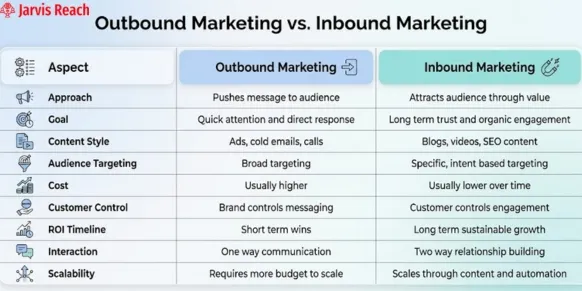
Inbound marketing welcomes customers by generating useful content that caters to their requirements, while outbound marketing comes down to interrupting prospective customers with sales pitches.
Outbound marketing is based on a “pull” strategy through strategies such as SEO, blogs, and social media to establish trust and relationships in the long term. Outbound marketing relies on a “push” strategy through approaches such as outbound calling, direct mail, and conventional advertising to target a large audience at the expense of individuality. The use of b2b data helps refine these techniques to make targeted marketing campaigns more effective and efficient.
Why Outbound Sales Still Matter in a Digital-First World
Outbound sales continue to be important in a digital-first era because they allow targeted, proactive contact, make the brand directly aware, bring faster returns, grant more pipeline control, and enable essential human interaction for complicated solutions. Through the union of B2B data-driven targeting with individualized, multi-channel methods like outbound calling and telesales, outbound sales strategies enable companies to create leads, grow more rapidly, and achieve a competitive advantage in saturated digital markets. Techniques like real-time monitoring optimize the effectiveness of these efforts.
Core Strategies of Outbound Marketing
To be effective in contacting future customers and driving sales, firms must utilize a set of core outbound marketing strategies that include proactive contact, focused messaging, and relationship-building.
1. Prospecting: Reaching the Right Audience at Scale
Prospecting is an integral outbound marketing strategy as it actively finds and interacts with prospective buyers who are yet to express interest in a company’s products or services. Salespeople start conversations and establish relationships by contacting the prospects matching the company’s ICP directly through cold calls, cold emails, and social selling in the hopes of creating new warm leads and customer acquisition. Prospecting efficiency is enhanced by leveraging robust b2b data and real-time monitoring during outreach.
2. Outbound Calling and Telesales: Modern Approaches to Engagement
Outbound calling or telesales is an essential outbound marketing method in which companies actively call prospective customers over the phone to sell products or services, create leads, and make sales. This method provides companies with control over initiating the sales process and forming personal relationships with their prospect base, making customer acquisition more precise and effective. Successful telesales campaigns often utilize real-time monitoring to track call outcomes and improve scripts dynamically.
3. Using Trade Shows and Events for Customer Acquisition
Employing trade shows and events for customer acquisition is a good outbound marketing technique since it enables one-on-one, in-person contact with prospective clients, enabling relationship building and the presentation of your product or service in concrete terms. To make your presentations more engaging and professional at these events, businesses are increasingly using an AI ppt generator to quickly create visually compelling slides tailored to their audience. An effective method includes choosing the proper trade shows, developing good materials and demonstrations, promoting yourself actively, generating leads, and having a strong post-event follow-up plan in place to convert interest into sales.
4. Targeted Marketing Campaigns: From Mass Outreach to Precision
Employing targeted marketing campaigns moves outbound marketing from mass outreach to precision targeting. Utilizing comprehensive b2b data along with segmentation tools, companies can craft highly personalized messages that resonate with niches or specific industries. This shift improves conversion rates and lowers costs by focusing on turning cold leads into warm leads. Good use of real-time monitoring allows campaign adjustments based on live feedback.
5. Building a Strong Outbound Sales Process
Outbound sales allow businesses to reach precisely the right company sizes, industries, or even decision-makers in businesses. The representative can tailor the message and pitch to suit each lead’s needs and issues, boosting customer acquisition success. A robust process integrates prospecting, outbound calling, and telesales along with data insights from b2b data platforms, supported by continuous real-time monitoring to adapt tactics instantly.
Digital outbound strategies
Social Media Advertising: This method will employ precise targeting (demographics, interests, actions), plus retargeting, to connect with desirable audiences on social media channels such as Facebook, Instagram, and LinkedIn – thereby ensuring your ads are placed in front of the right people and also outsiders who have engaged with your brand.
Search Engine Marketing (SEM): SEM allows you to run paid search ads and appear directly in front of the prospect or customer who is actively searching for your menu services or menu products – this provides immediate visibility with an audience who has a higher level of intent to purchase products or services. Additionally, SEM allows for strong measurement and budget controls to help you feel confident in optimizing for a strong return on investment.
Cold Email: A proactive attempt to communicate with prospects via personalized emails that provide value – this allows you to establish a valuable conversation, fill them in with content, and qualify the leads for a meeting.
Video Advertising: Video advertising can be used through channels like YouTube for pre-roll or in-stream ads and will help you quickly capture attention to deliver your advertising message – this format will create a visual differentiation for your brand and influence brand recall.
Influencer Marketing: An opportunity to develop a relationship with an influencer within your industry niche – you will reach a trusted group of followers with credibility, and offer your product or service to an available, engaged audience that is already prewarmed.
Retargeting / Remarketing: The opportunity to utilize ads to reach people who visited your website previously and provide an association of your brand when they visit other sites and/or social media. This method will enhance and prompt engagement, essentially functioning similarly to how we pronounce the name of a person, a store, or a restaurant we visited.
Traditional and event-based outbound strategies
Cold Calling: It is important to make purposeful, even value-centric calls to potential customers — focus on quality over quantity! Cold calling is a direct way to connect prospects with decision-makers and to establish an introduction over the phone.
Trade Shows & Industry Events: Trade shows present an opportunity for face-to-face interaction and the ability to create a demonstration of your product and answer questions in real time, while developing trust and credibility. Trade shows and industry events are also instrumental for collecting highly targeted leads as well as cultivating future business partnerships.
Direct Mail: Send personalized or hand-addressed postcards or letters that cut through digital communication noise and feel more authentic to the recipient. Direct mail is still incredibly effective in B2B selling, with observed very high response rates, and this is especially true if combined with specific targeting.
Print & Broadcast Media: Use print (magazines, trade publications) or broadcast (TV, radio) to reach your audience if they are not as digitally active. Using either of these media super-charges a traditional outreach method and is highly effective for establishing brand authority or targeting a narrower, local, and/or industry audience.
Role of B2B Data in Driving Effective Outreach
B2B data drives effective engagement by allowing precise targeting, one-on-one messaging, and thoughtful segmenting, which results in greater conversion rates and improved ROI. Leveraging quality b2b data supports prospecting, outbound calling, telesales, and targeted marketing.
1. From Cold to Warm Leads: How to Nurture Prospects
In order to heat up cold leads to warm leads, use techniques such as creating a value-first content marketing approach, employing personalized social media involvement and email marketing, and having automated re-engagement sequences in place to offer regular, useful touches. Success is dependent on knowing the prospect’s needs, regularly giving useful information, establishing trust through personalized communication, and applying automation to have regular contact and lead them through the sales funnel. Well-segmented b2b data allows for better lead nurturing strategies that increase customer acquisition rates.
2. Best Practices in Outbound Calling and Telesales
To become successful at telesales and outbound calling, there are a few practices that are well-suited: the proper target audience and exact data using B2B data, scripted calls to provide consistency and clarity, active listening to make the conversation personalized, technology like auto-dialers and CRM, and gauging metrics via real-time monitoring in order to improve continuously and achieve maximum results. Strong prospecting beforehand ensures higher success in dialing the right prospects for customer acquisition.
3. Preparation and Targeting
Step one in outbound calling is preparation. Begin with a good Ideal Customer Profile (ICP) so that your outreach is targeted to the right people. Additionally, prospect for opportunities before every call in order to customize your approach, demonstrate understanding, and build trust on the first call. The use of b2b data enhances targeting accuracy, while real-time monitoring tracks engagement.
4. Call Strategy and Execution
Scripted conversation is a good blueprint during implementation, but the discussion should be relaxed and adaptable. The essence is personalization, address the prospect by name, reminisce about previous conversations, and make your conversation specific to their needs. Active listening is also necessary in problem detection and fixing accordingly. Highlight the benefits and superiority of your product or service so that warm leads can visualize extremely well how it will solve their issues and accelerate customer acquisition.
5. Leveraging Real-Time Monitoring to Optimize Sales Outreach
Real-time monitoring maximizes sales outreach through instant feedback on performance, customer activity, and market trends for live campaigns, quick reaction to customer interest, and optimized resource allocation. This instant response enables sales teams to give priority to high-intent leads, offer customized communication, change sales approaches, and thereby reduce sales cycles and increase conversion rates. Integrated with b2b data, real-time monitoring enables superior targeted marketing, improves prospecting, enhances outbound calling and telesales efforts, and ultimately strengthens customer acquisition efforts.
Tools and Technology for Outbound Marketing
Taking advantage of proper tools and technology is critical in order to streamline outbound marketing campaigns, increase the accuracy of targeting, and optimize campaign performance in the current competitive environment.
1. CRM Systems and Data Integration
Outbound marketing relies on Customer Relationship Management (CRM) platforms. They integrate prospect and customer data, allowing sales forces to better monitor interactions, segment audiences, and personalize contact. CRM systems leverage b2b data to optimize prospecting, outbound calling, and telesales, all while enabling efficient pipeline management for outbound sales.
2. Real-Time Monitoring Tools for Campaign Performance
Real-time monitoring tools, often in the form of lead tracking software, enable sales and marketing teams to monitor outbound campaign performance in real time. It offers visibility into call outcomes, email opening rates, response rates, and interaction patterns. With instant feedback, teams can adjust on the fly, improve scripts, and optimize strategies to increase conversions, especially during trade shows and high-activity periods of customer acquisition.
3. Measuring Metrics that Matter
The success of outbound marketing relies on measuring the right metrics. The most important key performance indicators (KPIs) are conversion rates, cost per acquisition, call-to-meeting ratios, and pipeline growth. Using lead tracking software, you can tie each of these KPIs back to individual leads and understand which outreach channels are driving the most valuable b2b leads. It provides insights into what is working, where blind spots are, and where resources must be best utilized in a way that will have the greatest impact by measuring these metrics through the use of analytics dashboards. Effective use of real-time monitoring supports tracking these KPIs in outbound sales, telesales, and prospecting campaigns.
Measuring Success in Outbound Marketing
Tracking the effectiveness of outbound marketing campaigns is fundamental; that’s why many teams use lead tracking software to monitor conversion rates, response rates, and pipeline growth.
1. KPIs for Outbound Sales and Customer Acquisition
Outbound customer acquisition and sales KPIs track the effectiveness of marketing campaigns through data-based measures of campaign performance, identifying where to improve, and enabling strategic decision-making for maximizing reach, generating revenue, and aligning with business strategy. Incorporating b2b data analytics and real-time monitoring simplifies tracking these KPIs to sharpen targeted marketing efforts.
2. Converting Prospecting into Long-Term Customer Relationships
Converting leads into lifetime customers increases the effectiveness of outbound marketing by shifting the emphasis away from short-term lead generation towards sustainable growth, yielding increased Customer Lifetime Value (CLTV), more accurate analysis of sales cycle, better allocation of resources for high-value leads, and a streamlined, efficient sales process that generates revenue and creates brand advocates. Strong prospecting backed by b2b data and real-time monitoring helps identify and nurture warm leads into lasting relationships, enhancing overall customer acquisition ROI.
3. How Targeted Marketing Increases ROI
Targeted marketing improves the ROI of outsourced efforts by increasing conversion rates and reducing waste ad spend by reaching likely buyers, which in turn makes success easier to quantify through direct measurement of responses, lead generation, and sales increases associated with the correctly defined target audience. Metrics like cost per lead, conversion rate, and customer lifetime value are rendered more valuable in combination with a measurable, engaged audience that can be refined using B2B data to tailor campaigns for optimal impact.
Integration of real time monitoring tools further refines targeted marketing precision.
Challenges of Outbound Marketing
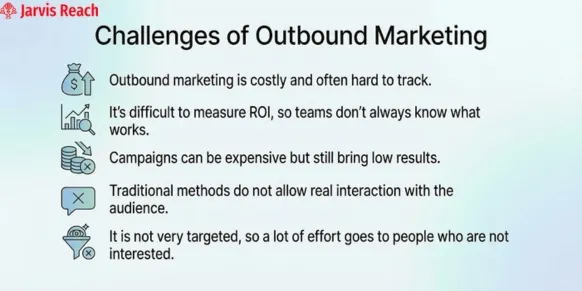
Outbound marketing often struggles with high costs, unclear results, and limited audience interaction, making it harder to achieve consistent growth.
1. Hard to measure the return on investment (ROI)
The difficulty of obtaining correct ROIs is one of outbound marketing’s biggest challenges, since it can be highly harmful when the executives have other complicated tasks at hand that they also need to work on and do not have time to explore further how well their marketing is performing. Employing real-time monitoring and detailed b2b data analysis alleviates some of these challenges but requires dedicated resource investment in outbound sales measurement.
2. High cost and low yield
It is a major issue for small businesses to have a large budget for outbound marketing campaigns. Depending on the advertisement type, the cost normally varies. Online ones are generally much less expensive compared to offline advertisements. Techniques involving outbound calling, telesales, and targeted marketing can offer better cost efficiencies, especially when supported by solid prospecting and real-time monitoring.
3. One-way communication system
There are no actual chances to connect with your desired audience if you place advertising banners along the roadside. Outbound marketing in this manner is difficult for advertisers because they cannot follow up on its performance and communicate with their potential customers. Modern outbound techniques like outbound calling, telesales, and trade shows address this by fostering two-way communication and lead engagement for better customer acquisition.
4. It’s not targeted
One of the primary drawbacks of conventional outbound marketing is that it is not focused. It renders this form of marketing less successful and more expensive. Identifying a focused group of people and developing ads that specifically target them is significant to being successful in such a saturated business environment. It’s a lot more difficult to perform these in offline marketing than online marketing, where one can perform these in under an hour. Using b2b data to refine targeted marketing plays a key role in overcoming this, combined with smart prospecting and real-time monitoring.
Future of Outbound Marketing
The future of outbound is being crafted in the shape of AI and automation — powered by lead tracking software integrated into intelligent SaaS tools, enabling smarter, more responsive campaigns. In order to thrive, they must prioritize building relevance through engagement with customers via interactive content and clever leveraging of first-party B2B data, all while being respectful of privacy and still effective. Outbound sales teams will rely heavily on real-time monitoring and refined prospecting techniques, using targeted marketing, trade shows, outbound calling, and telesales to generate and convert warm leads with speed and precision.
FAQs
1. What is an outbound marketing strategy?
Outbound marketing is a more traditional marketing scheme where the organization initiates contact with leads or potential buyers. Outbound marketing methods include cold calling, cold emailing (or spamming), direct mail, billboards, sponsorships of events, and presentations at tradeshows.
2. What are the 4 growth strategies in marketing?
The rollout of new products or services (Ansoff) encourages strong post-launch growth. The four categories of development that Ansoff discusses are market penetration, product development, market development, and diversification.
3. How do outbound processes drive business growth?
An effective outbound scheme will build not only strong brand awareness but, more importantly, customer retention of customers and longer lifetime value. By enacting personal interactions, whether they be face-to-face, phone talk to talk, or personalized emails, organizations can build trust and relationships with their buyers.
4. What are the 10 marketing strategies to fuel your business growth?
The small business professional can sustain an efficient growth plan through ten marketing campaign tactics: utilize social media, hold competitions, optimize your website, create a Google business account, utilize a cross via email, network in person, apply for industry awards, reach out to your friends and family, and develop some referral programs.
Conclusion
Outbound marketing is still an integral aspect of business expansion. It serves to raise brand visibility by actively targeting extensive and diverse masses via multiple avenues such as digital media, TV, trade shows, outbound calling, and mail.
Outbound marketing creates prompt leads and sales through creating urgency, provides control and targeting for messaging, as well as measurable outcomes to monitor performance using real-time monitoring and/or b2b data analytics. By making “first contact” with prospective customers through outbound sales, prospecting, and telesales, it offers the potential for new relationships and can serve as a cheap method for small, medium, or large-scale business enterprises to increase their client base through refined targeted marketing and effective customer acquisition.

