

Customer Acquisition Funnel: A Complete Guide for 2026
Did you know that companies with well-aligned sales and marketing funnels see up to 36% higher customer retention rates? Still, many businesses often have more than half a fully mapped-out customer acquisition funnel to guide their customer acquisition process. Typical end-to-end conversion rates sit around 2-3% across industries, leaving tons of upside if you tighten each step in the acquisition funnel and the broader customer journey.
You will learn what a customer acquisition funnel is and what it can do for you, as well as an overview of the steps to take to build effective client acquisition funnels and examples of the most important metrics to track as part of an effective customer acquisition funnel. You will also learn how to generate a template for building out the client acquisition funnel.
What Is the Customer Acquisition Funnel?
A customer acquisition funnel is a structured framework that explains how potential customers move through different stages before becoming paying users. It highlights every point in the customer journey, flagging drop-offs and spots for tweaks in the customer acquisition process.
A tight customer acquisition funnel helps you:
– Target the right crowd
– Nudge them through a straightforward customer funnel
– Bump up conversions stage by stage
– Lock in a steady customer acquisition rhythm
Teams with a clear acquisition funnel land better leads and grow more reliably. It syncs content, ads, and messaging with how users actually behave in the user acquisition funnel.
Stages of Customer Acquisition Funnel
Nailing the stages of customer acquisition turns browsers into regulars. Every part of the customer funnel feeds the overall customer acquisition process.
1. Awareness
People first spot your brand via posts, ads, content, or search. The user acquisition funnel here is about getting on their radar, without hard-selling.
2. Interest
They poke around more: reading posts, watching demos, or subscribing. The marketing acquisition funnel focuses on building rapport and holding attention.
3. Consideration
They’re shopping around, hunting reviews or comparisons. Your customer acquisition strategy needs to supply the evidence that tips them your way.
4. Conversion
They commit to signing up, demoing, or buying. A sharp customer acquisition funnel removes hurdles here.
5. Activation
Right after the buy, quick onboarding shows real value and seals the deal in the user funnel.
How to Build a Customer Acquisition Funnel
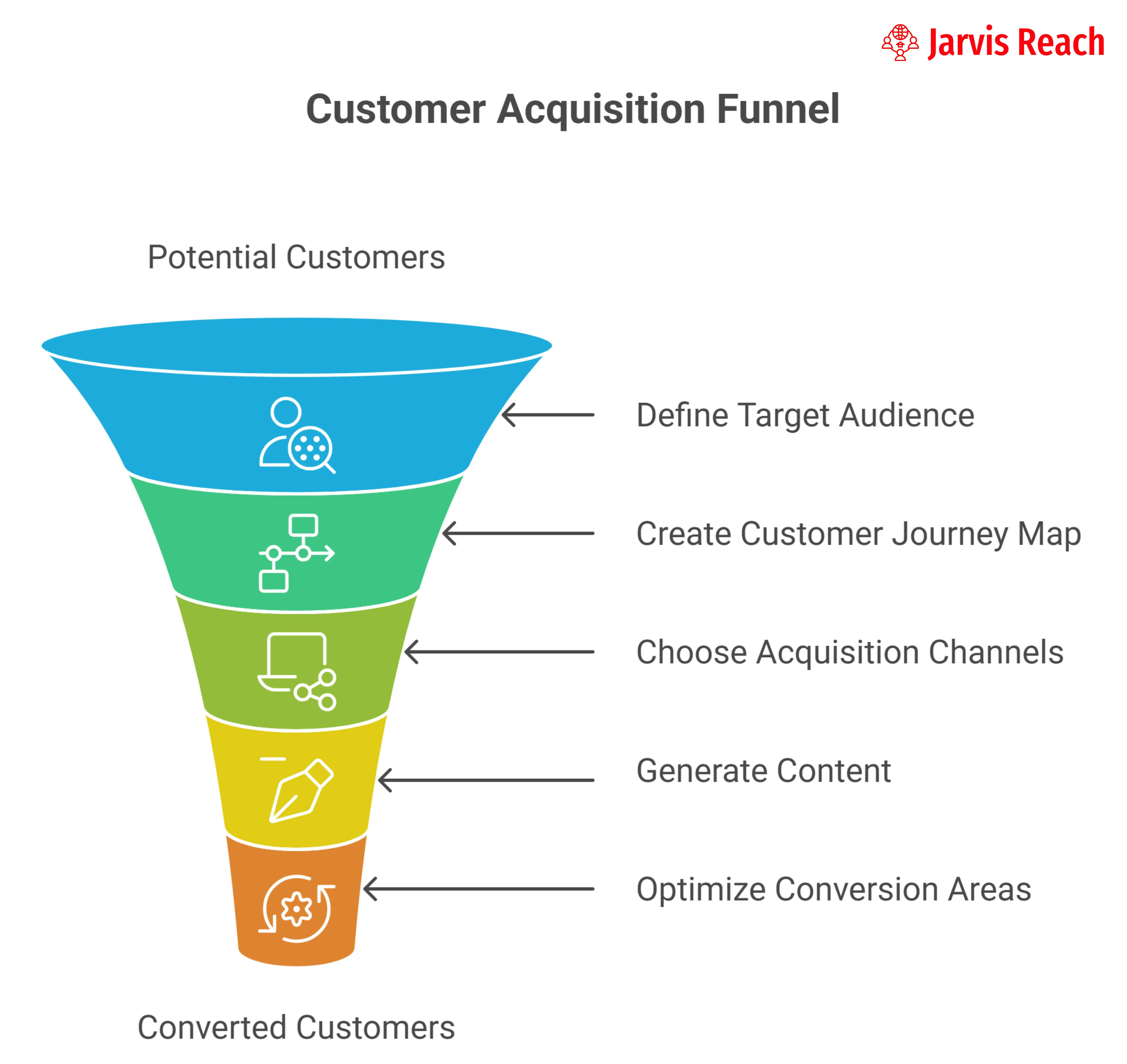
Putting together a client acquisition funnel isn’t rocket science. Stick to these steps for a customer funnel that moves people from hello to sale.
Step 1: Define Your Target Audience
By determining who you want to target, you can create a targeted and focused approach to develop your customer acquisition strategy and create a user acquisition funnel that will resonate with the target audience.
Step 2: Create a Customer Journey Map
Sketch the path through each customer acquisition process stage. Spot leaks and prime the acquisition funnel for fixes.
Step 3: Choose Acquisition Channels
Pick what works best, like social media, blogs, ads, and email, to pull in traffic for your marketing acquisition funnel and feed the customer funnel.
Step 4: Generate Content for Each Stage of the Funnel
It should include attention-grabbing content for brand awareness, trust-building material to help with consideration, and final push action items for conversion.
Step 5: Optimize Key Conversion Areas
Simplify Pages, Lead Forms, and Call to Action buttons. This lifts performance across the customer acquisition funnel and bolsters the user funnel.
Key Metrics for Customer Acquisition Funnel Analysis
Watching these numbers refines your client acquisition funnel and customer acquisition process. Prioritize:
1. Traffic Sources
Where entries hit your marketing acquisition funnel (search, social, ads, referrals).
2. Conversion Rate
Progress between stages in the customer acquisition funnel.
3. Cost Per Acquisition (CPA)
Spend per new customer in your customer acquisition strategy.
4. Time to Conversion
Duration through the full client acquisition funnel.
5. Drop-Off Points
Where folks exit the customer funnel, patch those in the marketing acquisition funnel.
These reveal ways to tune the user acquisition funnel and sharpen customer acquisition marketing.
How to Create a Customer Acquisition Funnel Template
A basic customer acquisition funnel template structures your customer acquisition process and tracks it easily.
Step 1: List Funnel Stages
Cover awareness to conversion (plus activation). This maps the user acquisition funnel and customer journey.
Step 2: Define User Actions
Flag behaviors like browsing, subscribing, and buying to inform your customer acquisition strategy.
Step 3: Assign Content and Channels
Link stages to tools: social for awareness, deep dives for consideration, fueling the marketing acquisition funnel.
Step 4: Set Goals and Metrics
Tie targets to stages for tracking engagement and leaks.
Step 5: Review and optimize
Dig into data often and adjust the customer funnel to evolve the user acquisition funnel.
Conclusion
A straightforward customer acquisition funnel shepherds prospects along the customer journey and smooths your customer acquisition process. Get the stages of customer acquisition right, craft a solid customer funnel, and monitor metrics. Your customer acquisition strategy yields stronger leads, higher conversions, and reliable growth.
Building a custom user acquisition funnel or marketing acquisition funnel template aligns stages and content for better outcomes. Focused customer acquisition marketing delivers the goods.
Tools like Jarvis Reach find contacts, enrich data, and integrate with CRMs, making planning, tracking, and optimizing your customer acquisition funnel far easier, keeping the customer acquisition process humming.
FAQs
1. Why is the customer acquisition funnel important?
It maps the customer journey, pushes users ahead, and steadies the customer acquisition process. A solid customer funnel turns conversions reliable.
2. What are real-world customer acquisition funnel examples?
Common examples are:
· Amazon’s seamless shopping path
· Netflix’s trial-to-subscription flow
· Tesla’s direct online sales with referrals
· Airbnb’s host/guest matching via search and reviews.
These illustrate the user funnel and customer acquisition marketing in action.
3. Common mistakes to avoid in customer acquisition?
· Skipping stages
· Wrong targeting
· Skipping analytics
· Weak CTAs
They sabotage your customer acquisition strategy and bleed potential from the acquisition funnel.
4. What are the key benefits of a customer acquisition funnel?
· Higher-quality leads
· Stronger conversions
· Trackable customer acquisition process
· Customer acquisition marketing.


