B2B Sales: Definition, Examples, and Winning Strategies
Introduction to B2B sales
B2B sales are a long game with high stakes. Buyers do deep research, involve many people, and expect clear value before they move. When your data is clean and your message is clear, b2b sales feel steady and predictable. When it is not, even strong offers stall. This guide gives you a steady path that any team can follow.
What is B2B Sales?
B2B sales mean selling products and services from one business to another. Buyers are companies, not individual consumers. A typical deal includes finance, operations, and leadership. Sales reps guide a structured sales process that addresses risk, value, and timing. Strong b2b sales work is consultative. Sellers listen first, frame a clear problem, and move each step with purpose.
Examples of B2B Sales
In b2b sales, the buyer is a company with a specific need. A buyer can be an owner, a director, or a manager with a budget. Most deals involve a user, a champion, a budget holder, and a decision maker. Sales teams align these roles, shape a case for change, and help the group choose the right product service fit.
· A software firm sells workflow tools to a logistics company.
· A manufacturer supplies parts to an equipment brand.
· An agency delivers content and social selling programs to a fintech startup.
· A data platform provides lead enrichment and crm enrichment to a global sales team.
Each case shows how b2b sales depend on proof, not hype. The seller maps the marketing funnel stages, shows value to each role, and uses a measured sales process to close deals.
Strategies for Winning
1. Create Relationships: Through consistent, personalised interaction and great service to customers, sales professionals build long-term relationships with customers. By developing trust and strengthening loyalty, the sales representative is also able to support future purchasing decisions of the customer throughout the entire B2B sales process.
2. Develop a Structured Selling Approach: Implementing a structured approach to selling B2B is important. Data supports the structure of the B2B Selling Approach to help sales representatives maintain clarity and consistency throughout the B2B Selling Process while transitioning potential customers from becoming the first point of contact with the company to purchasing from the company.
3. Identify Your Ideal Customer Profile: Create a profile identifying the type of organisation most likely to benefit from your service or product. With an ideal customer profile, sales representatives can target qualified leads and increase lead enrichment in an efficient manner within the B2B marketing and sales workflow.
4. Incorporate Technology into your Sales & Marketing Operations: The automation of the selling and marketing process lets you spend more time on your customers by automating more of your selling activities with greater accuracy. This allows your salespeople to spend more time on social engagement/conversation with customers and other revenue-generating activities.
B2B vs B2C Sales: Key Differences
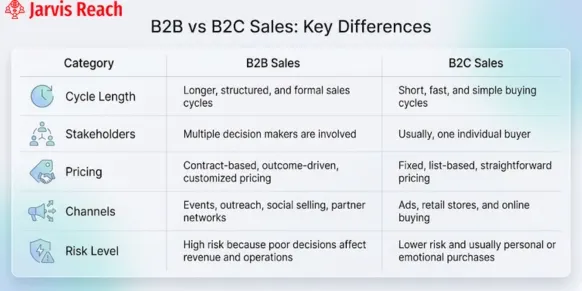
The goals may sound similar, yet the road is different.
B2B vs B2C Sales
1. Cycle length.
B2B sales cycles are longer and more formal.
B2C cycles are short.
2. Stakeholders.
B2B sales include many voices.
B2C usually involves one person.
3. Pricing.
B2B pricing ties to outcomes and contracts.
B2C pricing is list-based.
4. Channels.
B2B uses events, outreach, social selling, and partner routes.
B2C relies on ads and retail.
The real gap is risk. In b2b, a poor choice can cost a sales team time and money. That is why the sales process matters and why sales marketing alignment is vital.
What is the B2B Sales Process?
When clearly defined, having a sales process helps guide the sales force to stay focused as well as provide a sense of security to the buyer during the buying journey. To develop your own sales process, utilize the outline below, customizing the words and phrases used for your specific marketplace:
· Prospecting / Lead Generation: Use content, referral, and social selling to create interest from qualified prospects.
· Qualification: Confirm need, budget, timeline, and who will decide.
· Discovery: Learn the pain, the current flow, and the desired result.
· Demo: Show how the product service solves the real problem. Keep it short.
· Proposal: Write a plan that links price to value and stages to outcomes.
· Review: Handle risk and align on legal items without losing momentum.
· Close: Confirm scope and start fast so you close deals with confidence.
· Onboarding: Prove value in the first thirty days and set success metrics.
Across every step, sales reps should record notes in the crm and update the marketing funnel stages. Use enrichment on your leads to complete any missing data fields and to continue to be relevant while doing outreach. A structured sales process allows for quicker ramp-up times for new sales reps; it also allows a sales leader to forecast sales more accurately and with more confidence.
Common Challenges Faced in B2B Sales
Here are some of the biggest roadblocks sales teams run into when trying to close deals in the B2B space.
· Long decision cycles slow pipeline momentum in b2b sales and increase the risk of losing attention
· Multiple stakeholders make consensus harder, so deals stall unless each role sees clear value.
· Data gaps in the CRM create weak outreach and missed opportunities for follow ups.
· Poor handoffs between teams break rhythm and cause duplicated work for the sales team.
· Relying on discounts instead of outcomes trains buyers to ask for lower prices.
· Channel noise and generic messages drown out relevant outreach, reducing reply rates.
· Lack of reliable lead enrichment means reps waste time researching instead of selling.
· Weak or untimely follow ups turn interested prospects into cold leads.
How to Increase B2B Sales

Practical ways sales teams can cut through noise and actually move deals forward.
· Tighten targeting: Build a simple ideal customer profile. Link it to your marketing funnel stages and keep your list clean with lead enrichment.
· Lead with value: Every touch should teach something. Share a short idea that helps the buyer work better today.
· Focus on the sales process: Define the stages and exit rules. Train sales reps to run clean discovery and set clear next steps.
· Use social selling with intent: Engage buyers where they already learn. Add insight, not spam.
· Align sales marketing: Use shared metrics and a shared ideal customer profile. Set rules for handoffs and feedback.
· Strengthen product service proof: Publish short case notes that show business impact in plain words.
· Coach the team: Review calls, sharpen questions, and practice objection handling every week.
· Improve time to value: Make onboarding fast. Quick wins help close deals and expand accounts.
Practical B2B Sales Tips
Simple, no-fluff habits that make daily selling sharper and more effective.
· Keep outreach short: subject lines 6 to 10 words, body 2 to 3 sentences, and one clear call to action.
· Always set the next step on a call: a date, a deliverable, or a decision maker to contact next.
· Log everything in the CRM: clean notes, updated stages, and tags make coaching and forecasting real.
· Use lead enrichment before outreach: rich records feed better personalization and fewer wasted calls.
· Sequence follow ups: start with value, then follow up with case evidence, then a tight close attempt.
· Test small improvements: A/B test subject lines and follow ups to learn what gets replies.
· Block time for new pipeline and time for active deals so reps balance hunting and closing.
· Review calls weekly: pick one call to coach and publish one repeatable improvement for the team.
· Protect rep energy: encourage short breaks and realistic activity targets so quality stays high.
· Keep product service proof tidy: one pager that maps features to outcomes for easy sharing.
Jarvis Reach helps b2b sales teams act on clean data. The platform enriches contacts, removes duplicates, and routes each lead to the right owner. Outreach becomes timely and relevant. Sales reps see complete profiles and move through the sales process without guesswork. Managers get a clear marketing funnel stages and can coach with facts. Marketing sees what content sparks meetings so sales marketing stays aligned. The result is steady progress and more close deals without extra noise.
What Is the Future of B2B Sales?
Buyers expect clarity, speed, and proof. The next wave of b2b sales will feel more human and more data driven at the same time.
· AI will support work, not replace it. Tools will suggest next steps, draft notes, and highlight risk in deals. Sales reps will spend more time in real conversations.
· First-party data will guide outreach. Lead enrichment and identity tools will enhance lists and cut waste.
· Consent and privacy will shape sales marketing coordination. Clean data and clear value will win invites to talk.
· Social selling will mature. Sellers will build trust by teaching in public and by helping communities.
The sales process will get simpler. Teams will remove steps that do not help buyers and will track a few core metrics that tie to revenue.
B2B Sales Checklist
A quick list to keep your sales team aligned and moving in the same direction.
· Define the ideal customer profile and share it with the full team.
· Clean your data. Use lead enrichment to complete missing fields.
· Build a weekly rhythm. Pipeline review, coaching, and team learning.
· Refresh product service proof every quarter.
· Align sales marketing with shared metrics and clear handoffs.
· Commit to daily social selling and helpful outreach.
FAQs
1. What is an example of a B2B sales strategy?
A B2B transaction may include acquiring new AI software and training hundreds of employees to use the software; thus, the transaction may cost tens of thousands of dollars, and since the acquisition and onboarding process will involve several departments, there are numerous stakeholders who must first review and approve the transaction.
2. What do you mean by B2B sales and examples?
B2B Sales are defined as those situations when a Company sells products or Services to another Company, rather than directly to an End Customer. As an example of this type of sale, a CRM (Customer Relationship Management) Software Company provides a CRM System Package to a Company. A wholesale Distributor selling Office Supplies by the Case or a Manufacturing Company selling Automotive Parts to an Automotive Manufacturer are additional Illustrative Examples of B2B Sales.
3. What is the rule of 7 in B2B?
The Rule of 7 in B2B states that to take an action as a potential customer, you need at least 7 impressions of a business through either advertisements or direct contact with the business. This illustrates how important repeated exposure to the business and its services is in developing trust and familiarity with that specific company/brand in B2B transactions.
4. What is the 3-3-3 rule in sales?
The 3-3-3 Rule would be applied when selling. An example is sending out three separate messages about a product or brand to three different targeted markets, utilizing three different channels where the target market could be located. The 3-3-3 Model will allow for clear identification of the most important messaging, audiences, and channels of communication. By clarifying and focusing on the most important messages, you create a more streamlined approach, eliminating confusion in your strategy and message.
Final Thoughts
B2B sales is not deal closing deals, it is about trust and long-term partnership building. Success is a result of knowing your buyers, sales and marketing alignment, and the proper tools to streamline the sales process. With compelling strategies, solid follow ups, and fact-based insights, the sales team can make a real difference. The future of B2B sales is human touch-driven by intelligent technology. Companies that innovate early will always be ahead.