Customer Acquisition Strategy: How to Attract and Convert
Bringing in new customers is the lifeblood of any business, but it’s getting tougher. Customer acquisition costs have risen by around 60% over the past five years, with averages hitting about $70–$78 in e-commerce and up to $702 in SaaS. A strong customer acquisition strategy helps you attract and convert prospects efficiently without wasting budget.
A Customer acquisition strategy is a well-structured approach where businesses involve themselves in the efficient attraction, conversion, and retention of customers. In the absence of any defined strategy, companies tend to use scattered tactics for driving traffic that are not sustainable in the long run.
The guide will walk you through the core components of a customer acquisition strategy, how to build one from scratch, and show proven strategies and tactics that actually work today in real-world acquisition.
Core Elements of a Customer Acquisition Strategy
A robust customer acquisition strategy is built on a few foundational elements. Each element plays a role in guiding prospects through the customer acquisition process and ensuring long-term results.
1. Target Customer Definition
Customer acquisition begins with clarity: businesses need to clearly define:
• Who the ideal customer is
• What problems they are trying to solve
• Where they spend time online
Without a defined target audience, customer acquisition marketing often drives the wrong traffic, which can lead to poor conversions and high churn.
2. Clear Value Proposition
A Value proposition explains why someone should choose your product or service over alternatives. It is supposed to clearly answer:
• What problem do you solve
• How do you solve it better or differently
• What result can the customer expect from
Powerful customer acquisition strategies tie messaging directly to customer pain points, not product features.
3. Channel Selection
Not every channel of acquisition works for all businesses. Effective customer acquisition strategies focus on channels where the target audience already exists, such as:
• Organic Search and Content
• Paid search and social ads
• Email marketing
• Partnerships and referrals
Channel selection should be based on data and not on trends.
4. Customer Journey Mapping
Understanding the customer journey helps businesses align messaging with intent, including:
• Awareness-stage content
• Consideration stage education
• Conversion-focused touchpoints
Mapping the journey reduces friction and improves conversion rates throughout the customer acquisition process.
5. Measurement and Optimization
Every customer acquisition strategy should have metrics involved. Common ones include:
• Cost per acquisition
• Conversion rate
• Customer lifetime value
It enables teams to improve what works and eliminate what does not.
How to Build Your Strategy Step by Step
Building a customer acquisition strategy takes structure and iteration. The following provides a tangible step-by-step approach for one.
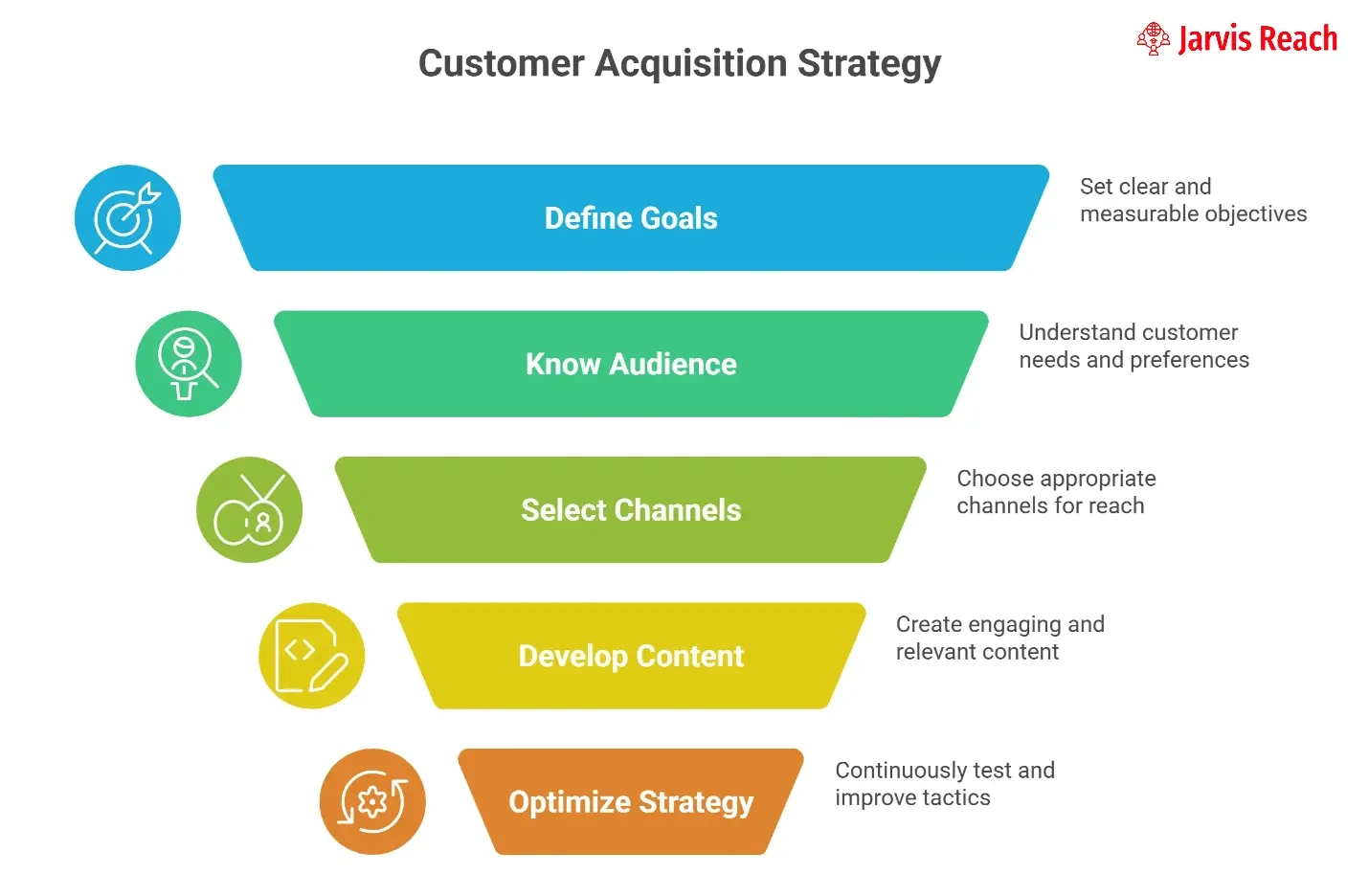
Step 1: Clearly Define Acquisition Goals
Define what success might look like. Possible goals could be:
• Monthly customer growth targets
• Cost-per-acquisition benchmarks
• Channel-specific performance objectives
Clear goals keep the customer acquisition plan both focused and measurable.
Step 2: Know Your Audience
Understand through surveys, analytics, and customer feedback:
• Buying motives
• Objections and Concerns
• Content format preferences
Audience research will ensure that your customer acquisition campaigns address real needs and not assumptions.
Step 3: Select the Right Acquisition Channels
Select channels based on:
• Audience behavior
• Budget constraints
• Results turnaround time
For example, organic content supports long-term growth, and paid ads support faster acquisition.
Step 4: Develop Relevant Content and Offers
The leading role in customer acquisition marketing belongs to content. It includes:
• Educational blog posts
• Comparison guides
• Free trials or demos
Each asset should correspond to a particular stage in the customer journey.
Step 5: Launch, Test, and Optimize
No customer acquisition strategy is perfect from day one. Continued testing improves:
• Messaging
• Targeting
• Conversion paths
Data-driven optimization turns an otherwise basic strategy into a scalable growth engine.
If you want a structured way to manage and optimize your acquisition workflows, platforms such as Jarvis Reach help to centralize strategy execution and performance tracking.
Proven Strategies and Tactics That Work
While the tactics may change, some customer acquisition strategies work when done properly.
1. Content-Led Customer Acquisition
Trust is established by content; high-intent users are attracted. Effective approaches include:
• SEO optimized Blog Content
• In-depth guides and tutorials
• Use-case driven articles
Content-driven customer acquisition works best when in line with search intent.
2. Paid Acquisition Campaigns
Paid drives accelerate reach when combined with strong targeting. Some effective tactics include:
• Search ads targeting high-intent keywords
• Social Ads targeting user segments
• Retargeting campaigns
A focused customer acquisition campaign avoids broad targeting and ensures relevance.
3. Referral and Word-of-Mouth Programs
Referral-based customer acquisition programs tap into your current customers. This works effectively because:
• Trust is already established
• Acquisition costs are lower
• Higher conversion rates
Simple incentives can sometimes outperform complex referral structures.
4. Partnerships & Integrations
Strategic partnerships enable businesses to tap into new audiences. For example:
• Co-marketing campaigns
• Platform Integrations
• Affiliate programs
Partnerships work best when the audience alignment is high.
5. Lifecycle and Email Marketing
Email nurtures leads through the customer journey in support of acquisition. Some effective tactics include:
• Educational onboarding sequences
• Behavior-based follow-ups
• Re-engagement campaigns
Lifecycle marketing improves conversion rates without increased acquisition spend.
Conclusion
A successful customer acquisition strategy is not about chasing every channel or copying competitors. It’s about understanding your audience, aligning with their journey, and executing consistently.
The next step is execution and refinement. Businesses that continuously measure, learn, and adapt their customer acquisition strategies are better positioned for sustainable growth.
For efficient planning, execution, and tracking of performance, seeking structured solutions such as Jarvis Reach will assist teams in converting strategy into consistent results.
FAQs
1. What are effective customer acquisition strategies used by leading SaaS companies?
Leading SaaS companies rely on content marketing, product-led growth, paid acquisition, and referral programs. These strategies focus on educating users, reducing friction, and optimizing the onboarding experience.
2. Which digital marketing platforms offer the best tools for customer acquisition?
Platforms like search engines, social media networks, and email marketing tools offer strong acquisition capabilities. The best platform depends on audience behavior and acquisition goals.
3. How can I use referral programs to boost customer acquisition in my startup?
Start with a simple referral incentive that rewards both the referrer and the new customer. Promote the program during onboarding and after positive customer interactions.
4. What budget-friendly customer acquisition channels work well for small businesses?
Content marketing, organic search, referrals, and email marketing are cost-effective channels. These approaches focus more on time and consistency than high ad spend.
5. How to create targeted ads for customer acquisition on social media platforms?
Target ads based on user behavior, interests, and intent signals. Use clear messaging that addresses a specific problem and directs users to a relevant landing page.
6. How do subscription-based companies optimize their customer acquisition strategies?
Subscription-based companies focus on reducing friction, improving onboarding, and aligning acquisition messaging with long-term value rather than short-term conversions.